In 1990, the World Wide Web existed on a single computer in a physics laboratory near Geneva. There were no search engines, no smartphones, no social networks and no online shops. In 2025, about 6 billion people, three quarters of humanity, were online, according to the International Telecommunication Union, and by September 2026 more than a billion people were using one AI assistant, ChatGPT, every week. All of that happened within a single working lifetime.
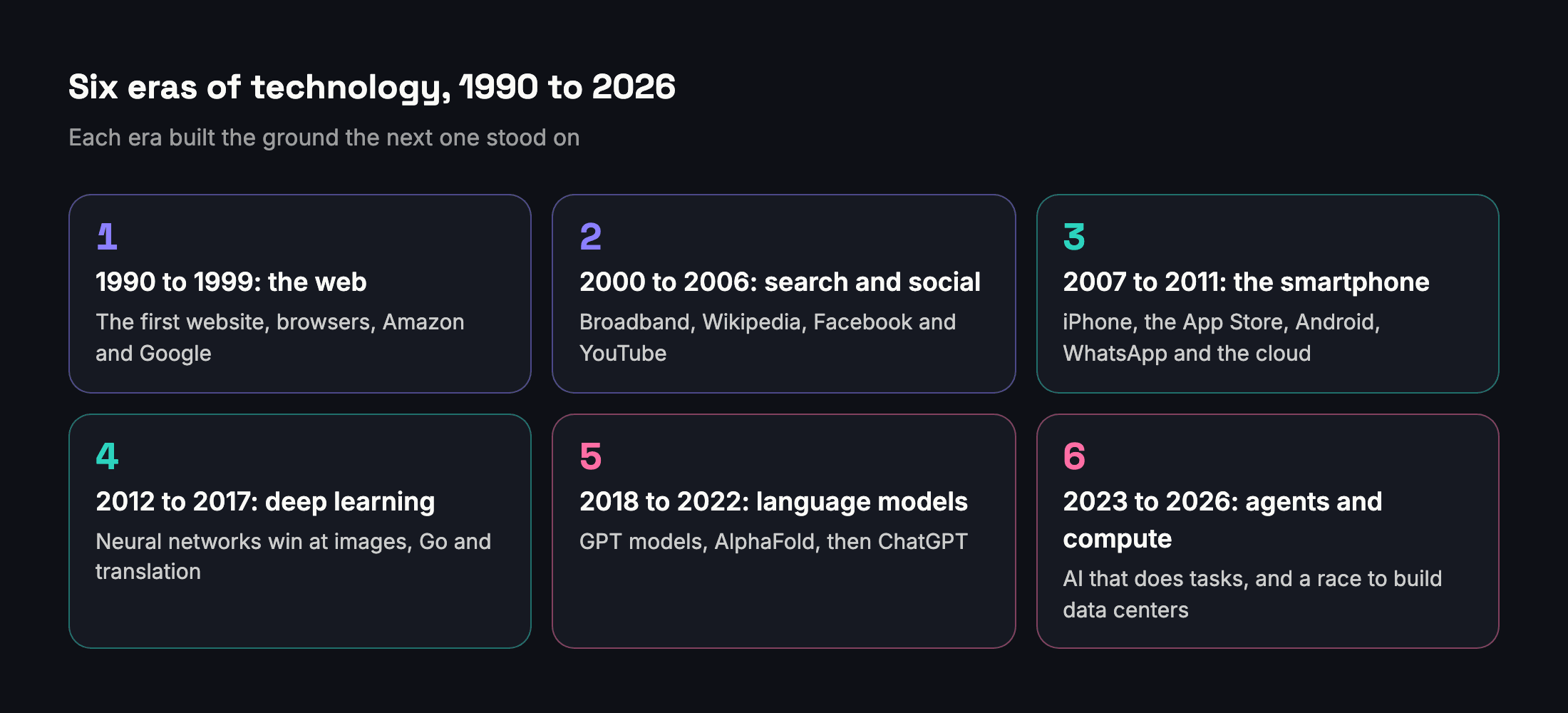
This guide tells the story of how technology evolved from 1990 to 2026 in six eras: the web, search and social media, the smartphone, deep learning, language models, and today’s AI agents and race for computing power. For each era you get the key dates, the people who doubted it, and why it mattered. At the end we look at the patterns that repeat in every wave, what they suggest about what comes next, and what it all means for businesses in Egypt and the Gulf.
How has technology changed since 1990?
The simplest way to see the change is to follow what a computer could do for an ordinary person. In 1990 it could store documents and run a spreadsheet. By 2000 it could find almost any public page on the web. By 2010 it fit in your pocket and knew where you were. By 2020 it could recognize your face and your voice. By 2026 it could write, reason, generate images and video, and carry out multi-step tasks on your behalf.
Each of those steps depended on the one before it. Search needed the web. Social media needed search habits and cheap storage. The smartphone needed mobile networks and a web worth carrying around. Deep learning needed the data that phones and social media produced, and the graphics chips that games had made cheap. Language models needed all of it. That is why we describe the period as six eras that overlap, not as six separate revolutions.
1990 to 1999: How did the World Wide Web begin?
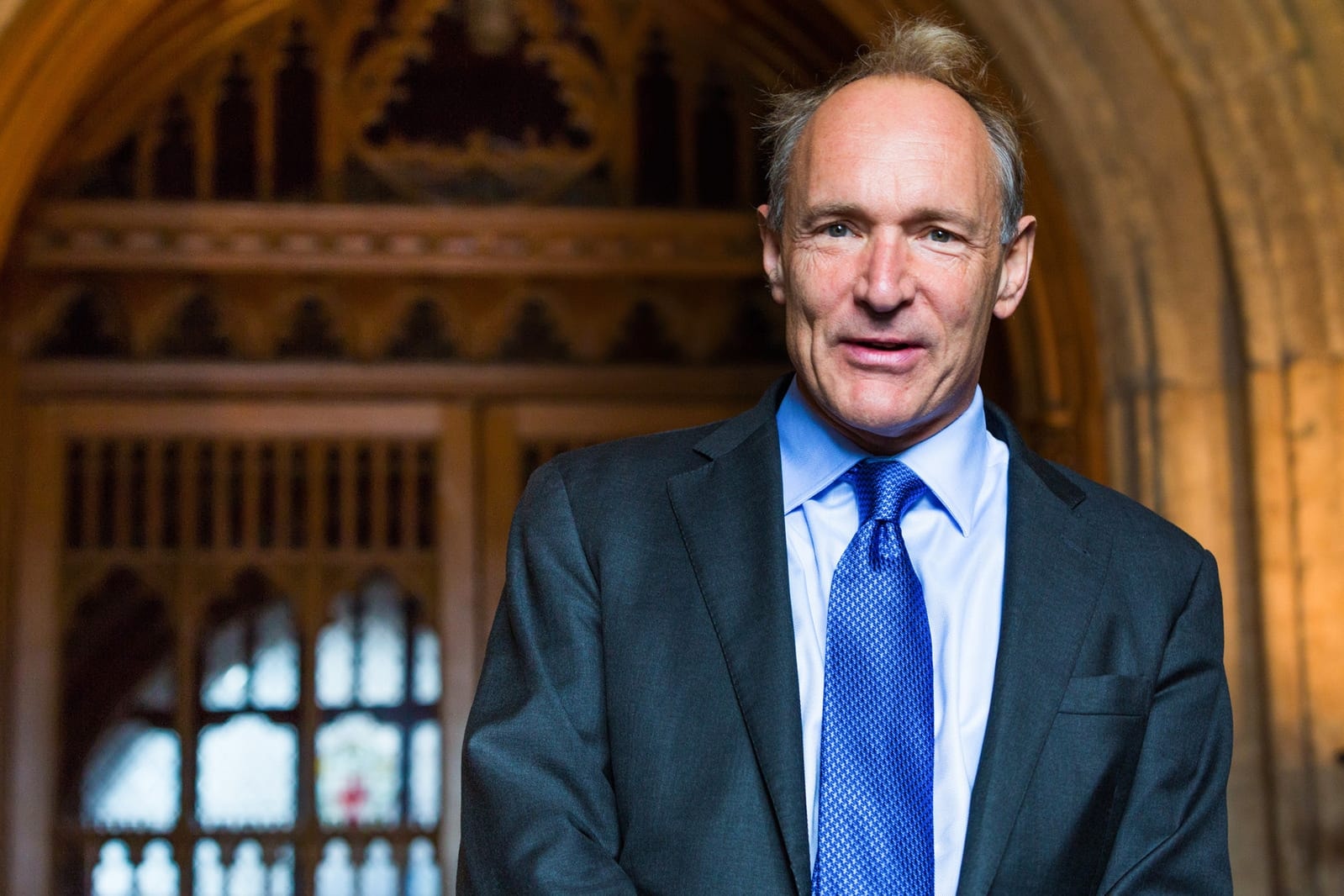
The internet, a network linking computers, already existed in 1990, but it was used mainly by universities, governments and engineers. What changed everything was a way to publish and link documents on it. In 1989, Tim Berners-Lee, a British scientist at CERN, the European physics laboratory, proposed the World Wide Web. According to CERN, the first website, info.cern.ch, ran on Berners-Lee’s NeXT computer and was dedicated to the web project itself.
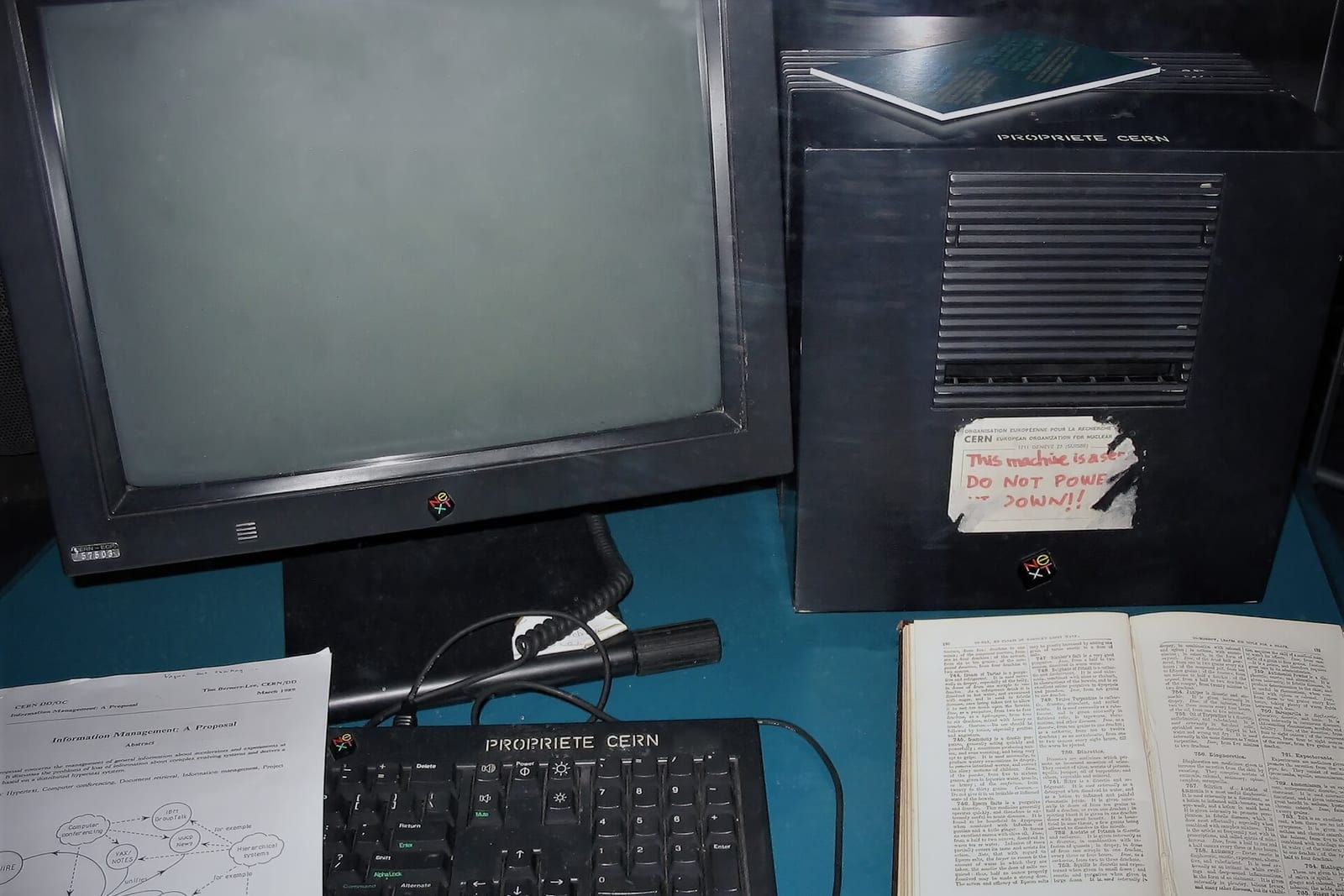
The decision that made the web a global medium came on April 30, 1993, when CERN put the web software in the public domain, so that anyone could use and build on it for free. Browsers made it easy to use: Mosaic appeared in 1993 and Netscape Navigator in 1994. Businesses followed: Amazon opened as an online bookstore in 1995, and Google was founded in 1998 to organize a web that had grown too large to browse by hand.
The established technology giants noticed. On May 26, 1995, Bill Gates sent his executives a memo titled “The Internet Tidal Wave,” according to the Computer History Museum, in which he wrote:
“The Internet is the most important single development to come along since the IBM PC was introduced in 1981.” Bill Gates, May 1995
Not everyone agreed. In the same year, the astronomer and author Clifford Stoll wrote a Newsweek essay titled “Why the Web Won’t Be Nirvana,” arguing, as The Hustle recounts, that “no online database will replace your daily newspaper” and “no computer network will change the way government works.” Within two decades, online news had overtaken print for many readers, and government services from tax filing to licenses had moved online in many countries, including Egypt and the Gulf states.
The decade also produced the first famous victory of machine intelligence over a human champion. In May 1997, IBM’s Deep Blue defeated the world chess champion Garry Kasparov 3.5 to 2.5 in a six-game rematch. Deep Blue could evaluate 200 million chess positions per second, according to IBM, which describes the win as “an inflection point in computing.”
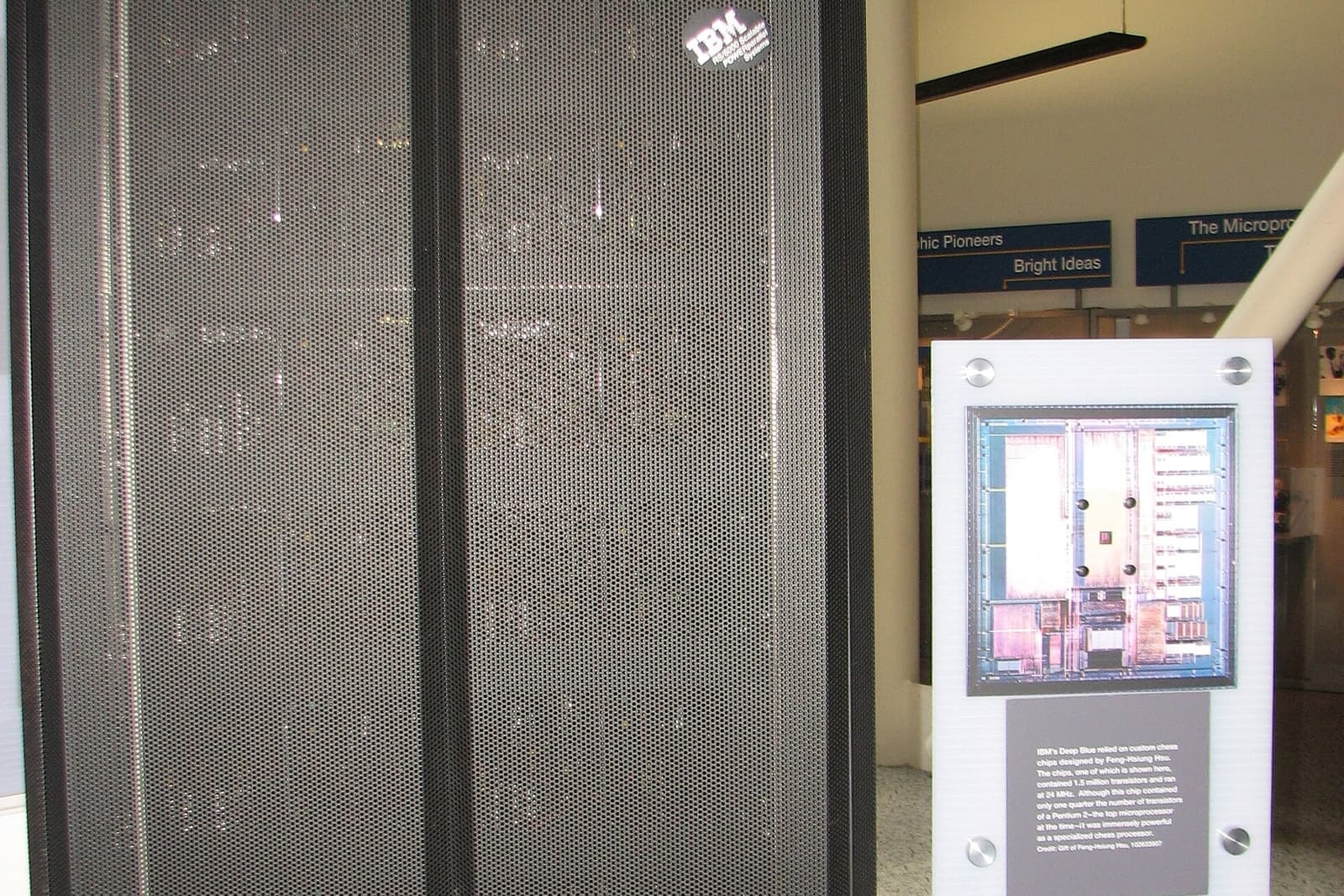
Deep Blue, however, was not AI in today’s sense. It won with brute-force search on special chips and an evaluation of positions crafted with the help of chess experts. It could play chess and nothing else. The methods that would later produce ChatGPT were, in 1997, a neglected corner of computer science.
2000 to 2006: How did search and social media take over?
The decade began with a crash. Investors had poured money into internet companies with no profits, and in 2000 the dot-com bubble burst, wiping out many of them. The survivors, however, were the companies that would define the next twenty years, and the ideas that had looked premature, such as shopping, banking and reading news online, kept growing.
Three things happened in this era that still shape the internet. First, search became the front door to the web, and Google’s model of free search paid for by ads became the business model of the consumer internet. Second, people began to publish, not just read: Wikipedia launched in 2001, Facebook in 2004, YouTube in 2005 and Twitter in 2006. Third, in 2006 Amazon began renting its computing infrastructure to other companies through Amazon Web Services, the start of cloud computing, which let a startup rent servers by the hour instead of building a data center.
For marketers, this era created the tools of modern digital advertising: ads matched to what people search for, and ads matched to who people are and what they like. Every ad platform that Egyptian and Gulf businesses use today, including Meta’s, grew from these two ideas.
2007 to 2011: How did the smartphone change everything?
On January 9, 2007, Steve Jobs introduced the iPhone at the Macworld conference in San Francisco. It was not the first phone with internet access, but it was the first to make the full web, maps, email and music easy to use on a touch screen. In 2008 Apple opened the App Store and the first Android phone went on sale, and within a few years the smartphone had become the main computer for billions of people.

Again, experts doubted it. In 2007, Microsoft’s chief executive, Steve Ballmer, told USA Today:
“There’s no chance that the iPhone is going to get any significant market share.” Steve Ballmer, 2007, as reported by TechRadar
He explained, as TechRadar recounts, that Apple might make a lot of money but would get perhaps 2 or 3 percent of the 1.3 billion phones sold each year, while he preferred Microsoft’s software to be on 60 to 80 percent of them. Within a few years, phones running Apple’s and Google’s software dominated the market, and Microsoft’s phone business never recovered.
The apps built for smartphones changed daily life. WhatsApp, founded in 2009, became the main way people communicate across Egypt and the Gulf. Instagram launched in 2010. Ride-hailing, food delivery and mobile banking followed. For many people in the Middle East, Africa and Asia, the smartphone was not their second computer but their first: they skipped the desktop entirely and went straight to mobile.
2012 to 2017: How did deep learning start the AI boom?
While the world was busy with smartphones, a small group of researchers was proving that an old idea, artificial neural networks loosely inspired by the brain, could finally work. The breakthrough came in 2012. According to the ACM, Geoffrey Hinton and his students Alex Krizhevsky and Ilya Sutskever improved convolutional neural networks and, in the prominent ImageNet image-recognition competition, almost halved the error rate for object recognition, reshaping the field of computer vision.
Two ingredients from earlier eras made this possible. The first was data: billions of photos and videos posted online gave neural networks something to learn from. The second was cheap computing power from graphics processors, chips originally designed for video games, which turned out to be ideal for the calculations neural networks need. The company that made most of those chips, Nvidia, would become one of the most valuable companies in the world because of it.
The progress came quickly. In March 2016, DeepMind’s AlphaGo defeated Lee Sedol, one of the world’s strongest players of Go, an ancient board game long considered too intuitive for computers, by four games to one. Unlike Deep Blue, AlphaGo learned much of its skill by studying human games and playing against itself.
Then, in June 2017, researchers at Google published a paper with a modest title, Attention Is All You Need. It introduced the Transformer, a new neural network design that could be trained efficiently on huge amounts of text. Almost every major AI model since, including GPT, Claude and Gemini, is built on it.
In 2019, the ACM gave its Turing Award, often called the Nobel Prize of computing, to Yoshua Bengio, Geoffrey Hinton and Yann LeCun for their work on deep neural networks. The award citation noted that their ideas were initially met with skepticism, and that by the early 2000s they were among a small group still committed to the approach. Their persistence through the years when neural networks were out of fashion is one of the most important stories in the history of technology.
2018 to 2022: How did language models arrive?
With the Transformer, researchers found that a model trained simply to predict the next word in huge amounts of text learned grammar, facts, reasoning patterns and even some programming along the way. OpenAI’s GPT-2 in 2019 surprised researchers with the quality of its writing, and GPT-3 in 2020 showed that a large enough model could perform many tasks from just a few examples, without special training for each.
The same years brought a scientific breakthrough that showed AI could do more than chat. DeepMind’s AlphaFold predicted the three-dimensional shapes of proteins, one of biology’s hardest problems. In 2024, Demis Hassabis and John Jumper shared the Nobel Prize in Chemistry for it, together with David Baker for computational protein design, according to the Nobel Foundation. The same year, the Nobel Prize in Physics went to John Hopfield and Geoffrey Hinton for foundational discoveries that enable machine learning with artificial neural networks.
The COVID-19 pandemic in 2020 also pushed the world further online. Remote work, video calls, e-commerce and digital payments that might have taken a decade to spread became normal within months, including across Egypt and the Gulf.
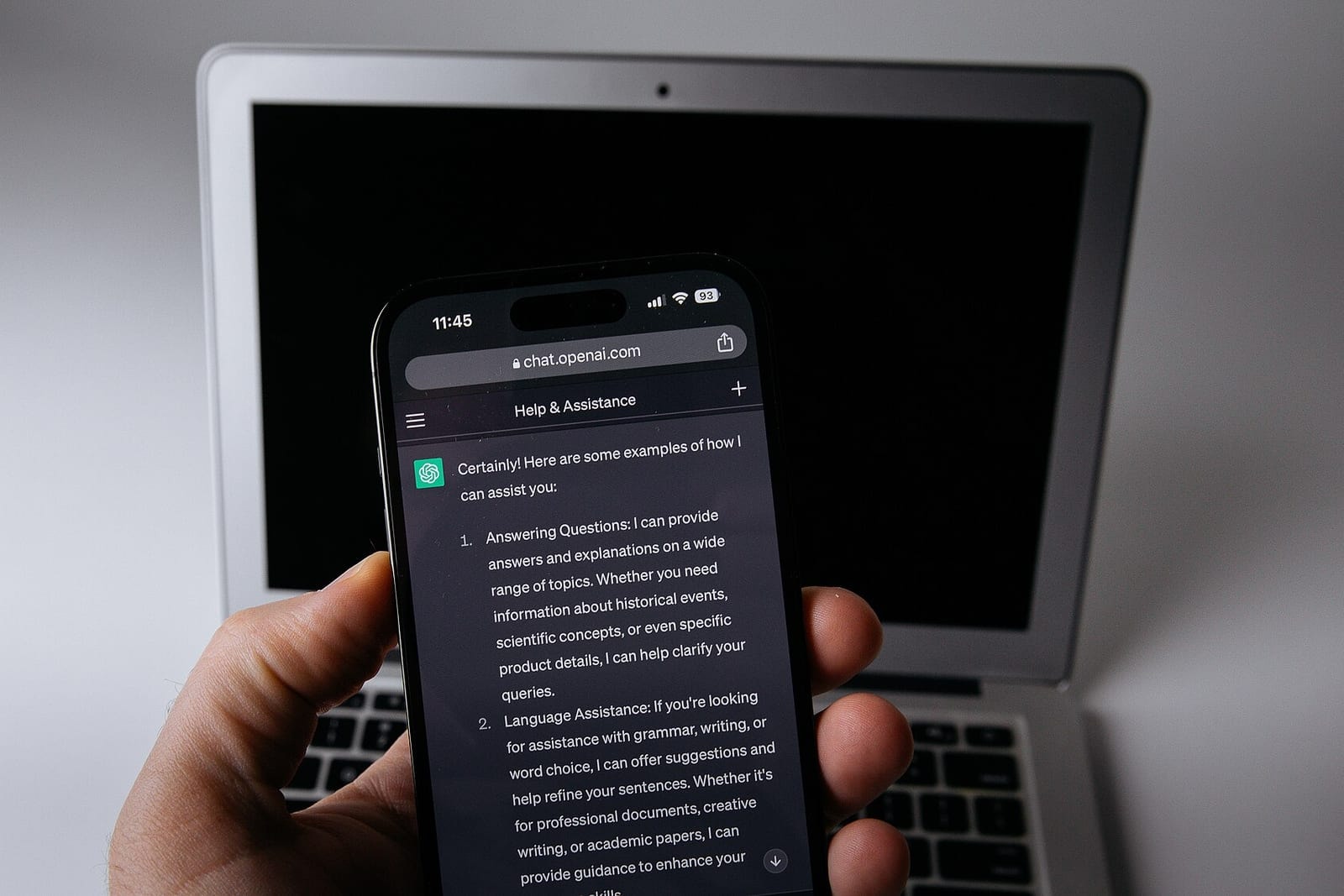
Then, on November 30, 2022, OpenAI released ChatGPT. Within about two months it had an estimated 100 million monthly users, which made it the fastest-growing consumer application in history, according to a UBS analysis reported by Reuters. For comparison, TikTok took about nine months and Instagram about two and a half years to reach that number.
2023 to 2026: What is happening now?
The years since ChatGPT have moved faster than any period before them. Several companies now build frontier models: OpenAI’s GPT series, Anthropic’s Claude, Google’s Gemini, Meta’s Llama, xAI’s Grok, and strong models from Chinese labs such as DeepSeek. In 2024, models that reason step by step before answering appeared. In 2025, AI agents that can carry out multi-step tasks, such as writing and testing software, became everyday tools. By September 2026, ChatGPT alone had 1.2 billion weekly users, according to Engadget.
Behind the products is a race for computing power. According to Epoch AI, the computing power used to train frontier AI models grew by 4 to 5 times per year from 2010 to 2024. To keep that pace, companies are building data centers on a scale never seen before. In January 2025, OpenAI and its partners announced Stargate, which intends to invest $500 billion over four years in AI infrastructure in the United States. Elon Musk’s xAI built its Colossus supercomputer in 122 days, and in 2026 merged with SpaceX with plans for data centers in orbit.
The money has followed. Anthropic was valued at $965 billion in May 2026, and the companies that make AI chips and run data centers are among the most valuable in the world. You can read how the leaders of this race think in our articles on Sam Altman, Dario Amodei and Elon Musk.
The full timeline, 1990 to 2026
| Year | Milestone |
|---|---|
| 1989 | Tim Berners-Lee proposes the World Wide Web at CERN |
| 1991 | The first website, info.cern.ch, is published |
| 1993 | CERN puts the web software in the public domain; the Mosaic browser appears |
| 1995 | Amazon opens; Bill Gates writes “The Internet Tidal Wave” |
| 1997 | IBM’s Deep Blue beats world chess champion Garry Kasparov |
| 1998 | Google is founded |
| 2000 | The dot-com bubble bursts |
| 2001 | Wikipedia launches |
| 2004 | Facebook launches |
| 2005 | YouTube launches |
| 2006 | Amazon Web Services starts renting computing power; Twitter launches |
| 2007 | Apple introduces the iPhone |
| 2008 | The App Store opens and the first Android phone goes on sale |
| 2009 | WhatsApp is founded |
| 2010 | Instagram launches |
| 2012 | Deep learning wins the ImageNet competition by a wide margin |
| 2016 | AlphaGo defeats Lee Sedol at Go |
| 2017 | Google researchers publish the Transformer |
| 2019 | Bengio, Hinton and LeCun receive the Turing Award |
| 2020 | GPT-3 and AlphaFold; the pandemic pushes daily life online |
| 2022 | ChatGPT launches on November 30 |
| 2023 | GPT-4, Claude and other large models; ChatGPT reaches about 100 million users in two months |
| 2024 | Nobel Prizes in Physics and Chemistry for AI work; reasoning models appear |
| 2025 | AI agents become everyday tools; Stargate is announced |
| 2026 | ChatGPT reaches 1.2 billion weekly users; SpaceX and xAI combine; AI companies approach trillion-dollar valuations |
How did the internet reach Egypt and the Gulf?
The Middle East joined the internet a few years behind the West, and then moved quickly. According to Human Rights Watch, Egypt first connected to the internet in October 1993, through the Egyptian Universities Network and the Cabinet’s Information and Decision Support Center. Saudi Arabia began allowing the public to access the internet through local service providers in January 1999, according to an earlier Human Rights Watch report.
Egypt’s turning point came from a simple idea. In January 2002, the Ministry of Communications and Information Technology, with Telecom Egypt and private internet providers, launched the Free Internet Program: no subscription, only the cost of a local phone call, which by September 2002 was about 15 US cents an hour nationwide. The number of internet users quadrupled, from 1 million in January 2002 to 4 million by March 2005.
Then the smartphone changed the scale. Millions of people in Egypt and the Gulf who had never owned a computer went online through a phone, and messaging apps, social networks and mobile payments followed. That is why the typical customer in the region today discovers a business on a phone screen, very often through a Facebook or Instagram ad that leads to a WhatsApp chat.
How many people are online now?
According to the International Telecommunication Union’s Facts and Figures 2025, about 6 billion people, roughly three quarters of the world’s population, were using the internet in 2025, up from 5.8 billion in 2024. More than 240 million people came online in that one year. But 2.2 billion people remained offline, and the gap between rich and poor countries is wide: 94 percent of people in high-income countries were online, compared with 23 percent in low-income countries.
Egypt shows how fast a large, young country can move. According to DataReportal, 98.2 million people in Egypt were using the internet at the end of 2025, 82.7 percent of the population, and there were 121 million mobile connections, more than one for every person in the country. About 95 percent of those mobile connections were broadband, meaning 3G, 4G or 5G. In the Gulf states, internet use is close to universal. For businesses in the region, that means the audience is already online, mostly on mobile, and increasingly using AI tools.
How did online advertising change from 1990 to 2026?
Advertising has followed every technology wave, and the story is worth knowing for anyone who buys ads today:
| Year | Advertising milestone |
|---|---|
| 1994 | HotWired, Wired magazine’s online affiliate, runs what becomes known as the web’s first banner ad |
| 2000 | Google launches AdWords, ads matched to what people search for |
| 2002 | AdWords moves to pay-per-click pricing |
| 2007 | Facebook launches its advertising platform |
| 2010s | Ads move to phones and social feeds, targeted by interests and behavior |
| 2020s | AI decides more of the targeting, bidding and creative inside the ad platforms |
According to Digiday, HotWired ran what later became known as the web’s first banner ad on October 27, 1994. Early banners were clicked at rates that sound impossible today, but, as Digiday’s oral history puts it, “after a while, people just tuned banners out,” a lesson every new ad format has repeated since. Google launched AdWords on October 23, 2000, with about 350 advertisers, and moved it to pay-per-click pricing in 2002, according to Wikipedia. Facebook opened its advertising platform in November 2007, according to Wikipedia’s timeline of online advertising.
Two things have changed steadily since. Targeting moved from pages, meaning where an ad appears, to people, meaning who sees it. And decisions moved from people to machines. In 2026, much of the targeting, the bidding and even the creative inside Meta’s and Google’s ad systems is chosen by AI. The marketer’s job has moved toward what the machine cannot do: the offer, the message, a clean conversion signal and an honest reading of the results. Our Meta ads metrics glossary explains the numbers those systems report.
What patterns repeat in every wave of technology?
Looking back over 36 years, five patterns appear again and again. They are the most useful thing history can teach about AI.
- Experts underestimate adoption. Stoll doubted the web, Ballmer doubted the iPhone, and many researchers doubted neural networks for decades. The people closest to the old way of doing things are often the worst at judging the new one.
- Costs fall faster than people expect. In 1965, Gordon Moore predicted that the number of components on a chip would double every year, which he later revised to every two years, according to the Computer History Museum. That steady fall in the cost of computing made every later wave possible. AI is following a similar curve.
- Each wave builds on the last. Search needed the web, the smartphone needed mobile networks, deep learning needed data and graphics chips, and language models needed all of them. The next wave will be built on today’s AI.
- Winners are platforms. In every era, a few companies that built platforms used by everyone else, such as Google, Apple, Amazon and Meta, captured much of the value. The race to build AI platforms is the same contest, played with larger sums.
- Advertising follows attention. Ads moved from newspapers and television to search, then to social feeds, then to phones. They are now moving into AI assistants and AI-generated recommendations. Marketers who follow attention early win.
What comes next?
This section is outlook, not fact: our reading of where current trends point.
The most likely next step is that AI moves from answering to acting. Agents that book, buy, reply, write code and produce reports are already here in early forms, and every major AI company is building more of them. The second likely step is AI moving into the physical world, through robots, self-driving vehicles and AI-designed drugs and materials, which is slower and harder but already funded on a massive scale. The third is a change in how people find information: more questions answered by AI assistants, fewer clicks through search results, which will change how businesses are discovered online.
A fourth change is already visible in offices: the gap between a junior employee who uses AI tools well and one who does not is widening. Companies that train their teams to use AI and to check its work will get more from the same people. Companies that wait will find those skills harder to hire later.
What is less clear is the timing. As our article on who predicted the AI era shows, people who saw the direction correctly were often wrong about the dates, sometimes by decades. The safest assumption is that the direction is right and the timing is uncertain.
Our view
This section is opinion: the view of the Adams Analytics editorial team.
The pace really is accelerating. The web took many years to become part of daily life for most people. The smartphone took fewer. ChatGPT reached 100 million users in two months and more than a billion weekly users in under four years. Each wave arrives faster, because it is delivered through the infrastructure the previous waves built.
The doubters are usually wrong about the direction and sometimes right about the details. Stoll was wrong that the web would not matter, but some of his worries about information overload were reasonable. The lesson is not to dismiss skeptics, but to separate their useful warnings from their bad predictions.
AI is different in one important way. Earlier waves made information and communication cheap. AI makes thinking itself cheaper, for at least some kinds of thinking. That affects office work directly, in a way the earlier waves did not.
The Middle East is better placed than in earlier waves. Egypt and the Gulf adopted the internet and smartphones after the West. With AI, the gap is much smaller: the tools arrive at the same time everywhere, Arabic support is improving quickly, and the Gulf is building some of the world’s largest AI data centers.
History rewards early adopters who measure. In every wave, the businesses that gained most were not the ones that adopted every new tool, but the ones that tried new channels early and measured honestly what worked. That habit matters even more with AI, where an impressive demonstration and a real result can be far apart.
What it means for businesses and marketers in Egypt and the Gulf
Every era since 1990 has changed how businesses reach customers. Here is what the history suggests you do now:
- Treat mobile as the default. In Egypt, mobile connections already outnumber people. Every ad, page and report should work on a phone first.
- Prepare to be found by AI. As more people ask AI assistants for recommendations, clear and well-structured information about your business, with direct answers and real numbers, becomes your new search optimization.
- Use AI for production, keep humans for judgment. AI can write first drafts, generate variations and summarize data. Deciding which message fits your market, and which result really matters, is still your job.
- Measure, because platforms automate. As ad platforms automate more of the buying, the only way to know if it is working is to measure results carefully and compare periods honestly.
That last point is where Adams Analytics helps. It turns your Meta ad accounts into clear reports in English and Arabic, so you and your clients can see what is really working. Our guide to the Meta ads report for clients shows what to include, and our Meta ads metrics glossary explains every number.
Key takeaways
- In 1990 the web existed on one computer at CERN; in 2025 about 6 billion people were online, according to the ITU.
- Technology since 1990 moved in six overlapping eras: the web, search and social media, the smartphone, deep learning, language models, and AI agents with a race for computing power.
- Every era was doubted by experts at the start, from Newsweek’s 1995 essay on the web to Steve Ballmer’s 2007 dismissal of the iPhone.
- Deep learning took off in 2012, the Transformer arrived in 2017, and ChatGPT reached about 100 million users two months after its November 2022 launch.
- The computing power used to train frontier AI grew 4 to 5 times a year from 2010 to 2024, which explains the race to build data centers.
- In Egypt, 98.2 million people were online at the end of 2025, and mobile connections outnumber people.
- For businesses, the lessons are to put mobile first, prepare to be found by AI, keep human judgment, and measure everything.
To see who saw all this coming, read the people who predicted the AI era before it arrived.
Questions
How has technology changed since 1990?
In six overlapping eras: the web in the 1990s, search and social media in the 2000s, the smartphone from 2007, deep learning from 2012, language models from 2018 with ChatGPT in 2022, and AI agents with a race for computing power since 2023. Each era was built on the one before.
When was the first website published?
The first website, info.cern.ch, was created by Tim Berners-Lee at CERN and ran on his NeXT computer. It was published in 1991, and on April 30, 1993 CERN put the web software in the public domain so anyone could use it.
When did artificial intelligence really take off?
Modern AI took off in 2012, when deep neural networks almost halved the error rate in the ImageNet image-recognition competition. The Transformer design followed in 2017, and ChatGPT brought language models to the public in November 2022.
How many people use the internet in 2025?
About 6 billion people, roughly three quarters of the world’s population, according to the International Telecommunication Union. Around 2.2 billion people remained offline, mostly in low- and middle-income countries.
How many people use the internet in Egypt?
According to DataReportal, 98.2 million people in Egypt were using the internet at the end of 2025, or 82.7 percent of the population, and there were 121 million mobile connections.
What was the fastest-growing app in history?
ChatGPT. A UBS analysis reported by Reuters estimated it reached 100 million monthly users about two months after its launch in November 2022. TikTok took about nine months and Instagram about two and a half years.
Why is AI developing so fast now?
Three things came together: huge amounts of digital data, cheap computing power from graphics chips, and the Transformer design. Epoch AI estimates the computing power used to train frontier models grew 4 to 5 times a year from 2010 to 2024.
What can businesses learn from the history of technology?
Experts tend to underestimate adoption, costs fall faster than expected, and attention moves to new platforms, with advertising following it. Businesses that adapt early to new channels, today AI assistants and agents, usually benefit most.
Sources
- CERN — A short history of the Web
- Computer History Museum — This day in history, May 26: Gates’s “Internet Tidal Wave” memo (1995)
- The Hustle — In 1995, Newsweek predicted the internet would fail
- IBM — Deep Blue
- TechRadar — Steve Ballmer: “There’s no chance that the iPhone is going to get any significant market share”
- ACM — Fathers of the deep learning revolution receive the 2018 ACM A.M. Turing Award (March 2019)
- Vaswani and others — Attention Is All You Need (the Transformer paper), arXiv (June 2017)
- Brown and others — Language Models are Few-Shot Learners (the GPT-3 paper), arXiv (May 2020)
- The Nobel Prize — The Nobel Prize in Physics 2024
- The Nobel Prize — The Nobel Prize in Chemistry 2024
- Reuters via Inquirer — ChatGPT sets record for fastest-growing user base, analyst note (February 2023)
- Engadget — OpenAI DevDay 2026 live blog (September 2026)
- Epoch AI — Training compute of frontier AI models grows by 4-5x per year (2024)
- OpenAI — Announcing the Stargate Project (January 2025)
- ITU — Facts and Figures 2025: connecting the world and beyond (November 2025)
- DataReportal — Digital 2026: Egypt
- Human Rights Watch — False Freedom: Online censorship in the Middle East and North Africa, Egypt (November 2005)
- Human Rights Watch — The Internet in the Mideast and North Africa: Saudi Arabia (1999)
- Digiday — “The beginning of a giant industry”: an oral history of the first banner ad
- Wikipedia — Google Ads
- Wikipedia — Timeline of online advertising
- Computer History Museum — 1965: “Moore’s Law” predicts the future of integrated circuits
Send your next client report in minutes
Adams Analytics connects to your Meta ad accounts and builds branded PDF reports in English or Arabic. Free for 7 days — no credit card.
Start free trialWritten by the Adams Analytics team and checked against Meta’s documentation and our own product. Spotted something out of date? Tell us at support@buildincairo.com.