Few people talk about superintelligence as confidently as Elon Musk. In January 2026, on stage at the World Economic Forum in Davos, he said AI would be smarter than any single human by the end of the year and smarter than all of humanity combined within five years. Two weeks later he combined his AI company, xAI, with SpaceX, and described the mission of the merged company as making “a sentient sun to understand the Universe.” Along the way he co-founded OpenAI, sued it, warned that AI could end humanity, and built one of the largest AI supercomputers on Earth.
This guide explains Elon Musk’s vision for superintelligence from his own words and from the public record: what he means by the word, the dates he has given, the companies he is using to get there, his fight with OpenAI, and how his past predictions have held up. Every number has a source. Where we give our own opinion, we say so clearly.
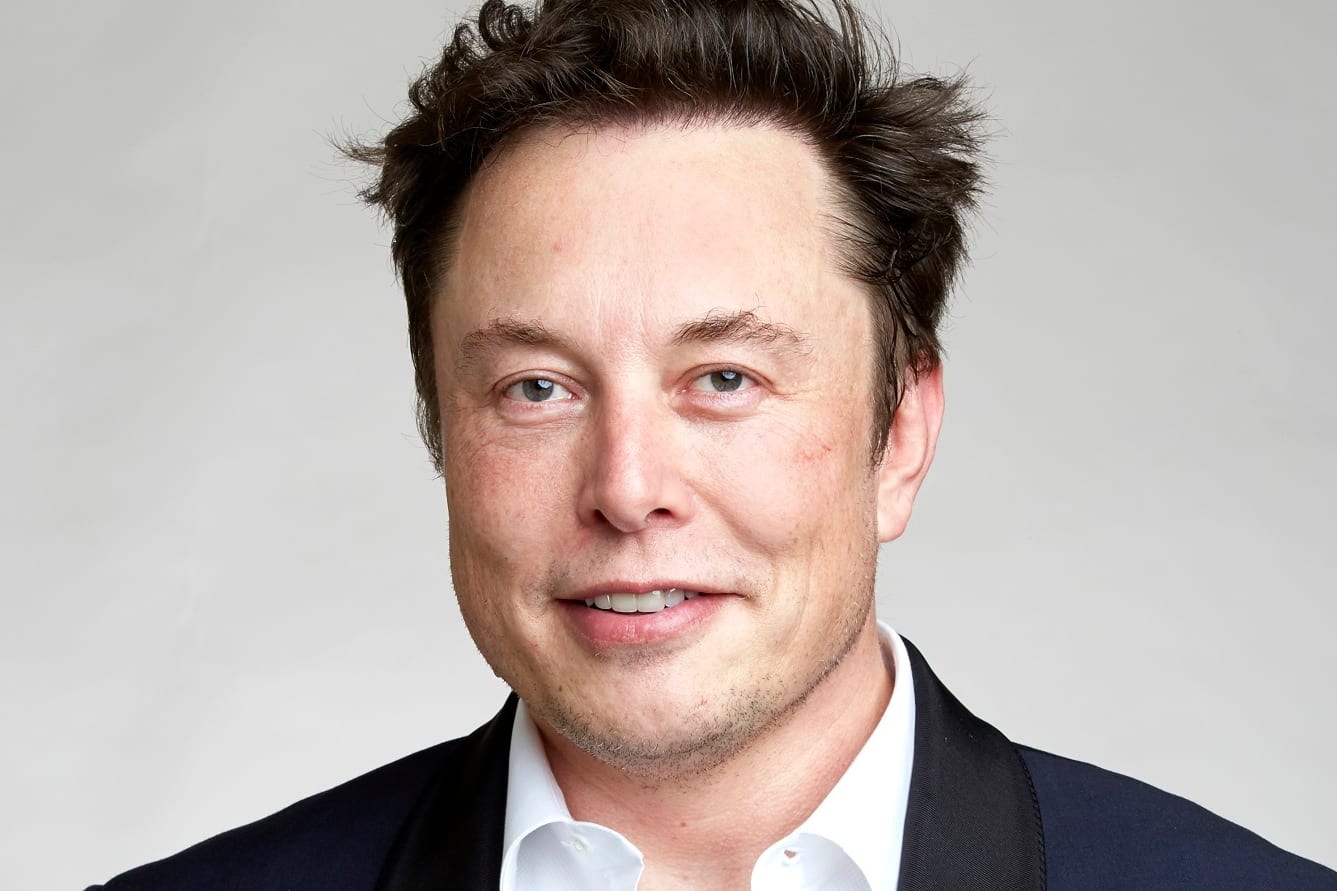
Who is Elon Musk, and why does his view of AI matter?
Elon Musk runs Tesla and SpaceX and founded xAI, the company behind the Grok chatbot. He was also one of the founders of OpenAI, the lab that later built ChatGPT. Few people have touched so many parts of the AI story: he helped fund the lab that started the current boom, he has spent more than ten years warning about where it leads, and he now controls one of the largest pools of computing power in the industry.
That combination is why his view matters even if you disagree with it. When Musk decides that AI needs more electricity, more chips or more robots, he can move tens of billions of dollars toward that idea, and the rest of the industry has to respond. For anyone trying to understand where AI is heading, his statements are not only opinions. They are signals about where money, engineers and political attention will flow next.
Here is his AI story in one table:
| Year | What happened |
|---|---|
| 2014 | At MIT, Musk calls AI “our biggest existential threat” and says “we are summoning the demon” |
| 2015 | He co-founds OpenAI as a nonprofit and co-chairs it with Sam Altman |
| 2018 | He leaves OpenAI’s board |
| 2023 | He signs an open letter asking labs to pause training AI more powerful than GPT-4, then launches xAI in July |
| 2024 | xAI switches on Colossus, a 100,000-GPU supercomputer in Memphis built in 122 days |
| 2025 | xAI takes over X; Tesla shareholders approve a pay plan tied to selling 1 million Optimus robots |
| 2026 | Musk predicts AI smarter than any human by the end of the year; SpaceX and xAI combine; a jury rules against him in his case against OpenAI |
What does Musk mean by superintelligence?
Superintelligence usually means an AI far smarter than the best humans in almost every field: science, engineering, strategy and persuasion. Musk describes it in two steps. First comes AI that is smarter than any single human. Then comes AI that is smarter than all humans combined, the point at which, in his view, most of the thinking done on Earth is done by machines.
For Musk the goal is not a better chatbot. When SpaceX and xAI combined in February 2026, he described the new company as “the most ambitious, vertically-integrated innovation engine on (and off) Earth” and summed up its mission in one line:
“Scaling to make a sentient sun to understand the Universe and extend the light of consciousness to the stars!” Elon Musk, February 2026, as reported by CNBC
The language is grand on purpose, but the idea underneath has stayed the same for years. When xAI was announced in July 2023, its stated goal was to “understand the true nature of the universe,” according to its Wikipedia entry. In Musk’s framing, superintelligence is an instrument for discovery, like a telescope for the mind, and the biggest limits on it are physical: chips, electricity and cooling. That is why so much of his plan is about hardware, energy and space rather than software alone.
What does a “sentient sun” mean? Musk did not define it, and it would be a mistake to read it as an engineering plan. Our reading is that he is pointing at scale: a civilization that turns large amounts of the sun’s energy into computation, and uses that computation to think. It is a science-fiction image, but it tells you how large the ambition is, and why he keeps coming back to rockets and solar power when he talks about AI.
He mixes this optimism with fear. For more than a decade Musk has said that a superintelligence that does not share human values could be catastrophic. His answer to that fear has changed over time: first he asked for regulation, then for a pause, and then he started building his own models. We come back to that tension below.
When does Musk say superintelligence will arrive?
Musk gives dates, and they have moved closer over time. His clearest recent statements came at Davos on January 22, 2026, in a conversation with BlackRock’s chief executive, Larry Fink. According to Euronews, he said:
- AI would be smarter than any individual human by the end of 2026.
- AI would surpass the collective intelligence of humanity within five years, around 2031.
- “My prediction is that there will be more robots than people.”
- Tesla’s Optimus robots, already doing simple tasks in its factories, would take on more complex work by the end of 2026, still in industrial settings.
Two years earlier he gave a similar forecast. In April 2024, in a live interview on X with Nicolai Tangen, the head of Norway’s sovereign wealth fund, he said: “If you define AGI artificial general intelligence] as smarter than the smartest human, I think it’s probably next year, within two years,” according to [Reuters. In the same interview he said the main limit on AI had moved from chips to electricity, that training Grok 2 had taken about 20,000 Nvidia H100 chips, and that the models after it would need about 100,000.
Notice the pattern. In 2024 the date was “next year, within two years.” In 2026 it was “by the end of this year.” The target keeps arriving about a year away. That does not prove it is wrong: AI has improved very quickly, and Musk sits closer to the frontier than most commentators. But it does mean that his dates are best read as statements of ambition, not as forecasts you can build a business plan on.
His record outside AI helps you calibrate. Here are four public predictions and what happened:
| Prediction | When he made it | Deadline | What happened |
|---|---|---|---|
| A Tesla will drive itself from Los Angeles to New York | October 2016 | End of 2017 | It did not happen by the deadline |
| “Over a million robotaxis on the road” | April 2019 | 2020 | It did not happen; Tesla had no robotaxi network in 2020 |
| AI smarter than the smartest human | April 2024 | 2025 to 2026 | Still debated; no lab or independent body has declared it reached |
| AI smarter than any individual human | January 2026 | End of 2026 | Open |
The coast-to-coast drive and the million robotaxis were not small misses. They show a habit: Musk tends to announce the date at which something becomes technically possible in his mind, not the date at which it works reliably for millions of people. With AI those two dates can be years apart.
Why did Musk go from “summoning the demon” to building xAI?
In October 2014, speaking to students at MIT’s AeroAstro Centennial Symposium, Musk gave one of the most quoted warnings in the history of the field:
“With artificial intelligence we are summoning the demon.” Elon Musk, MIT, October 2014
In the same talk, as Live Science reported, he called AI “our biggest existential threat” and said there should be “some regulatory oversight, maybe at the national and international level, just to make sure that we don’t do something very foolish.”
A year later he acted on that worry. When OpenAI was announced in December 2015, TechCrunch reported that Musk and Sam Altman would co-chair the nonprofit and that its backers had pledged more than $1 billion. The idea was simple: if powerful AI was coming, it should be built in the open, for the benefit of everyone, by a lab that did not answer to shareholders.
In March 2023, a few months after ChatGPT launched, Musk signed the Future of Life Institute’s open letter, which called on “all AI labs to immediately pause for at least 6 months the training of AI systems more powerful than GPT-4.” No major lab paused. By July 2023 Musk had launched xAI.
How does someone go from asking the world to slow down to racing to build the thing he fears? His public answer is that the risk is real but the benefits are bigger. At the Abundance Summit in March 2024 he said there was “some chance” that AI would end humanity, put it at roughly 10 to 20 percent, in line with Geoffrey Hinton’s estimate, and said that the likely positive outcome outweighs the negative one, as TechRadar reported. Read together, his statements describe a bet: superintelligence will be built anyway, so he would rather be one of the people building it.
What does Musk think AI will do to jobs and money?
Musk’s vision of the economy after superintelligence is radical, and he states it bluntly. Speaking to the VivaTech conference in Paris in May 2024, he said: “In a benign scenario, probably none of us will have a job,” according to Fox Business. Instead of universal basic income, he predicted “universal high income,” with “no shortage of goods or services,” and he put the chance of that good outcome at about 80 percent.
The logic is straightforward. If machines can do most mental work and robots can do most physical work, the cost of producing goods and services falls toward the cost of energy and materials. In that world, Musk argues, scarcity disappears and work becomes optional. He has also said the harder question is meaning: if a machine can do everything better than you, what gives your life purpose?
There are good reasons to be careful with this picture. Prices of goods might fall, but land, housing and attention do not get cheaper because a robot exists. Gains from automation usually flow first to whoever owns the machines. And the transition matters as much as the destination: a world that ends in abundance can still pass through years of lost jobs. Dario Amodei, the head of Anthropic, has warned about exactly that transition, as we explain in our article on his vision.
How does xAI’s Colossus fit into the plan?
Musk’s first big move with xAI was not a clever algorithm. It was a building. In Memphis, Tennessee, xAI and Nvidia built Colossus, a supercomputer with 100,000 Nvidia Hopper GPUs. According to Nvidia, the facility and supercomputer were built in 122 days, when systems of that size usually take many months or even years, and training began 19 days after the first rack rolled onto the floor. By October 2024 xAI was already doubling it to 200,000 GPUs. Colossus trains xAI’s Grok models, which are offered to subscribers on X.
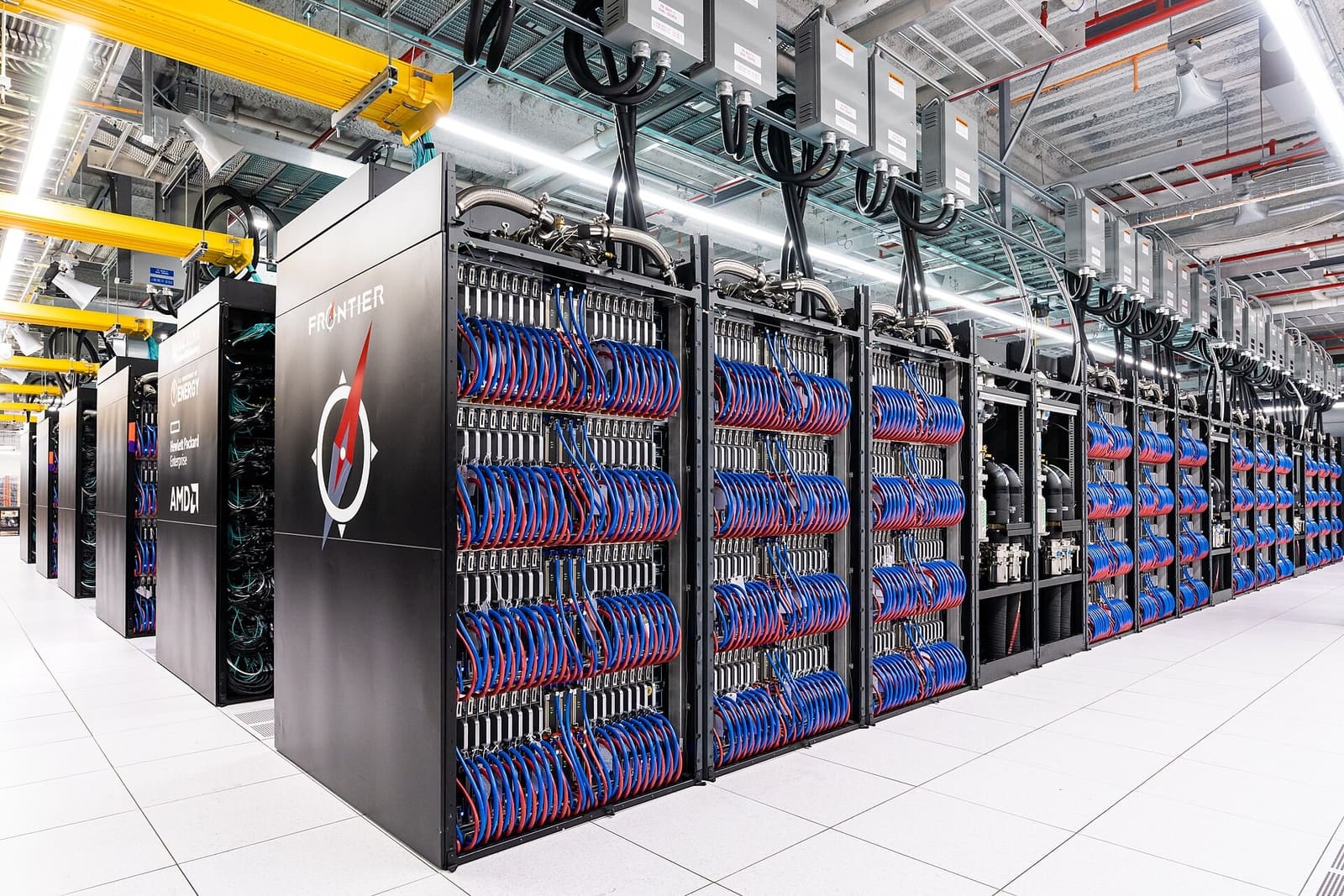
Speed of construction is Musk’s real advantage in AI. Models matter, but frontier AI is now limited by how fast you can bring chips, electricity and cooling together in one place. Musk runs companies that are good at exactly that kind of work: factories, supply chains and large engineering projects. When he said in 2024 that electricity would be the main constraint within a year or two, he was describing the problem his companies are built to attack.
Data is the other ingredient. In March 2025 xAI took over X, the social network formerly called Twitter, in an all-stock deal that valued X at $33 billion and the combined company at $80 billion, according to Bloomberg Law. Musk wrote that the futures of the two companies were “intertwined.” X gives Grok a stream of real-time posts and a built-in audience of hundreds of millions of people.
This is where Musk’s vision differs most from Sam Altman’s and Dario Amodei’s. Altman talks about making intelligence cheap and abundant for everyone, and Amodei writes about safety and what AI could do for medicine. Musk talks about megawatts, rockets and robots. If you want to understand his plan, follow the hardware.
Why did SpaceX and xAI merge?
On February 2, 2026, Musk combined SpaceX and xAI. CNBC reported that the combined company was valued at about $1.25 trillion, roughly $1 trillion for SpaceX and $250 billion for xAI, ahead of a planned SpaceX share sale later in the year. The reason Musk gave was not marketing. It was physics:
“Global electricity demand for AI simply cannot be met with terrestrial solutions, even in the near term… Space-based AI is obviously the only way to scale.” Elon Musk, February 2026, as reported by CNBC
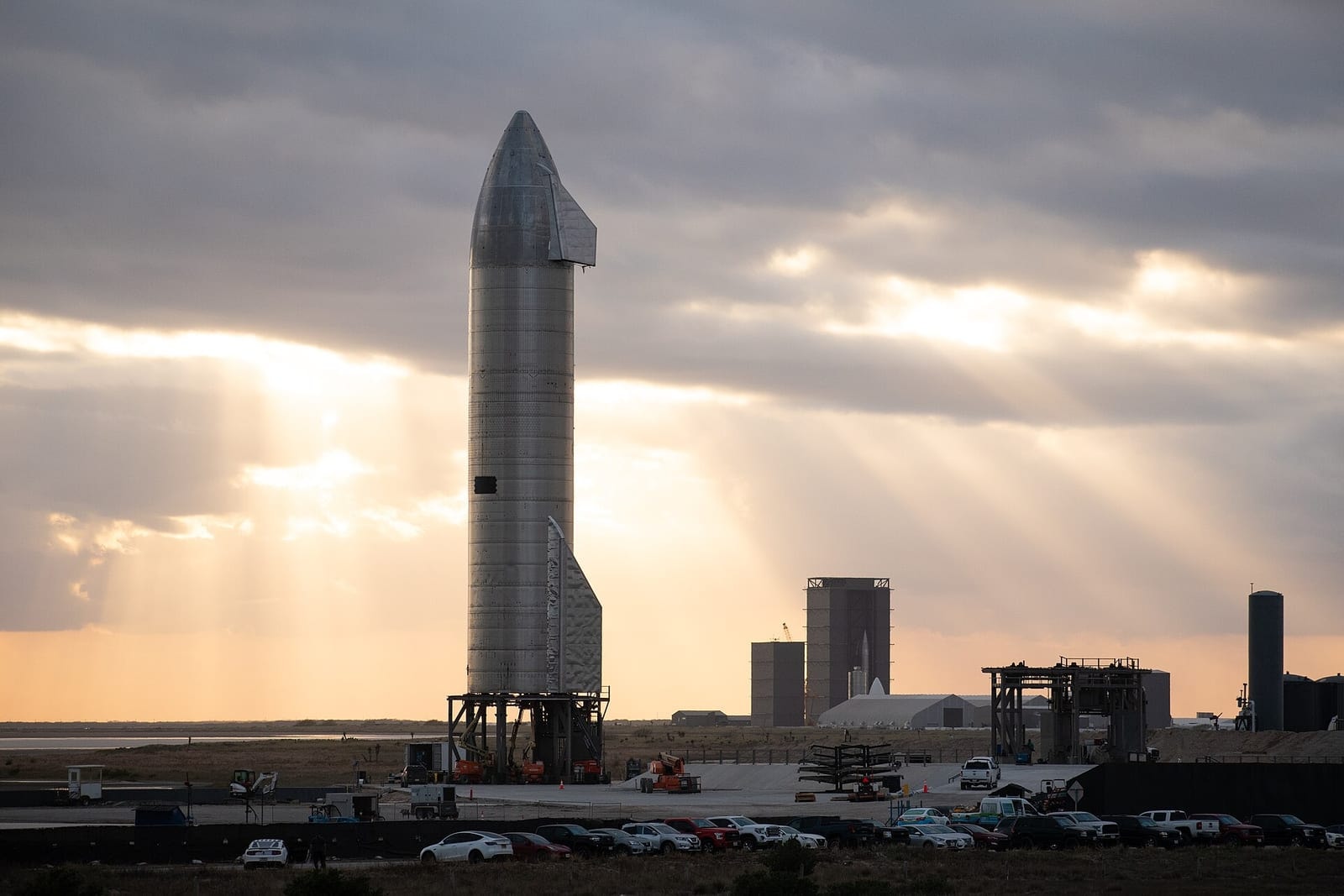
The argument goes like this. The best AI models need ever larger data centers. Those data centers need gigawatts of electricity and huge cooling systems, and building power plants and grid connections on the ground takes years. In the right orbit, solar panels get sunlight almost all the time. If launch costs fall far enough, which is the whole point of SpaceX’s reusable Starship, then putting computing in orbit could, in Musk’s view, become cheaper than building it on the ground.
There are real open questions, and they are worth stating plainly. In space, heat cannot be carried away by air or water; it has to be radiated, which needs large radiators. Broken hardware cannot easily be repaired. Data has to travel to and from the ground, and launches carry risk. None of this makes the idea impossible, and SpaceX has a record of doing things experts called impossible, such as landing and reusing rockets. It does mean that orbital data centers are a long-term engineering project, not a product you can buy in 2026.
What role do robots play in Musk’s vision?
For Musk, superintelligence that lives only on screens is half the story. The other half is robots that do physical work. At Davos he said he expects “more robots than people,” and Tesla’s humanoid robot, Optimus, is at the center of that idea.
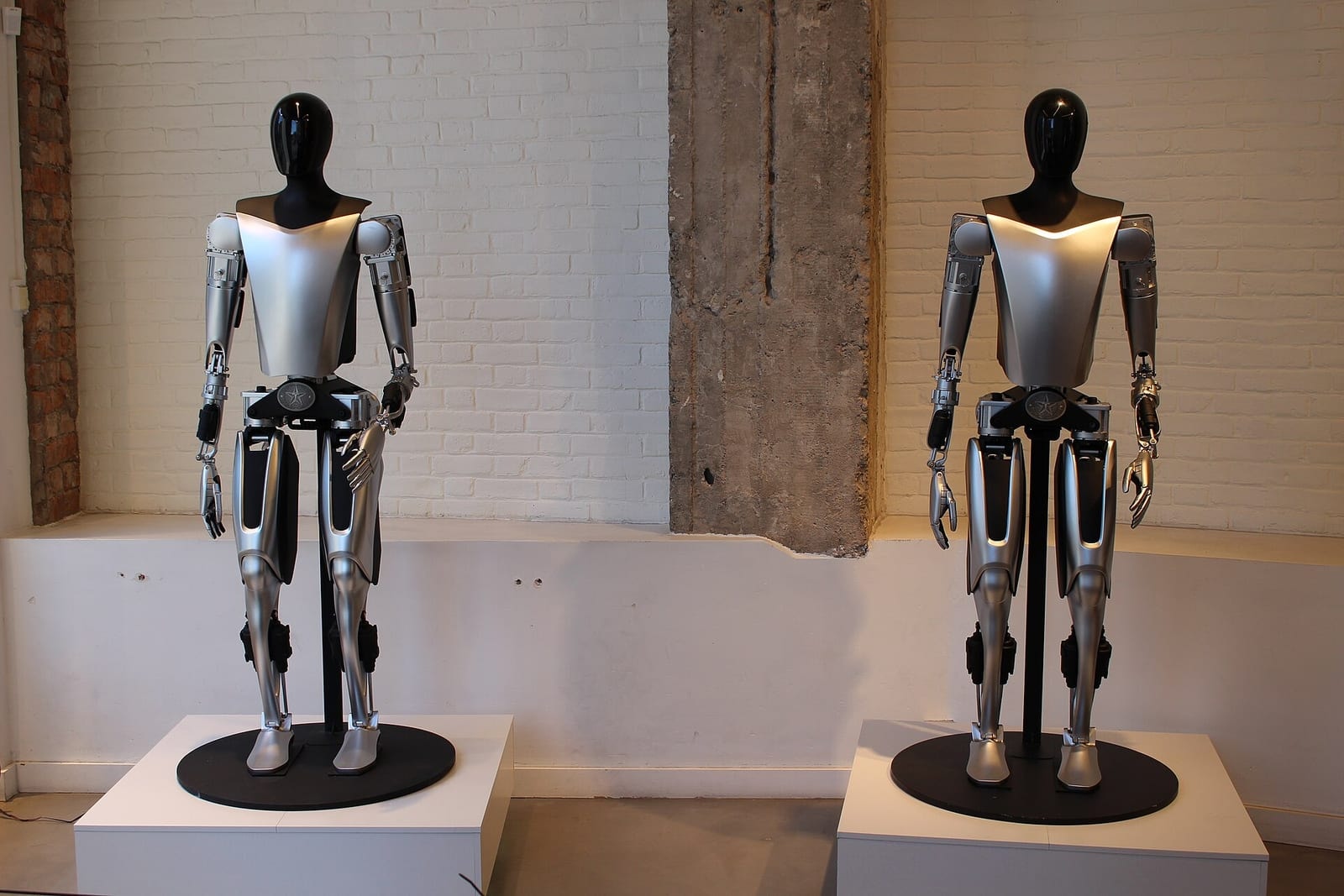
The clearest evidence of how seriously he takes this is his Tesla pay plan. On November 6, 2025, Tesla shareholders approved, with more than 75 percent support, a package that could give Musk up to about $1 trillion in Tesla stock over ten years, according to Anadolu Agency. He receives it only if Tesla reaches milestones that include delivering 20 million vehicles, operating 1 million robotaxis, selling 1 million robots, earning up to $400 billion in core profit, and growing its market value from about $1.5 trillion to $8.5 trillion. In effect, Musk has tied his personal fortune to the bet that AI moves into the physical world.
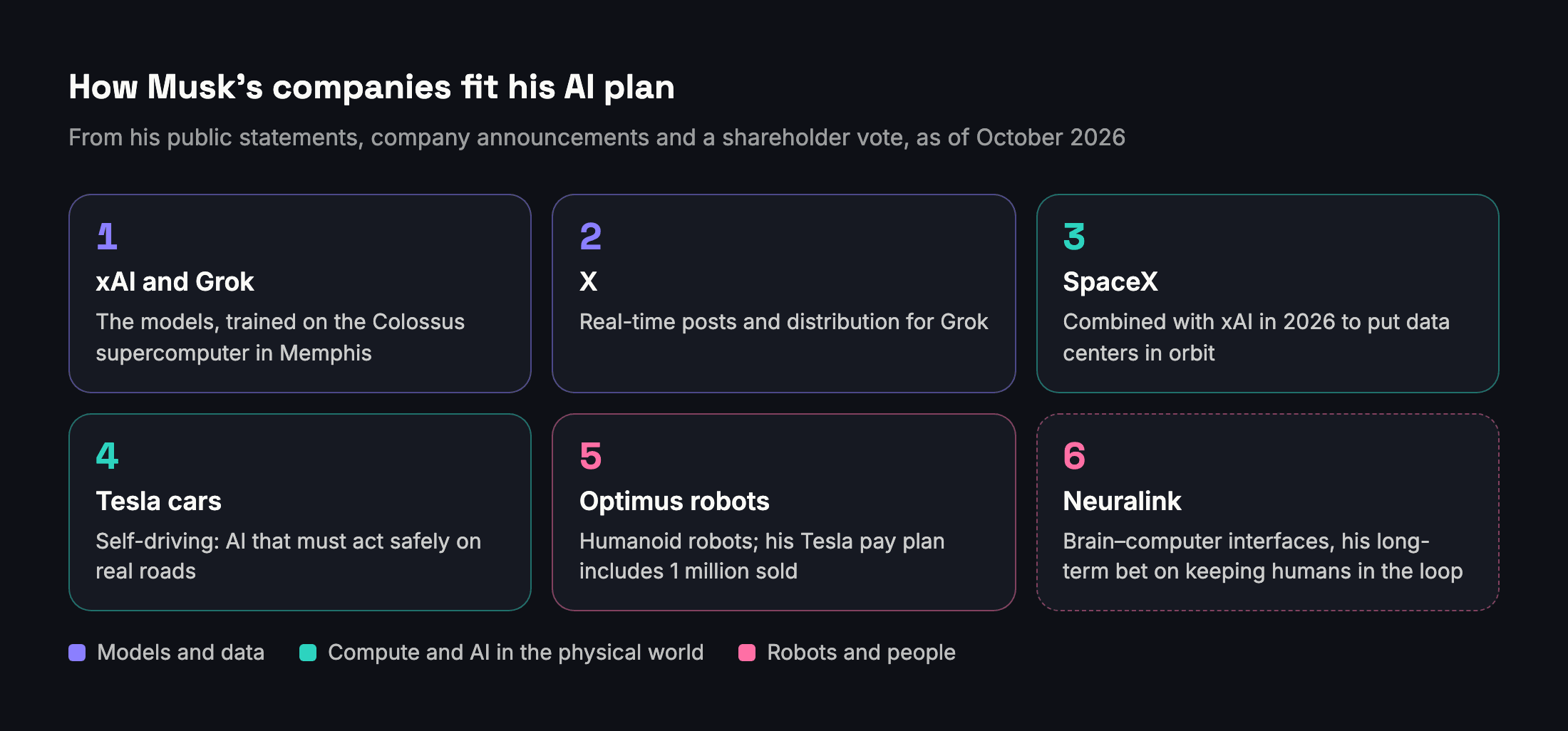
Seen together, his companies form one plan. xAI builds the models. X gives them real-time data and an audience. SpaceX provides launches, satellites and, in theory, orbital computing. Tesla’s cars and Optimus robots give AI a body that can move through the world. Neuralink, his brain–computer interface company, is the long-term idea that people might connect directly to computers instead of being left behind by them. No other AI leader controls a group of companies like this, and that is what makes his vision different in kind, not only in degree.
How does Musk’s vision compare with Sam Altman’s and Dario Amodei’s?
The three best-known AI founders agree that very powerful AI is close. They disagree about what limits it, what could go wrong and how to get there. Here is our summary, based on their own words:
| Topic | Elon Musk | Sam Altman | Dario Amodei |
|---|---|---|---|
| Company | xAI, part of SpaceX since 2026, plus Tesla | OpenAI | Anthropic |
| Best-known AI product | Grok | ChatGPT | Claude |
| His word for the goal | Superintelligence | Superintelligence | Powerful AI |
| Latest timeline | Smarter than any human by the end of 2026; than all humans by about 2031 | Superintelligence in “a few thousand days,” written in 2024 | Possibly one to two years away, written in January 2026 |
| Main bottleneck he talks about | Electricity and compute; his answer is space | Compute and energy; his answer is giant data centers | Safety and control; his answer is research and rules |
| How he describes the risk | A 10 to 20 percent chance of catastrophe | In 2015 he called superhuman machine intelligence “probably the greatest threat” to humanity | Five kinds of risk, from misuse to economic disruption |
The differences matter more than the agreement. Musk thinks the hard part is physical scale. Altman thinks it is building and shipping fast enough to make intelligence cheap for everyone. Amodei thinks it is keeping control of systems that may become smarter than us. Each bet leads to a different company, and each one tells you something about where the money in AI will go. You can read the full story of Sam Altman’s vision and Dario Amodei’s vision in their own articles.
What happened between Musk and OpenAI?
The relationship between Musk and OpenAI is the most dramatic part of the story, and it matters because it shaped two of the companies that now compete hardest.
Musk left OpenAI’s board in February 2018. Years later, when he sued, OpenAI published his old emails. According to OpenAI’s account, reported by Engadget in March 2024, Musk had wanted majority equity, initial board control and the chief executive role in a for-profit OpenAI, and later suggested that OpenAI should become part of Tesla. OpenAI says the other founders refused because no single person should have absolute control. Musk’s side tells a different story: that OpenAI abandoned the nonprofit mission he had paid for.
The court case ended its first round in May 2026. According to Al Jazeera, a jury found for OpenAI after deliberating for less than two hours, because Musk had brought his case too late. Musk said he would appeal and posted: “Altman & Brockman did in fact enrich themselves by stealing a charity. The only question is WHEN they did it!” OpenAI’s position was that there had never been a promise to remain a nonprofit forever.
Whatever you think of the case, it shows something important about Musk’s view of AI: he believes control matters enormously. He worries about who will control superintelligence, and the record suggests he also wanted that control to be his. Both readings can be true at the same time, and both help explain why he now builds his own models instead of funding someone else’s.
How should you read Musk’s AI predictions?
Musk’s statements move markets and headlines, so it helps to have a simple way to read them. We use four questions:
- Is he describing a capability or a deployment? “AI can do this in a demo” and “millions of people rely on this every day” are different claims, often years apart.
- Who would measure it? “Smarter than any human” has no agreed test. A claim that cannot be measured can be declared true by whoever makes it.
- What is he spending? His most reliable signals are not his words but his budgets: Colossus, the SpaceX merger and the Tesla pay plan show where he truly expects value.
- What does his record say? On rockets and electric cars he was late but largely right. On self-driving he was very early. Weigh new forecasts accordingly.
Used this way, his statements become useful. They tell you which way the industry is likely to move, while your own plans stay grounded in what you can test today.
Is Musk right? Our view
This section is opinion: the view of the Adams Analytics editorial team, based on the record above.
He is probably right about the direction. AI has improved faster than almost anyone expected ten years ago, and the bottlenecks really have shifted from ideas to chips and electricity. Musk saw the power problem early and built for it. His bet that AI will move into robots and vehicles also looks sound; the hard part is engineering, not imagination.
He is probably wrong about the dates. His record shows a consistent gap between when something works in a demonstration and when it works reliably for millions of people. “Smarter than any human” is also a slippery finish line: today’s models beat most people on many written tests and still fail at tasks a careful intern would get right. Expect him to declare victory on a narrow definition long before the world agrees on a broad one.
The orbital data center is the most interesting idea, and the least proven. If launch costs keep falling, computing in space could matter a great deal in the 2030s. In 2026 it is a reason for investors to value SpaceX more highly, not a working product.
His warnings deserve attention, even from someone racing to build. A 10 to 20 percent chance of disaster, coming from a person who builds the technology, is not a reason to panic. It is a strong reason to want independent testing, transparency and rules that apply to every lab, including his.
Our practical advice: separate Musk the engineer, who builds real things at extraordinary speed, from Musk the forecaster, whose dates slip. Plan around what exists and can be measured, and treat his dates as a sign of where he is putting money.
What Musk’s vision means for businesses and marketers in Egypt and the Gulf
You do not need an opinion on orbital data centers to run an online business in Cairo, Riyadh or Dubai. But the direction Musk describes, cheaper intelligence and AI that acts on its own, is already reaching marketing:
- AI is becoming a cheap input. Text, images and video that took a team a week now take minutes. The advantage moves to people who know which message to test and why.
- Platforms will automate more of the buying. The same race for compute powers the ad systems at Meta, Google and X. Expect fewer manual settings and more decisions made by the platform.
- Proof becomes your edge. When everyone has the same tools, clients pay for results they can see. A clear, honest report that compares two periods is worth more than a deck full of AI buzzwords.
- Do not plan on a forecast. If a tool you need is promised for “next year,” build your plan on what works today and treat the promise as a bonus.
If you manage Meta ads for clients, the safest way to benefit from AI is to measure carefully what it changes. Our guide to comparing two periods in Meta ads shows how to tell a real improvement from noise, and our guide to the Meta ads report for clients shows how to present it. Adams Analytics turns your Meta ad accounts into clear reports in English and Arabic, so your clients see the results, not the hype.
Key takeaways
- Musk defines superintelligence in two steps: AI smarter than any single human, then smarter than all humans combined. In January 2026 he put the first at the end of 2026 and the second around 2031.
- His plan is physical: Colossus for compute, X for data, SpaceX for launches and orbital data centers, Tesla and Optimus for AI in the real world, and Neuralink for linking people and machines.
- He has warned about AI since 2014, signed the 2023 pause letter and puts the risk of catastrophe at 10 to 20 percent, while building one of the largest AI efforts in the world.
- He expects AI to end the need for most jobs and talks about “universal high income,” but the path there is far less clear than the destination.
- His dates have often been early: the 2017 self-driving trip and the 2020 robotaxis did not happen on time.
- He lost the first round of his case against OpenAI in May 2026 and has said he will appeal.
- For businesses, the useful lesson is to follow where he spends, plan around what works today, and measure everything.
For the bigger picture, read our guides to how technology evolved from 1990 to 2026 and the people who predicted the AI era before it arrived.
Questions
What does Elon Musk mean by superintelligence?
He describes it in two steps: AI that is smarter than any single human, and then AI that is smarter than all humans combined. He sees it as a tool for scientific discovery whose main limits are physical: chips, electricity and cooling.
When does Elon Musk say superintelligence will arrive?
At Davos in January 2026 he said AI would be smarter than any individual human by the end of 2026 and would surpass the collective intelligence of humanity within five years, around 2031. In 2024 he had said it would probably happen within two years.
Does Elon Musk think AI is dangerous?
Yes. In 2014 he called AI humanity’s biggest existential threat, in 2023 he signed a letter asking labs to pause, and in 2024 he put the chance that AI ends humanity at roughly 10 to 20 percent. He still argues that the likely positive outcome outweighs the risk.
Why did SpaceX and xAI merge?
Musk says the electricity AI needs cannot be supplied on the ground, so the combined company plans to put data centers in orbit, powered by the sun and launched by SpaceX. CNBC reported the merged company was valued at about $1.25 trillion.
What is Colossus?
Colossus is xAI’s supercomputer in Memphis, Tennessee. According to Nvidia it started with 100,000 Hopper GPUs, was built in 122 days, and was being doubled to 200,000 GPUs in late 2024. It trains xAI’s Grok models.
Why did Elon Musk sue OpenAI, and who won?
Musk argued that OpenAI abandoned the nonprofit mission he helped fund. In May 2026 a jury found for OpenAI because Musk had brought his case too late. He said he would appeal.
How accurate are Elon Musk’s predictions?
His direction is often right and his dates are often early. A self-driving trip across the United States promised for 2017 and a million robotaxis promised for 2020 did not happen on time. It is wise to treat his dates as ambitions.
What does Musk’s AI vision mean for marketers?
AI makes content cheaper and lets ad platforms automate more of the buying, so the advantage moves to strategy, creative judgment and proof of results. Plan on tools that work today and measure what changes.
Sources
- Euronews — Elon Musk predicts a robot-majority future in his first Davos appearance (January 2026)
- Reuters via South China Morning Post — Tesla’s Musk predicts AI will be smarter than the smartest human next year (April 2024)
- CNBC — Musk’s SpaceX and xAI combine in the biggest merger ever (February 2026)
- Live Science — Elon Musk: artificial intelligence is humanity’s “biggest existential threat” (October 2014)
- TechCrunch — Non-profit OpenAI launches with backing from Elon Musk and Sam Altman (December 2015)
- Future of Life Institute — Pause Giant AI Experiments: An Open Letter (March 2023)
- Wikipedia — xAI (company)
- TechRadar — Top AI researcher says AI will end humanity, but Elon Musk disagrees (April 2024)
- Nvidia via HPCwire — Nvidia Ethernet networking accelerates xAI’s Colossus AI supercomputer (October 2024)
- Bloomberg Law — Musk says his xAI startup has acquired X for $33 billion (March 2025)
- Anadolu Agency — Tesla shareholders approve Elon Musk’s compensation package (November 2025)
- Fox Business — Musk predicts AI will create “universal high income” (May 2024)
- Engadget — OpenAI says Elon Musk wanted it to merge with Tesla to create a for-profit entity (March 2024)
- Al Jazeera — Elon Musk loses lawsuit against OpenAI (May 2026)
- The Drive — Tesla still planning coast-to-coast autonomous drive (2018)
- CNBC — Elon Musk says Tesla robotaxis will hit the market next year (April 2019)
Send your next client report in minutes
Adams Analytics connects to your Meta ad accounts and builds branded PDF reports in English or Arabic. Free for 7 days — no credit card.
Start free trialWritten by the Adams Analytics team and checked against Meta’s documentation and our own product. Spotted something out of date? Tell us at support@buildincairo.com.