Dario Amodei, the chief executive of Anthropic, the company that makes Claude, has a habit that is rare among technology leaders: he writes long essays that say both what could go right and what could go wrong. In October 2024 he argued that AI could compress 50 to 100 years of progress in biology and medicine into 5 to 10 years. In January 2026 he warned that humanity was entering a “rite of passage” that “will test who we are as a species.” In between, his company became one of the most valuable startups in the world and ended up in court with the United States Department of Defense.
This guide explains Dario Amodei’s vision for AI from his own writing and from the public record: who he is, why he left OpenAI to found Anthropic, how Claude evolved, what his two big essays actually say, how Anthropic tries to make AI safe, what he predicts for jobs, and why the Pentagon labeled his company a risk. Every number has a source, and our opinion is labeled.
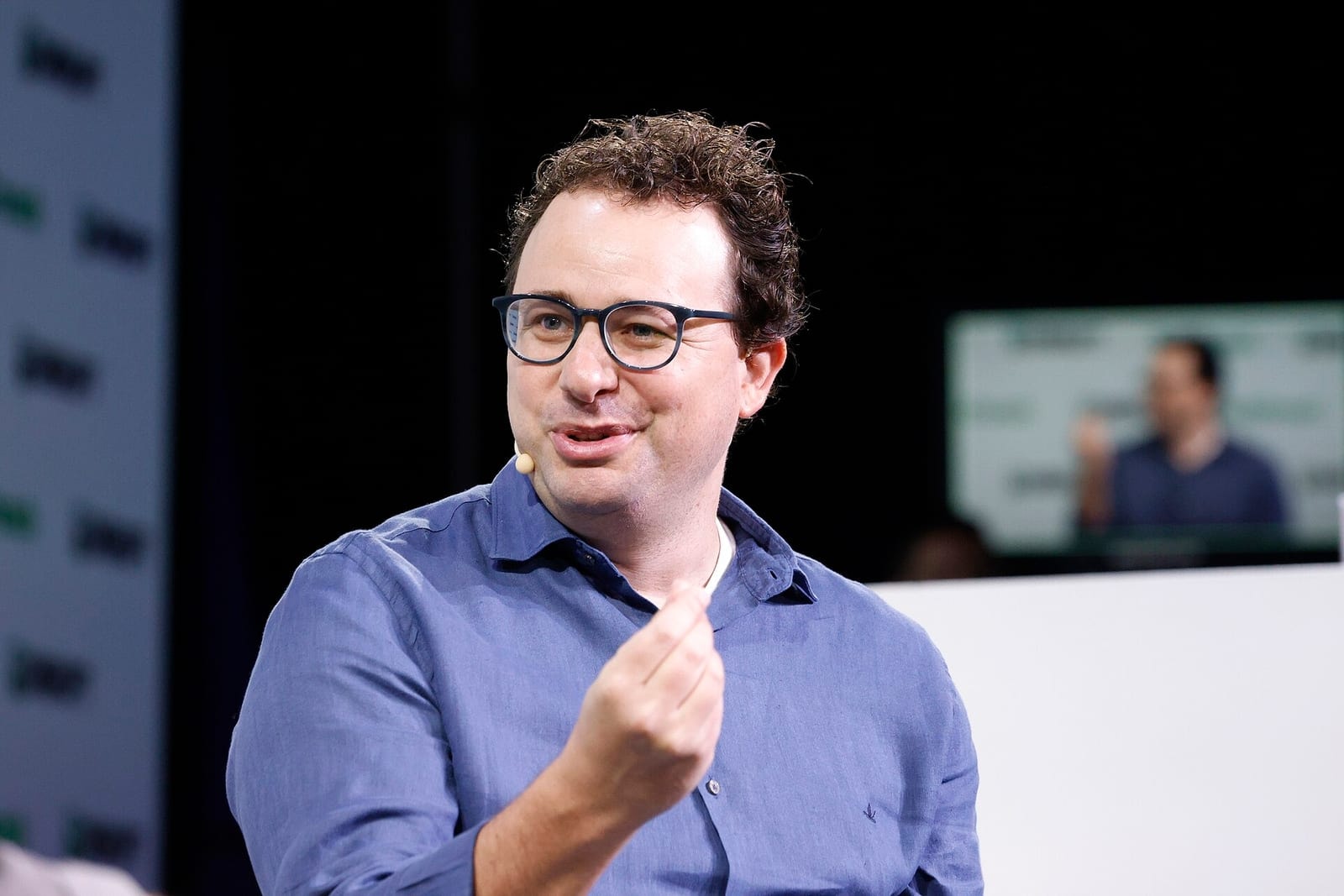
Who is Dario Amodei?
Dario Amodei was born in San Francisco in 1983. He studied physics at Stanford, earned a PhD in biophysics at Princeton in 2011 and worked as a postdoctoral scholar at the Stanford University School of Medicine, according to his Wikipedia biography. He then moved into AI, working at Baidu from 2014 to 2015 and at Google before joining OpenAI in 2016, where he became vice president of research.
Two research papers show the two sides of his career. In 2016 he was the lead author of Concrete Problems in AI Safety, one of the first papers to describe, in practical engineering terms, how AI systems can go wrong: by pursuing the wrong goal, finding shortcuts their designers did not intend, or behaving badly in situations they were not trained for. In 2020 he was one of the authors of the GPT-3 paper, which showed that a large language model could perform many tasks from just a few examples. He was, in other words, helping to build powerful AI while also writing the manual on how it could fail.
His influence is now widely recognized. Time magazine named him to its list of the 100 most influential people in 2025 and 2026, and included him among the “Architects of AI” it named Person of the Year for 2025.
Here are the main events of his story and Anthropic’s:
| Year | What happened |
|---|---|
| 2016 | Amodei joins OpenAI and is lead author of “Concrete Problems in AI Safety” |
| 2020 | He co-authors the GPT-3 paper |
| 2021 | He and his sister Daniela leave OpenAI with other senior colleagues and found Anthropic |
| 2022 | Anthropic publishes its Constitutional AI method |
| 2023 | Claude launches in March; Anthropic publishes its Responsible Scaling Policy in September |
| 2024 | Claude 3 and Claude 3.5 Sonnet; Amodei publishes “Machines of Loving Grace” in October |
| 2025 | Claude Code launches in February; Claude 4 arrives in May |
| 2026 | “The Adolescence of Technology” in January; the Pentagon dispute begins; a $65 billion funding round; the Claude 5 family |
Why did Dario Amodei leave OpenAI and found Anthropic?
In 2021, Amodei and his sister Daniela Amodei left OpenAI together with other senior researchers, including Jared Kaplan, Jack Clark, Chris Olah, Ben Mann, Sam McCandlish and Tom Brown, and founded Anthropic, according to Wikipedia. Dario became chief executive and Daniela became president. Wikipedia describes the reason for leaving as “directional differences.” In plain words, they wanted an AI lab where safety research would shape the company from the start, not be added later.
Anthropic’s legal structure reflects that. It is a public benefit corporation, a type of company that must balance profit with a stated public purpose. Anthropic describes its purpose as “the responsible development and maintenance of advanced AI for the long-term benefit of humanity.” It also created a Long-Term Benefit Trust: an independent body of five financially disinterested members with authority to select and remove a growing portion of the board, and to elect a majority of it within four years of its creation.
The central bet behind Anthropic is easy to state and hard to execute. If powerful AI is going to be built anyway, the people most worried about its risks should be at the frontier, building the most capable systems, so that they can study real dangers instead of hypothetical ones, show that safety and usefulness can go together, and have a voice when rules are written. Critics say this makes Anthropic one more competitor in a race it says it fears. Amodei’s answer, repeated in his essays, is that staying out of the race would not stop it; it would only remove the safety-focused players from it.
What is Claude, and how has it evolved?
Claude is Anthropic’s family of AI models and the assistant built on them. It was first released in March 2023 and, according to Wikipedia, is reportedly named after Claude Shannon, the mathematician who founded information theory. Like ChatGPT, Claude can write, analyze documents, answer questions and write code; Anthropic has focused especially on long documents, careful reasoning and software engineering.
| Date | Release |
|---|---|
| March 2023 | Claude |
| July 2023 | Claude 2 |
| March 2024 | Claude 3 family (Haiku, Sonnet and Opus) |
| June 2024 | Claude 3.5 Sonnet |
| February 2025 | Claude 3.7 Sonnet and Claude Code |
| May 2025 | Claude 4 (Sonnet 4 and Opus 4) |
| November 2025 | Claude Opus 4.5 |
| June 2026 | Claude Fable 5 and Claude Sonnet 5 |
| July 2026 | Claude Opus 5 |
| September 2026 | Claude Opus 5.5 and Claude Sonnet 5.5 |
Two parts of this timeline matter most for the business story. The first is Claude Code. Anthropic introduced it in February 2025 as “our first agentic coding tool,” one that lets developers hand whole engineering tasks to Claude from their terminal: searching code, editing files, writing tests and running commands, according to Anthropic. It turned Claude from a chat assistant into something closer to a colleague that does work, and it became one of the company’s biggest sources of growth.
The second is how Anthropic handles its most capable models. In 2026 it released a model class it calls Mythos. According to Wikipedia, it made Claude Fable 5 available for general use with a set of safeguards, while keeping a version called Claude Mythos 5, with some of those safeguards lifted, on restricted access. Releasing different versions of the same model to different users, depending on risk, is the Responsible Scaling Policy in practice.
Underneath every Claude model is a method Anthropic calls Constitutional AI. Instead of relying only on people to rate millions of answers, the model is trained against a written set of principles, a “constitution,” and learns to critique and improve its own answers. Wikipedia notes that the 2026 version of Claude’s constitution runs to about 23,000 words, up from 2,700 in 2023, with much fuller explanations of how Claude is meant to behave.
Why does Amodei believe powerful AI is so close?
Amodei’s confidence comes from an idea he helped establish: scaling. In January 2020 he was one of the authors of Scaling Laws for Neural Language Models, a paper led by Jared Kaplan, who later co-founded Anthropic with him. It showed that the performance of language models improves smoothly and predictably as three things grow together: the size of the model, the amount of training data and the amount of computing power used to train it. The improvement followed simple mathematical curves, called power laws, across many orders of magnitude.
That finding changed the industry. If performance is predictable, then spending billions on a bigger training run is not a gamble on a lucky breakthrough; it is an investment with a forecastable return. GPT-3, Claude and almost every frontier model since were built on that logic, and the race to build ever larger data centers, from Musk’s Colossus to OpenAI’s Stargate, follows directly from it.
Amodei’s timelines are, in essence, this curve projected forward. If each generation of models keeps improving predictably, and the computing power available keeps rising several times each year, then a system with Nobel-level ability across many fields is a matter of a few more generations. The weak points in the argument are ones he acknowledges: the curves could bend, useful data could run short, and the last steps to reliable expert-level work could prove harder than the earlier ones. So far, they have not bent enough to slow the race.
What does “Machines of Loving Grace” say?
In October 2024, Amodei published Machines of Loving Grace, named after a 1967 poem by Richard Brautigan. It is the most optimistic thing he has written, and he says he wrote it partly because safety-focused people rarely describe what success would look like.
He starts by defining what he means by “powerful AI.” He avoids the term AGI. Instead he describes a system that:
“In terms of pure intelligence, it is smarter than a Nobel Prize winner across most relevant fields.” Dario Amodei, Machines of Loving Grace, October 2024
Such a system could work on its own for hours or days on a task, use the same tools a human uses on a computer, and run as millions of copies at once. His shorthand for this is “a country of geniuses in a datacenter.” On timing he was careful but bold: “I think it could come as early as 2026, though there are also ways it could take much longer.”
His central claim is what he calls the compressed 21st century. Powerful AI, he argues, could “compress the progress that human biologists would have achieved over the next 50-100 years into 5-10 years.” The bottleneck in medicine is not a shortage of ideas but the slow cycle of experiments, and millions of tireless AI researchers could speed that cycle up dramatically.
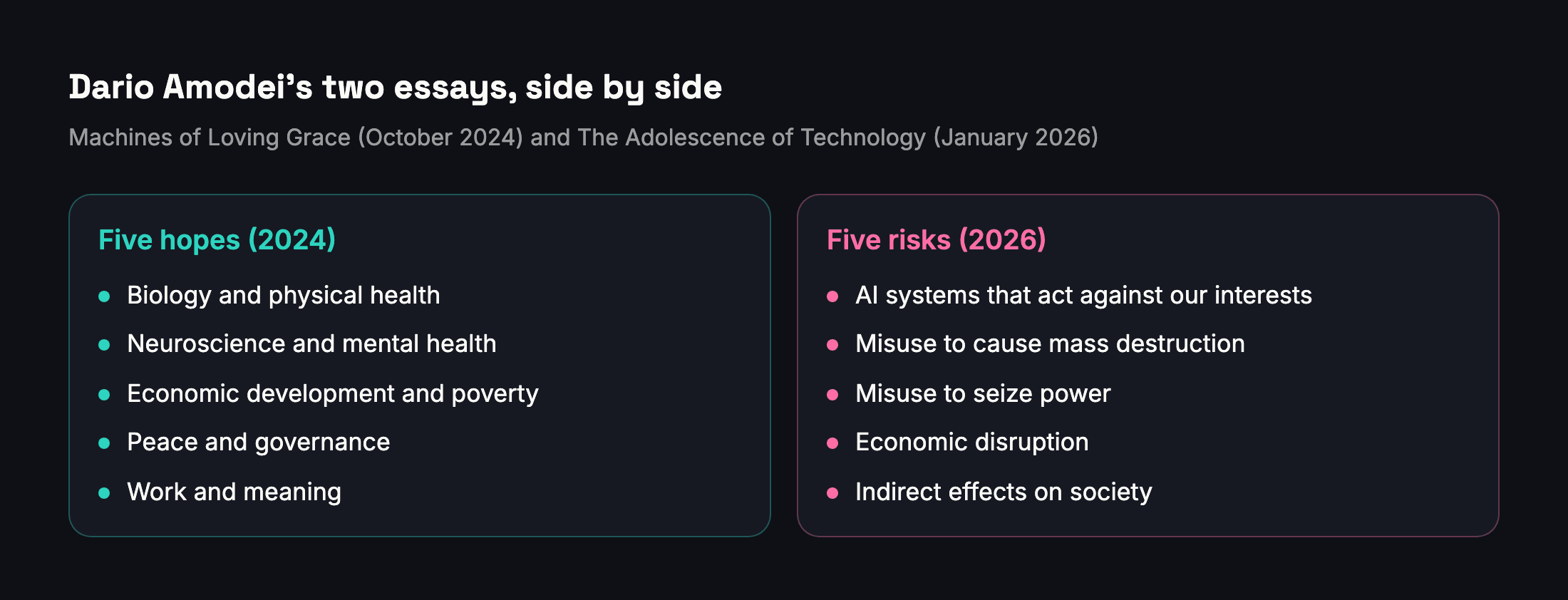
The essay covers five areas:
- Biology and physical health: preventing and curing most infectious diseases and many cancers, and possibly doubling the human lifespan over time.
- Neuroscience and mental health: real treatments for depression, schizophrenia, addiction and other conditions.
- Economic development and poverty: helping the developing world catch up, with growth rates that could be far faster than history’s.
- Peace and governance: helping democracies stay stronger than authoritarian states, and making governments more effective and fair.
- Work and meaning: what people will do, and what will give life meaning, in a world where AI can do most tasks.
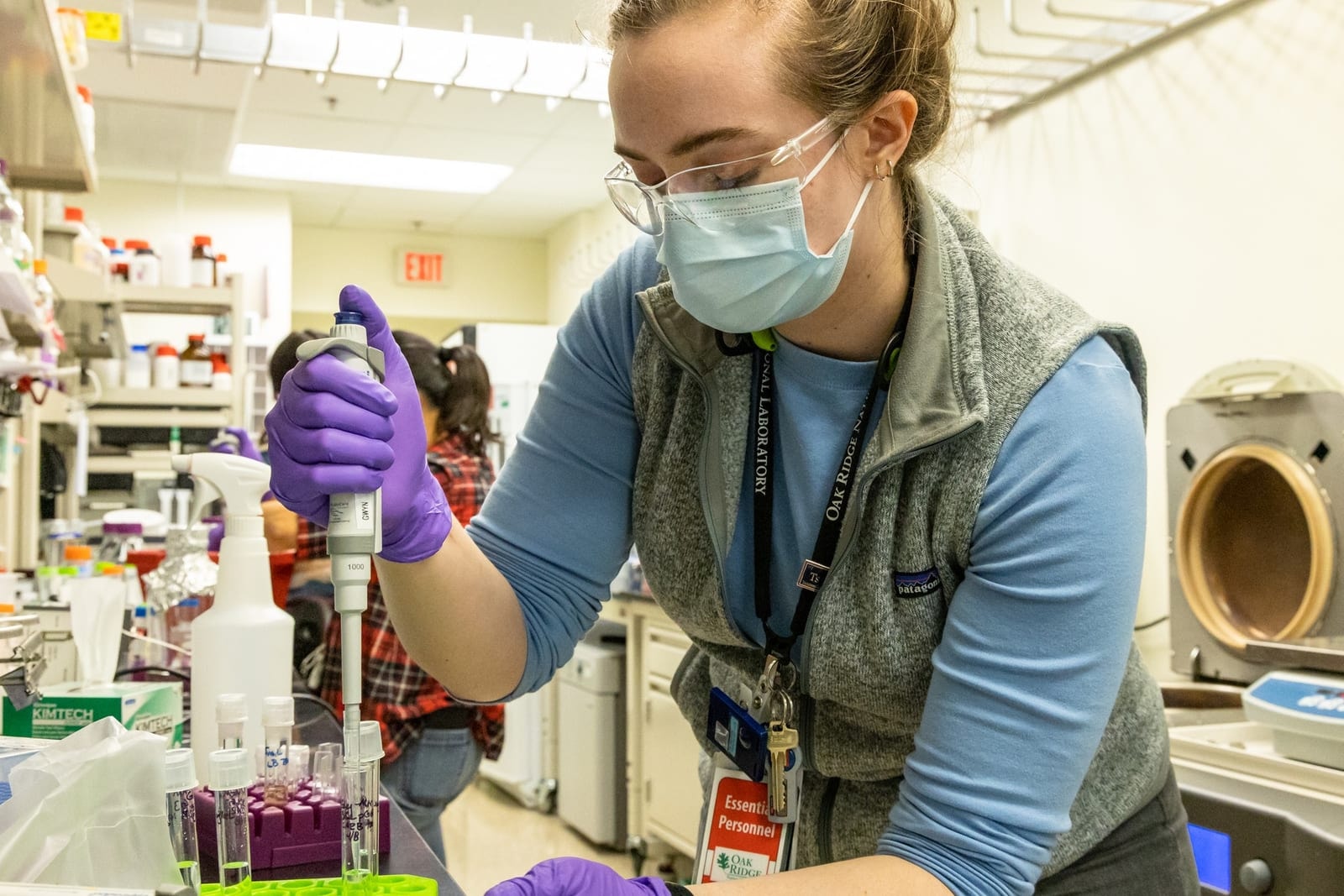
Why does biology come first? Partly because of who Amodei is: a biophysicist who studied neural circuits before moving into AI. And partly because it is where the gains are easiest to measure and to agree on. Almost nobody argues against curing cancer. Making that the headline was a deliberate choice to show what the safety work is for.
What does “The Adolescence of Technology” warn about?
In January 2026, Amodei published a second long essay, The Adolescence of Technology. If the first essay described the destination, this one describes the dangerous road. He frames the moment like this:
“I believe we are entering a rite of passage, both turbulent and inevitable, which will test who we are as a species.” Dario Amodei, The Adolescence of Technology, January 2026
He groups the dangers into five kinds of risk:
- Autonomy risks: AI systems that pursue goals of their own, against our interests.
- Misuse for destruction: people using AI to help build weapons, such as biological ones, that could kill large numbers of people.
- Misuse for seizing power: governments or groups using AI for surveillance and control.
- Economic disruption: AI replacing large amounts of human work faster than societies can adapt.
- Indirect effects: slower, harder-to-see changes to how societies work.
On timing, he repeated and sharpened his earlier view: “As I wrote in Machines of Loving Grace, powerful AI could be as little as 1–2 years away, although it could also be considerably further out.” That puts his central guess at around 2027 or 2028, with real uncertainty.
The essay is also a policy document. Amodei supports laws that require AI companies to be transparent about their safety practices, and names California’s SB 53 and New York’s RAISE Act as examples that Anthropic supported. He argues for strict export controls on advanced chips, writing: “We should absolutely not be selling chips, chip-making tools, or datacenters to the CCP.” And he points to two technical answers: training methods such as Constitutional AI, and interpretability, the science of looking inside a model to understand what it is actually doing.
How does Anthropic try to make AI safe?
Anthropic’s safety work rests on a few ideas that are worth understanding, because other labs have copied several of them.
- The Responsible Scaling Policy. Published in September 2023, it is, in Anthropic’s words, “a series of technical and organizational protocols” for managing the risks of more capable AI, according to Anthropic. Its core is a ladder of AI Safety Levels, modeled on the biosafety levels used for dangerous pathogens: the more dangerous a model’s capabilities, the stricter the security and deployment rules.
- Constitutional AI. Written principles shape how models behave, so the rules can be read, debated and changed in public.
- Interpretability research. Anthropic invests heavily in understanding what happens inside its models, so that problems can be found by inspection rather than only by testing behavior.
- Limits on use. Anthropic sets rules on what customers may do with its models, and as the Pentagon dispute shows, it has been willing to hold to some of them under heavy pressure.
- Rules for everyone. Amodei argues that voluntary commitments are not enough, and supports transparency laws that would apply to all frontier labs.
Interpretability deserves a word of explanation, because it is the most distinctive part of Anthropic’s research. A modern AI model is an enormous set of numbers learned from data. Nobody writes its rules by hand, so nobody can simply read them. Interpretability researchers try to translate those numbers back into concepts a person can understand, for example finding which internal features light up for a city, a feeling or a false statement. One way to picture the goal is an MRI for AI: a way to check whether a model is safe by looking inside it, instead of only watching what it does. Amodei names it in his 2026 essay as one of the main technical defenses against the risks he describes.
Does it work? No one can fully answer that yet, because the hardest tests involve systems more capable than any that exist today. What can be said is that Anthropic publishes more about its reasoning than most labs, and that it has paid a real commercial price for at least one of its rules, which is more than many corporate safety promises can claim.
What does Amodei predict for jobs and the economy?
Amodei has been the most outspoken AI leader on jobs. In May 2025 he warned that AI could eliminate half of all entry-level white-collar jobs and push unemployment to 10 to 20 percent within one to five years, according to Fortune. He said AI companies and governments needed to stop “sugar-coating” what was coming, and named technology, finance, law and consulting as especially exposed, above all at the junior level. He described a possible future in a single sentence:
“Cancer is cured, the economy grows at 10% a year, the budget is balanced, and 20% of people don’t have jobs.” Dario Amodei, May 2025
That sentence captures his whole outlook: enormous gains and serious pain arriving at the same time. Unlike Musk’s “universal high income,” Amodei does not promise that the transition takes care of itself.
He has also made forecasts that ran ahead of reality. In March 2025, at the Council on Foreign Relations, he said that within three to six months AI would be writing 90 percent of code, and within twelve months “essentially all of the code.” Across the software industry as a whole, that did not happen on that schedule, even though AI coding tools, including his own company’s Claude Code, spread faster than almost any developer tool before them. It is a useful reminder that even careful forecasters underestimate how long it takes for a capability to become everyday practice.
Our reading: his job warnings are best treated as a serious scenario rather than a forecast. The direction he describes, junior tasks automated first, is already visible in many offices. The size and speed are uncertain, and they will depend on choices made by companies and governments, not only on what the models can do.
Why did Anthropic clash with the Pentagon?
In early 2026, Anthropic became the first major AI company to fight the United States government in court over how its technology could be used.

According to TechCrunch, the Pentagon formally designated Anthropic a supply chain risk in March 2026, after the administration ordered federal agencies to stop using its products. The dispute centered on two uses Anthropic refused to allow: mass surveillance of Americans and fully autonomous weapons, meaning weapons that select and fire on targets without a human involved.
The courts have split. In August 2026, U.S. District Judge Rita Lin found that the government had acted unlawfully, saying its actions were based on a desire to make a public example of Anthropic, as reported by CNN and ABC News. Then, on September 25, 2026, a federal appeals court in Washington upheld the Pentagon’s designation in a 2-1 decision, in a separate case brought by Anthropic, according to ABC News. Anthropic said it would keep fighting, pointing out that another federal court had already held the government’s parallel designation unlawful.
Why does this matter beyond Anthropic? Because it is the first real test of whether an AI company can set limits on how a government uses its models, and what it costs to try. Supporters see a company keeping its word on two of the most serious risks Amodei writes about. Critics argue that a private company should not decide national security questions. Either way, the case will shape how every AI lab negotiates with governments, including governments in the Middle East that are investing heavily in AI.
How big is Anthropic now?
Anthropic has grown from a research lab into one of the largest companies in technology. In May 2026 it raised $65 billion in a Series H funding round at a $965 billion valuation after the investment, according to TechCrunch, which reported that its annualized revenue run rate had passed $47 billion that month, driven especially by businesses using Claude Code. TechCrunch also reported that the round could be its last private fundraising before a stock market listing.
The growth creates a tension that Amodei himself acknowledges in his essays. A safety-focused lab needs to stay at the frontier, which requires enormous amounts of money and computing power, which in turn requires a large, fast-growing business. The more successful Anthropic becomes commercially, the more it has to prove that commercial pressure is not bending its safety commitments.
How does Amodei’s vision compare with Altman’s and Musk’s?
All three founders expect very powerful AI within a few years. The differences are in emphasis:
- On the goal. Sam Altman and Elon Musk speak of superintelligence. Amodei prefers “powerful AI” and defines it concretely, as Nobel-level ability across fields, running as millions of copies.
- On what limits progress. Musk focuses on electricity and hardware, and Altman on compute and cost. Amodei focuses on whether we can keep these systems under control and use them well.
- On risk. Musk gives a probability of disaster, about 10 to 20 percent. Altman wrote in 2015 that superhuman machine intelligence was “probably the greatest threat” to humanity, and now writes mostly about abundance. Amodei lists specific risks and proposes specific defenses for each.
- On jobs. Musk predicts that work becomes optional, with high incomes for all. Altman expects most jobs to change more slowly than people think. Amodei warns of a painful transition for junior white-collar workers.
You can read the full stories in our articles on Elon Musk and superintelligence and Sam Altman, OpenAI and ChatGPT.
Is Amodei right? Our view
This section is opinion: the view of the Adams Analytics editorial team, based on the record above.
His framework is the most useful of the three. Listing specific hopes and specific risks, with specific defenses, is more helpful to businesses and governments than either Musk’s probabilities or Altman’s broad optimism. You can disagree with his numbers and still use his map.
His timelines are probably early, like everyone’s. His March 2025 forecast that AI would write 90 percent of code within months did not hold across the industry. “Powerful AI” in one or two years is possible, but the gap between what a model can do in a test and what organizations actually adopt is wide, and it is often measured in years.
The biology argument is his strongest. If AI can speed up the experimental cycle in medicine even modestly, the benefits would be enormous and widely shared. This is the part of his vision most likely to change ordinary lives in the 2030s, including in Egypt and the Gulf, where health systems face rising demand.
The Pentagon fight will define Anthropic’s reputation. Holding to its limits under that kind of pressure is the clearest evidence yet that its safety commitments are more than marketing. The appeals court ruling shows how costly that position can be.
Publishing his reasoning is itself a public service. Whether or not his forecasts hold, long and specific essays let everyone check his thinking against what actually happens. That is more than most leaders of trillion-dollar AI efforts offer, and it gives regulators, customers and critics something concrete to argue with.
The job warning deserves to be taken seriously by employers now. The entry-level work that trains young professionals is exactly what AI does first. Companies that stop hiring juniors may save money for a few years and then find they have no one to promote.
What Amodei’s vision means for businesses and marketers in Egypt and the Gulf
For a business in Cairo, Riyadh or Dubai, Amodei’s vision is less about Washington court cases and more about how work changes:
- Junior tasks are automated first. Drafting reports, summarizing data, first versions of ad copy and simple code are already done well by AI. Train your team to check and improve AI output instead of producing everything from scratch.
- Agents are arriving in daily work. Tools like Claude Code show where things are heading: AI that completes multi-step tasks, not just answers questions. Expect the same in marketing tools.
- Trust becomes a feature. As AI does more, clients will care more about whether the numbers they receive are accurate and explained. Accuracy and transparency become selling points.
- Arabic matters. The large models handle Arabic far better than they did a few years ago, which lowers the cost of serving Arabic-speaking customers well.
For marketers managing Meta ads, the most important habit in an AI-heavy world is checking whether results really improved. Our guide to comparing two periods in Meta ads shows how, and our Meta ads metrics glossary explains every number in plain English and Arabic. Adams Analytics turns your Meta ad accounts into clear, accurate reports for your clients, in both languages.
Key takeaways
- Dario Amodei is a biophysicist turned AI researcher who led safety work and helped build GPT-3 at OpenAI before co-founding Anthropic in 2021 with his sister Daniela.
- He describes “powerful AI” as “a country of geniuses in a datacenter” and believes it could arrive within one to two years of January 2026, while admitting it could take longer.
- “Machines of Loving Grace” imagines 50 to 100 years of biological progress compressed into 5 to 10 years; “The Adolescence of Technology” lists five serious risks and defenses for each.
- Anthropic’s safety approach combines the Responsible Scaling Policy, Constitutional AI, interpretability research, limits on use and support for transparency laws.
- He warns AI could eliminate half of entry-level white-collar jobs and push unemployment to 10 to 20 percent within one to five years.
- In 2026 Anthropic refused to allow mass surveillance of Americans and fully autonomous weapons, was labeled a supply chain risk by the Pentagon, and is fighting the decision in court.
- In May 2026 Anthropic raised $65 billion at a $965 billion valuation, with Claude Code a major driver of growth.
For the history behind this moment, read how technology evolved from 1990 to 2026 and the people who predicted the AI era before it arrived.
Questions
Who is Dario Amodei?
Dario Amodei is the co-founder and chief executive of Anthropic, the company that makes Claude. He holds a PhD in biophysics from Princeton, was vice president of research at OpenAI, and co-founded Anthropic in 2021 with his sister Daniela Amodei and other former OpenAI researchers.
What does Dario Amodei mean by “a country of geniuses in a datacenter”?
It is his description of powerful AI: a system smarter than a Nobel Prize winner across most fields, able to work on tasks for hours or days and to run as millions of copies at once, as if a whole nation of top experts were working inside a data center.
When does Dario Amodei think powerful AI will arrive?
In October 2024 he wrote it could come as early as 2026. In January 2026 he wrote that it could be as little as one to two years away, although it could also be considerably further out.
What is Machines of Loving Grace about?
It is Amodei’s October 2024 essay on what could go right with AI. Its central idea is that powerful AI could compress 50 to 100 years of progress in biology into 5 to 10 years, and it covers health, mental health, poverty, governance and the meaning of work.
What risks does Dario Amodei warn about?
In The Adolescence of Technology he lists five: AI systems acting against our interests, misuse to cause mass destruction, misuse to seize power, economic disruption, and indirect effects on society.
Why did the Pentagon label Anthropic a supply chain risk?
The dispute centered on Anthropic’s refusal to allow its AI to be used for mass surveillance of Americans or for fully autonomous weapons. A district judge found the government acted unlawfully in August 2026, but a federal appeals court upheld the designation in September 2026 in a separate case.
What is the difference between Claude and ChatGPT?
Both are AI assistants built on large language models. Claude is made by Anthropic and ChatGPT by OpenAI. Anthropic trains Claude with Constitutional AI, a written set of principles, and has focused on long documents, careful reasoning and coding tools such as Claude Code.
What does Amodei’s vision mean for businesses in the Middle East?
Expect junior tasks to be automated first, AI agents to enter daily work, and accuracy and transparency to become selling points. Train teams to check and improve AI output, and measure whether results really improve.
Sources
- Dario Amodei — Machines of Loving Grace: how AI could transform the world for the better (October 2024)
- Dario Amodei — The Adolescence of Technology (January 2026)
- Wikipedia — Dario Amodei
- Wikipedia — Anthropic
- Wikipedia — Claude (language model)
- Amodei and others — Concrete Problems in AI Safety, arXiv (June 2016)
- Brown and others — Language Models are Few-Shot Learners (the GPT-3 paper), arXiv (May 2020)
- Kaplan, Amodei and others — Scaling Laws for Neural Language Models, arXiv (January 2020)
- Bai and others — Constitutional AI: Harmlessness from AI Feedback, arXiv (December 2022)
- Anthropic — Anthropic’s Responsible Scaling Policy (September 2023)
- Anthropic — The Long-Term Benefit Trust (September 2023)
- Anthropic — Claude 3.7 Sonnet and Claude Code (February 2025)
- TechCrunch — Anthropic raises $65 billion, nears $1 trillion valuation ahead of IPO (May 2026)
- Fortune — Anthropic CEO warns AI could eliminate half of entry-level white-collar jobs (May 2025)
- Council on Foreign Relations — CEO Speaker Series with Dario Amodei (March 2025)
- TechCrunch — It’s official: the Pentagon has labeled Anthropic a supply chain risk (March 2026)
- CNN — Judge rules the Pentagon’s supply chain risk label for Anthropic unlawful (August 2026)
- ABC News — Federal appeals court upholds Pentagon designation of Anthropic as a supply chain risk (September 2026)
Send your next client report in minutes
Adams Analytics connects to your Meta ad accounts and builds branded PDF reports in English or Arabic. Free for 7 days — no credit card.
Start free trialWritten by the Adams Analytics team and checked against Meta’s documentation and our own product. Spotted something out of date? Tell us at support@buildincairo.com.