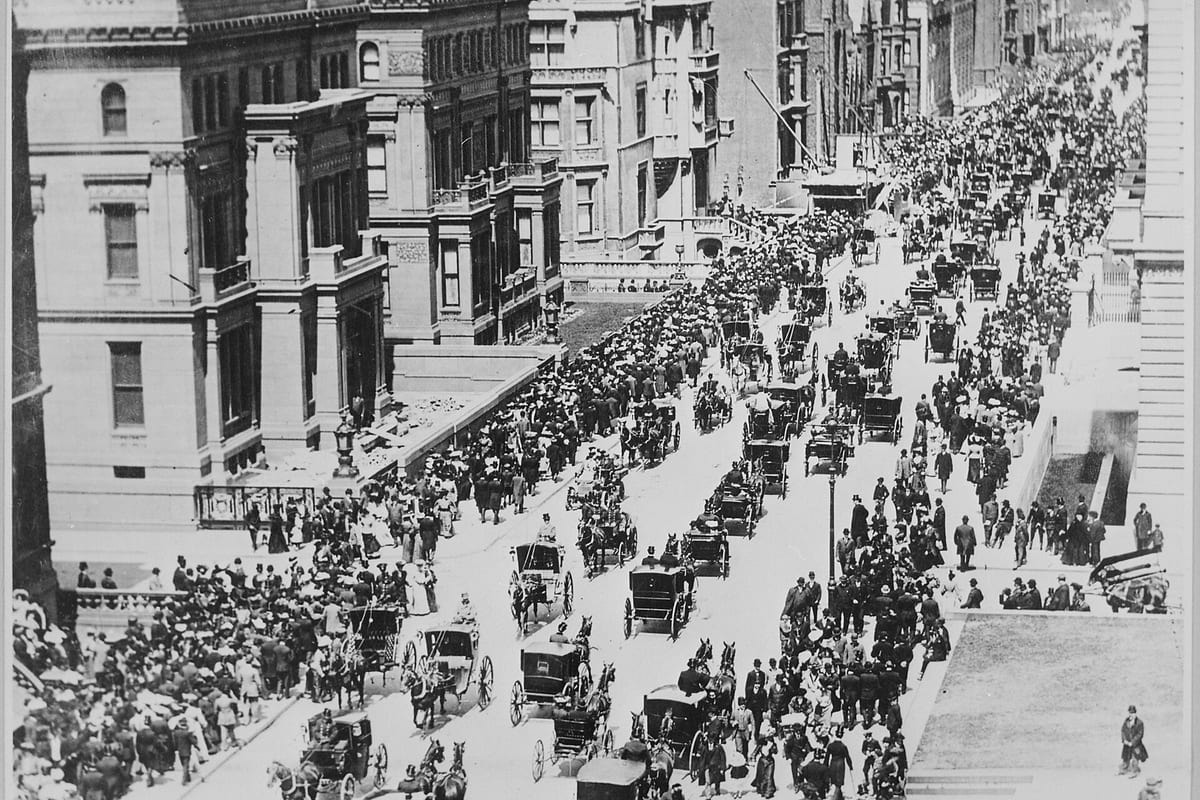
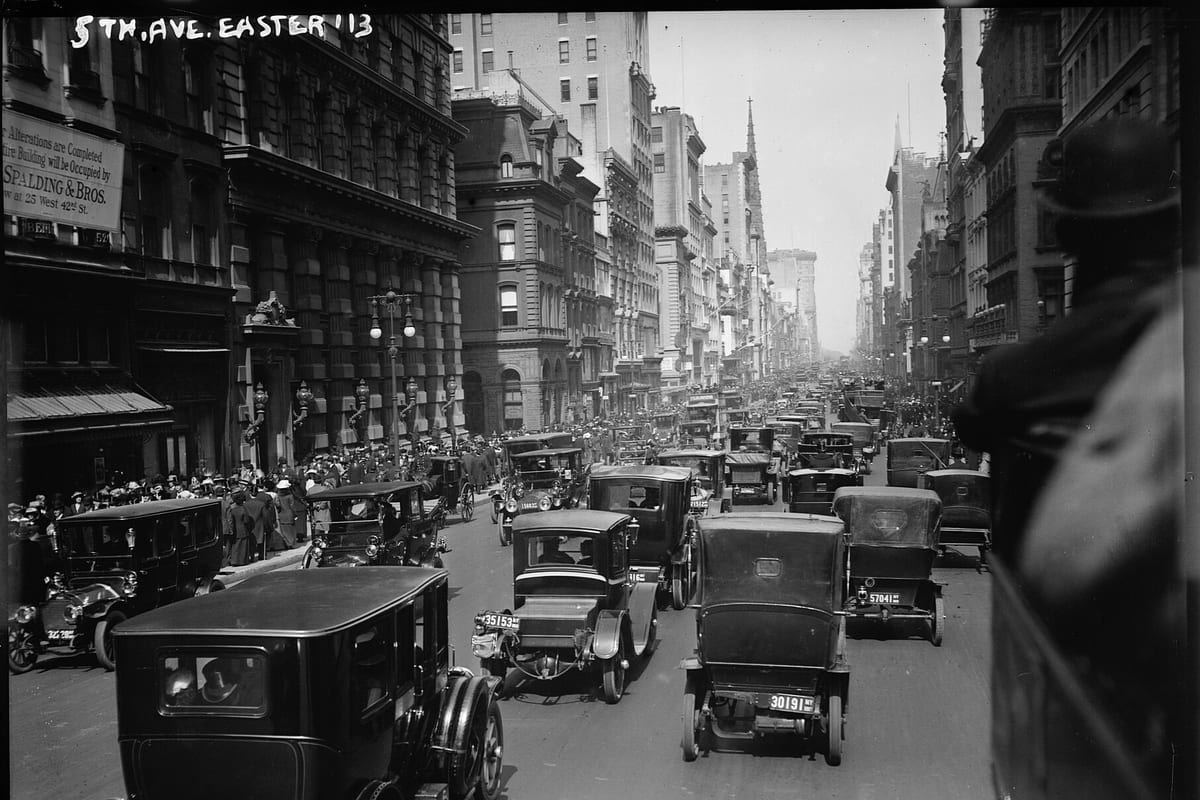
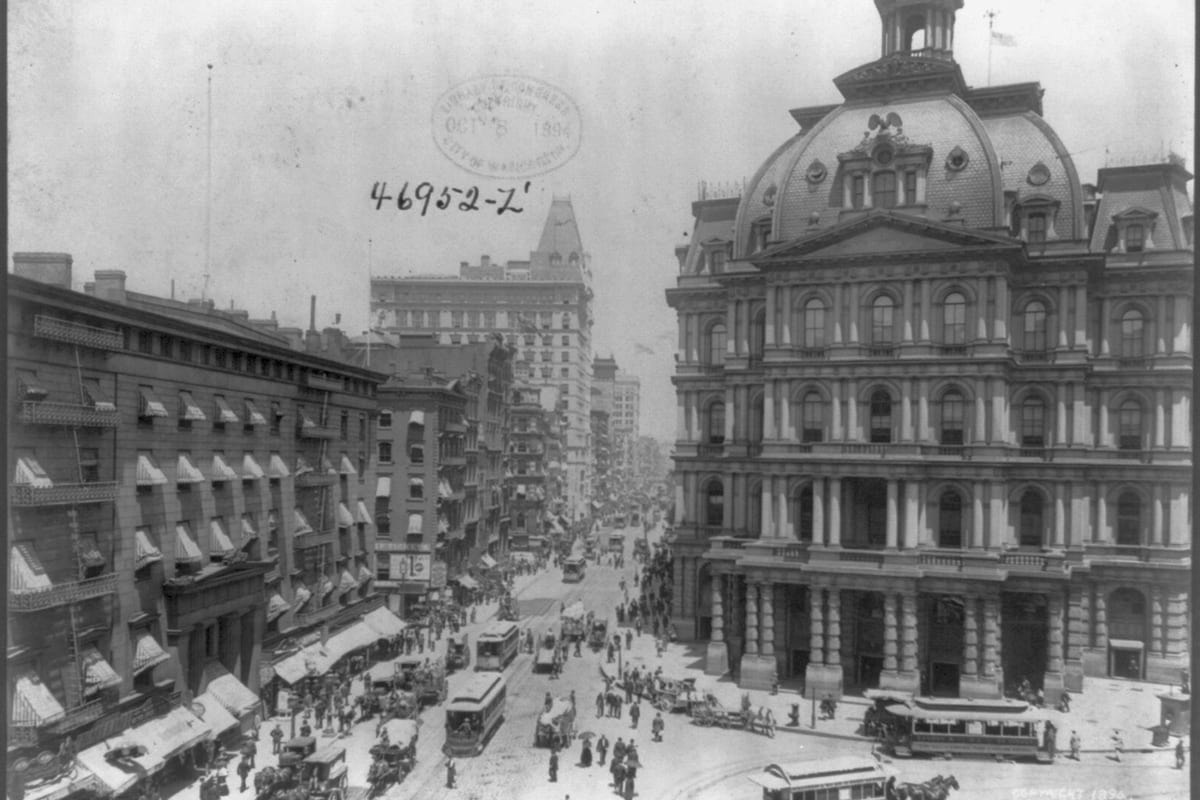
On Easter morning in 1900, a photographer looked down on Fifth Avenue in New York. The picture shows a river of horse-drawn carriages filling the street from one side to the other. The caption in the U.S. National Archives counts the horse-drawn traffic and notes two motor cars. Thirteen years later, at Easter 1913, a photograph from the Bain News Service shows the same avenue. This time the street is full of automobiles, and you have to search the picture for a horse.
Thirteen years is less time than most careers last. In that window a whole economy built around the horse began to break apart: the stables, the blacksmiths, the harness makers, the carriage factories, the hay trade, the street cleaners who shoveled manure. At the same time a new economy appeared that almost nobody in 1900 could describe in detail: car factories, gas stations, auto loans, motels, highways, suburbs, trucking companies and driving schools. Some families who had built carriages for generations ended up building cars. Others went on making buggy whips until there was no one left to buy them.
We are living through the same kind of shift with AI and superintelligence (SI). The question is no longer whether this technology will change the world. It already is. The real question is the one this article tries to answer: will you hold on to the industries of the past, or will you be one of the people who build the industries of the future? To answer it, we look at what actually happened when cars replaced horses, why most people first use a new technology to do old work, what the latest research says about who is getting value from AI in 2026, which new industries AI is already creating, and what all of this means for Egypt, the Arab world and anyone who works in marketing.
How big was the economy built on horses?
It is hard to picture today how much of daily life ran on horses. In 1900 a horse was a truck, a taxi, a tractor, a delivery van and a bus. Cities depended on horse-drawn streetcars and wagons. Farms depended on horses and mules to plough, plant and haul. Every one of those animals had to be bred, fed, shod, harnessed, stabled, doctored and, at the end, carried away.
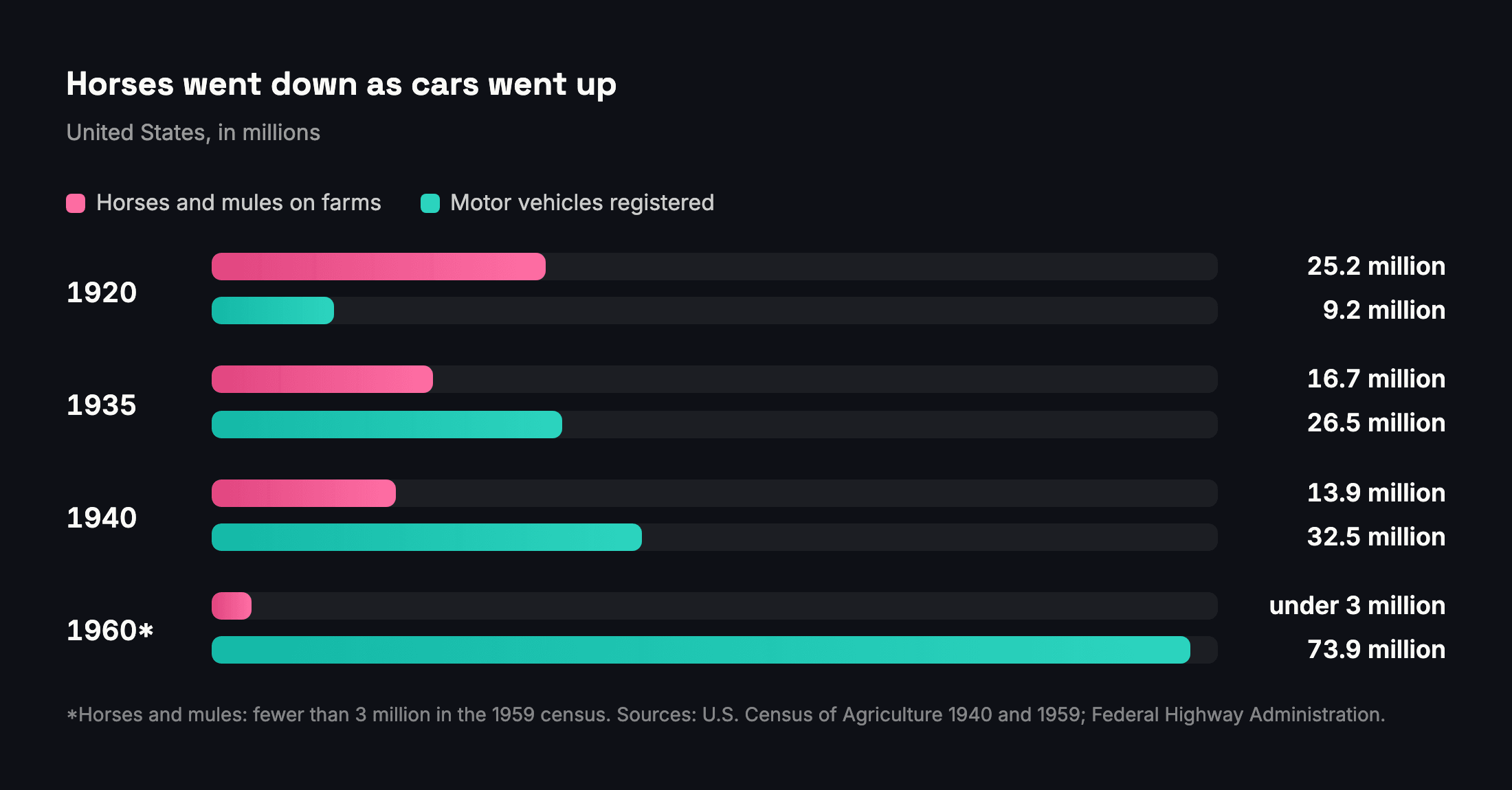
The numbers are enormous. The U.S. Census counted 25,199,552 horses and mules on American farms on 1 January 1920, the peak, according to the 1940 census report on livestock. Feeding them took a large share of the country’s land. The economic historians Alan Olmstead and Paul Rhode calculated that between 1880 and 1920, draft animals on farms consumed the output of roughly 22% of all the cropland harvested in the United States, and animals in cities and mines consumed the output of another 5%. The land used to grow feed for horses and mules peaked around 1915 at about 93 million acres, according to their study of the tractor. In other words, roughly a quarter of the country’s harvest went into the animals that did the work.
Around that animal economy stood a long list of trades and businesses, each of them stable, respected and, for decades, safe:
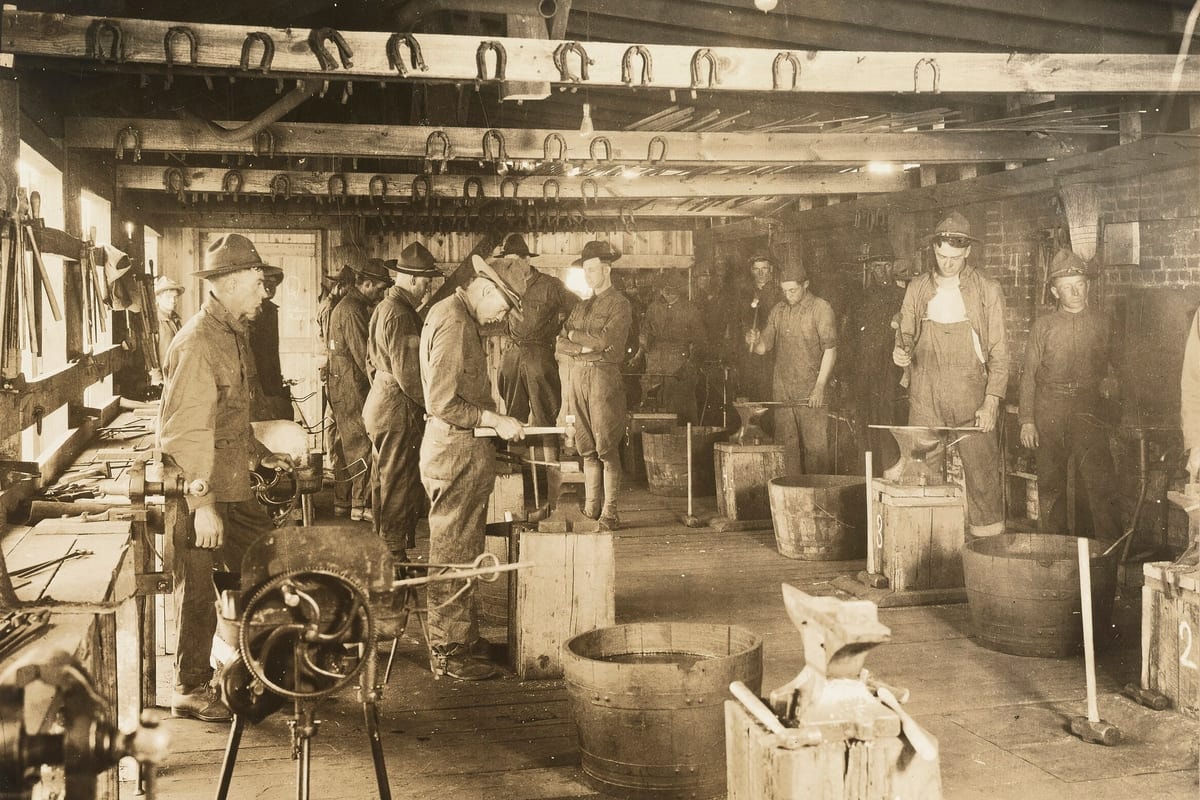
- Blacksmiths and farriers, who shod horses and repaired tools in almost every town.
- Harness and saddle makers, who supplied the straps, collars and bridles.
- Carriage, buggy and wagon builders, from small workshops to factories with thousands of workers.
- Livery stables, which rented, boarded and cared for horses, much like car rental and parking today.
- Hay and feed dealers, and the farmers who grew oats and hay for city horses.
- Horse breeders, dealers and veterinarians.
- Horse-drawn streetcar companies, and the stable hands and drivers who worked for them.
- Whip makers. One town, Westfield in Massachusetts, became known as “Whip City”.
- Street cleaners, who removed the manure that horses left on every city street.
Westfield is a good example of how complete these industries were. The United States Whip Company was formed there in 1892 by combining local whip makers, and at its height in the 1910s it was the world’s largest manufacturer of whips, according to the history of its factory complex. People who worked in that company had every reason to think their industry was permanent. Horses had been part of human life for thousands of years.
What happened to the industries built on horses?
They shrank, quickly and then all at once. The census numbers tell the story. From the peak of more than 25 million in 1920, the number of horses and mules on American farms fell to 13,931,531 in April 1940, a drop of 44.7%. The census noted that the farm land that had supported 11,268,021 work animals had been released for other uses. By 1959 there were fewer than 3 million horses and mules on farms, and the census explained why in one sentence: tractors, motortrucks and electricity now provided most of the power for American farms, as its 1959 summary put it. The land that had fed horses fell from about 93 million acres to only 5 million acres by 1960, according to Olmstead and Rhode.
Cars rose just as fast in the opposite direction. There were 8,000 motor vehicles registered in the United States in 1900, 468,500 in 1910, more than 9.2 million in 1920, 26.7 million in 1930 and almost 74 million in 1960, according to the Federal Highway Administration’s historical table. Sometime between 1920 and 1935 the two lines crossed. After that, the horse economy was living on borrowed time.
For the people inside the old industries, the change did not feel like a revolution at first. It felt like a slow decline, a few fewer customers every year, a few more empty stalls in the stable, until one day the business was no longer viable. The whip makers of Westfield are a good example of the two possible reactions. Some closed. The United States Whip Company did something smarter. In 1928 it changed its name to U.S. Line Company and moved from whips into braiding linen and silk fishing line. It used what it was good at, braiding, for a market that was still growing.
The horse itself did not disappear either. It moved from work to leisure. Today horses are mostly about sport, racing, riding and tourism, an industry that still exists but plays a far smaller part in the economy than it once did. That is a pattern worth remembering: when a technology replaces an old way of working, the old way rarely vanishes completely. It shrinks into a niche, often a premium or nostalgic one, while the mass market moves on.
Which new industries did the car create?
This is the part of the story that people in 1900 found hardest to imagine. The car did not simply replace the horse one for one. It created a whole web of new industries, many of which had nothing to do with transport at first sight.
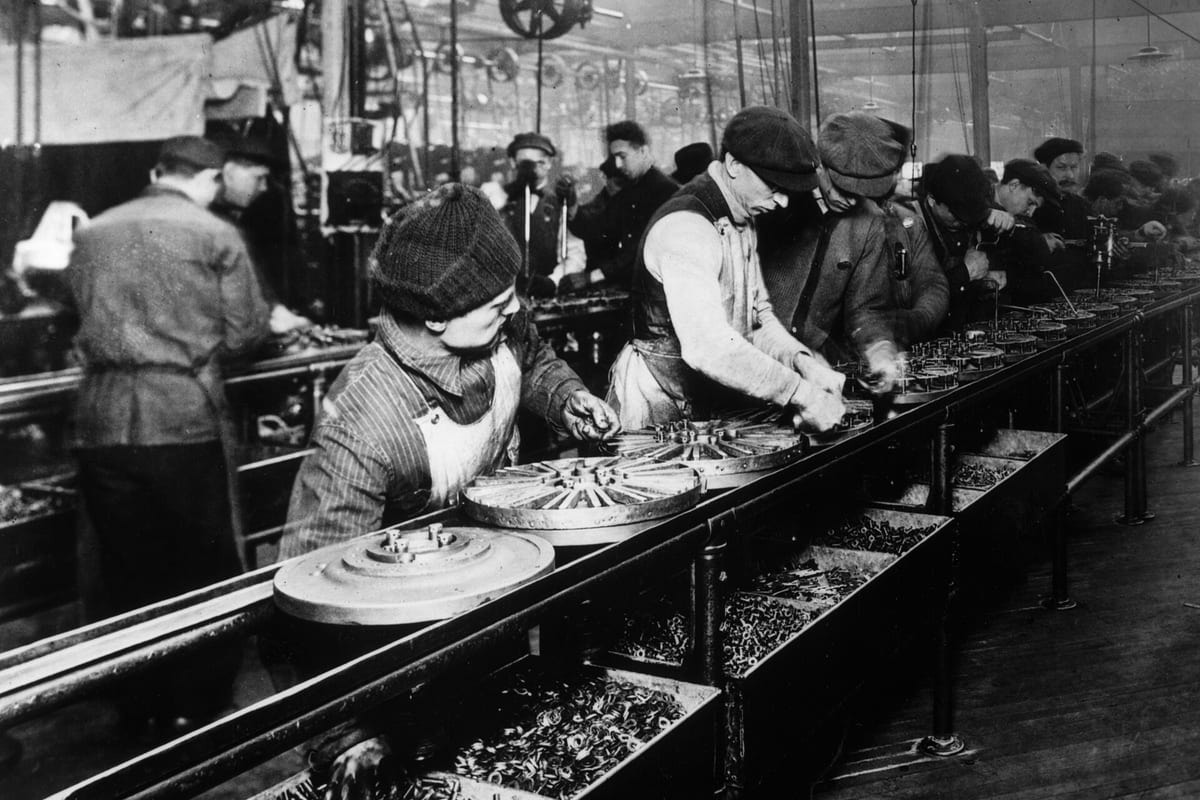
The first was the car industry itself, and it transformed how things are made. In 1913 Henry Ford introduced the moving assembly line. A Model T came off the line every 93 minutes, compared with 12½ hours per car under the old stationary methods, and between 1908 and 1927 Ford produced more than 15 million Model Ts while the price fell from $850 to as little as $260, according to The Henry Ford museum. In January 1914 the company announced it would pay five dollars for an eight-hour day, compared with $2.34 for a nine-hour day before. Mass production, mass wages and mass consumption grew up together.
Then came industries that supplied, fueled, financed and housed the new machines:
- Fuel stations. On 1 December 1913, at the corner of Baum Boulevard and St. Clair Street in Pittsburgh, the Gulf Refining Company opened a drive-in station built to sell gasoline to motorists. It sold 30 gallons at 27 cents a gallon on its first day, offered free air, water and tire service, and sold the first commercial road maps in the United States, according to the American Oil & Gas Historical Society. Within a few decades, filling stations lined roads everywhere.
- Car loans. In 1919 General Motors set up GMAC to help dealers finance their stock. Until then, people who wanted a car or truck had to pay cash or find their own financing from banks that did not usually lend for cars, according to Ally, the company GMAC became.
- Motels. On 12 December 1925 the Milestone Mo-Tel opened in San Luis Obispo, California, charging $1.25 a night. Its architect, Arthur Heinemann, coined the word motel as shorthand for “motor hotel”, according to KSBY News. Road travel created a hospitality industry of its own.
- Roads and highways. Paved roads, bridges, traffic lights and later national highway systems became a vast public works effort, and an industry of contractors, engineers and materials suppliers.
- Everything else around the car. Repair shops and mechanics, dealerships, tires and spare parts, insurance, driving schools, traffic police, parking, trucking and logistics, roadside restaurants, suburbs and shopping centers built around parking lots.
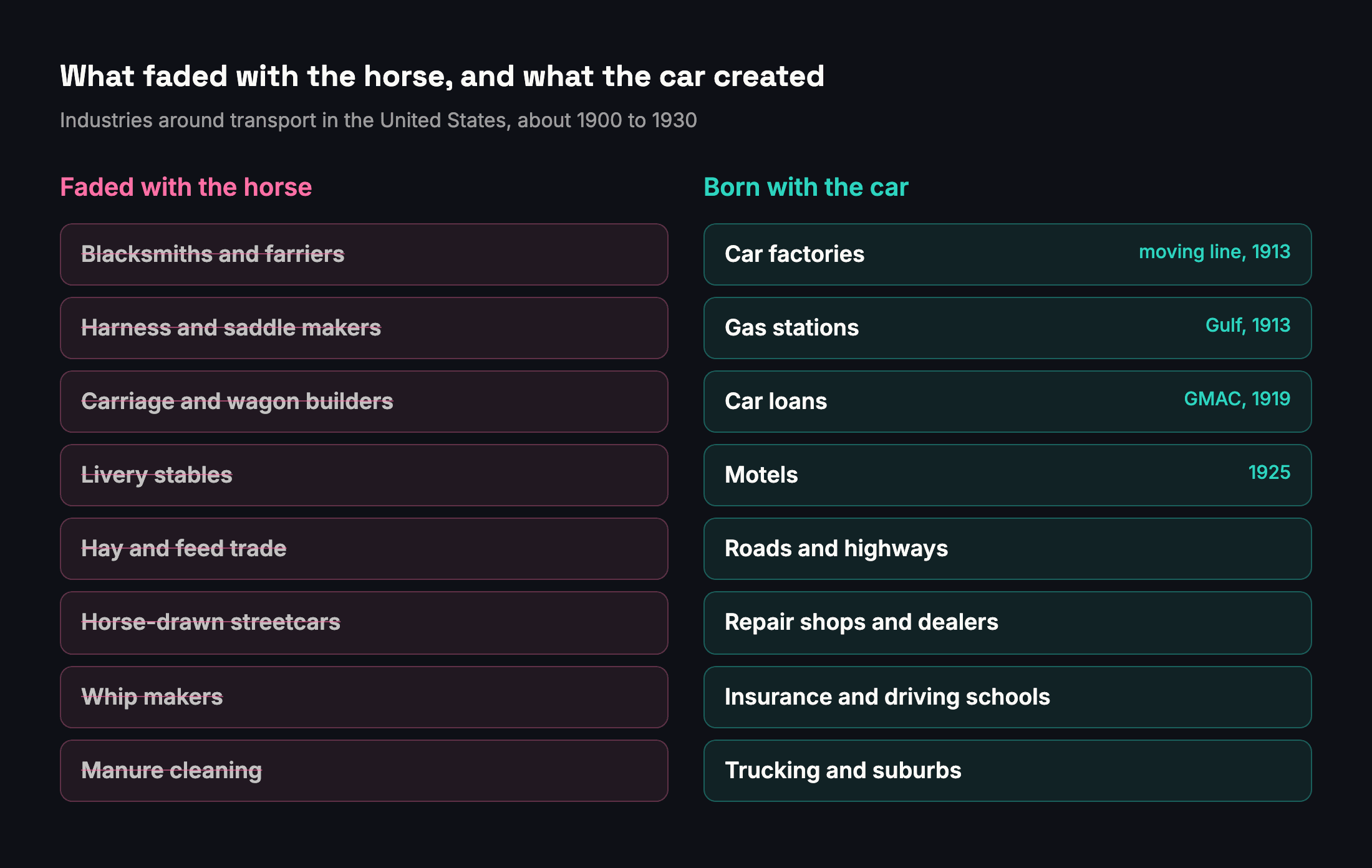
Look at that list again and ask who, in 1900, could have predicted it. A blacksmith might have guessed that cars would need repair. Very few people would have guessed that cars would change where families live, how money is lent, how food is sold and how holidays are spent. That is the most important lesson from the horse-to-car shift: the biggest opportunities were not in doing the old job with the new machine. They were in the new needs the machine created.
Who saw the change early, and who missed it?
The most striking stories from this period are about people who came from the old industry and still saw the new one before others did.
William Durant was a carriage maker. In 1886 he bought a road cart company and, with his partner Dallas Dort, built it into the Durant-Dort Carriage Company in Flint, Michigan. The two partners became millionaires within ten years. Durant then took charge of the Buick Motor Company and made it a success, and in 1908 he negotiated the deals that formed General Motors, according to the Genesee County Historical Society. The carriage company itself officially ended carriage production in 1917. A carriage maker did not save the carriage. He built the company that replaced it.
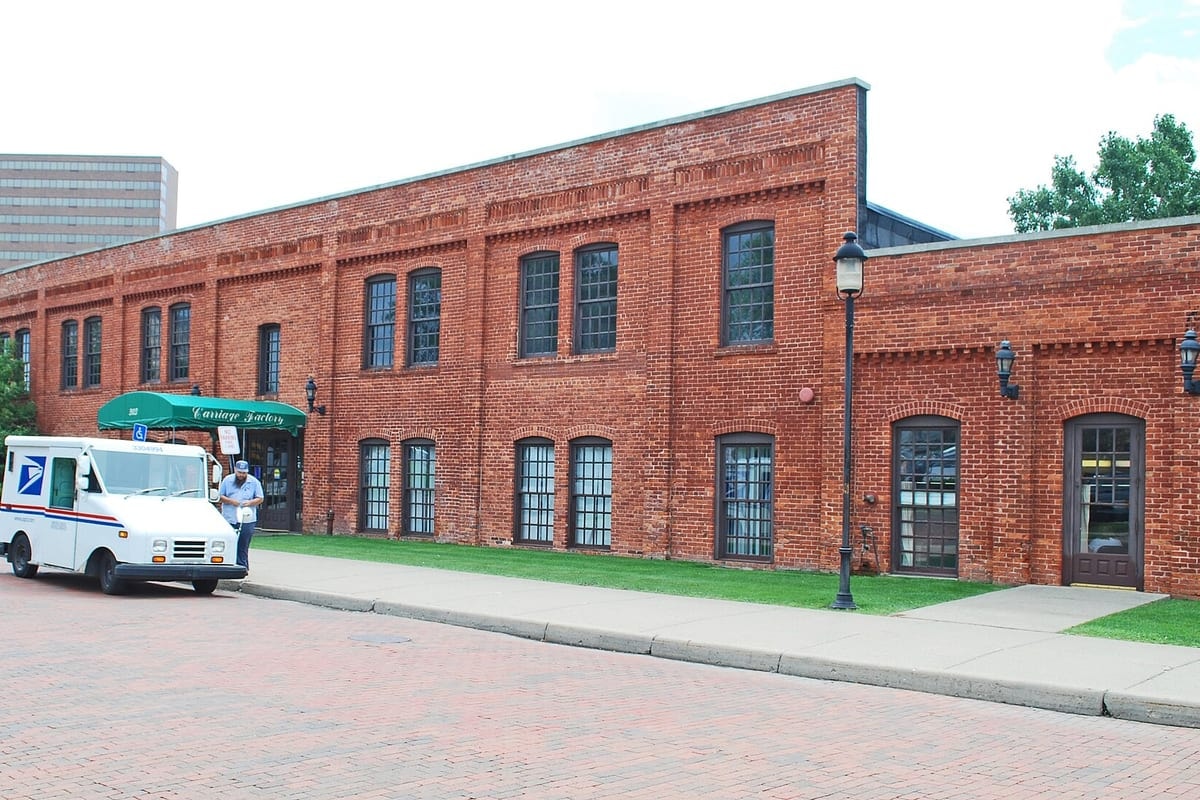
The Fisher brothers grew up around a horse-drawn carriage shop in Norwalk, Ohio. Fred and Charles Fisher moved to Detroit and, on 22 July 1908, founded the Fisher Body Company. Their skill was building bodies, the part of the carriage that people sat in, and they applied it to cars. By 1914 they were the world’s largest manufacturer of car bodies, and in 1919 General Motors bought 60% of the company, according to its history. For decades GM cars carried a “Body by Fisher” plate.
Studebaker began in 1852 in South Bend, Indiana, as a maker of wagons, buggies and carriages. It started building electric cars in 1902 and gasoline cars in 1904 in partnership with other firms, and it sold its first gasoline cars built entirely by Studebaker in 1912, according to the company’s history. It was a wagon maker that experimented early, made mistakes, changed course and survived the transition.
Now compare the people who tried to stop the change. In Britain, the Locomotive Act of 1865, nicknamed the Red Flag Act, limited self-propelled road vehicles to 4 miles per hour in the country and 2 miles per hour in towns, and required a person to walk 60 yards ahead carrying a red flag, according to the history of the Locomotive Acts. The flag was dropped in 1878, but the walker remained until the Locomotives on Highways Act of 1896 freed light vehicles from the old rules. Motorists celebrated with the Emancipation Run from London to Brighton, where Lord Winchelsea tore a red flag in two, according to the history of the run. For three decades the law protected the old world from the new one. It did not save the old world. It only made Britain slower.
The marketing professor Theodore Levitt turned this into one of the best-known ideas in business. In “Marketing Myopia”, first published in 1960, he argued that industries decline when they define themselves by their product instead of by the need they serve. A carriage maker who thought he was in the carriage business was finished. A carriage maker who thought he was in the business of moving people comfortably could build car bodies. The same question applies to every business today. Are you in the business of making designs, or the business of helping your clients sell more?
Why do people use new technology to do old work first?
The first cars were called horseless carriages, and that name tells you how people thought about them: as carriages, just without the horse. Early cars even looked like carriages. People understand a new technology through the old one it seems to replace, so they use it to do the old job a little better.
There is a famous line, usually attributed to Henry Ford, that if he had asked people what they wanted, they would have said faster horses. It is almost certainly not his. Quote Investigator found no evidence that Ford ever said it. The earliest version it found dates from 1999 and the first attribution to Ford from 2001, more than fifty years after his death. The line survives because it describes something true: people ask for improvements to what they already know.
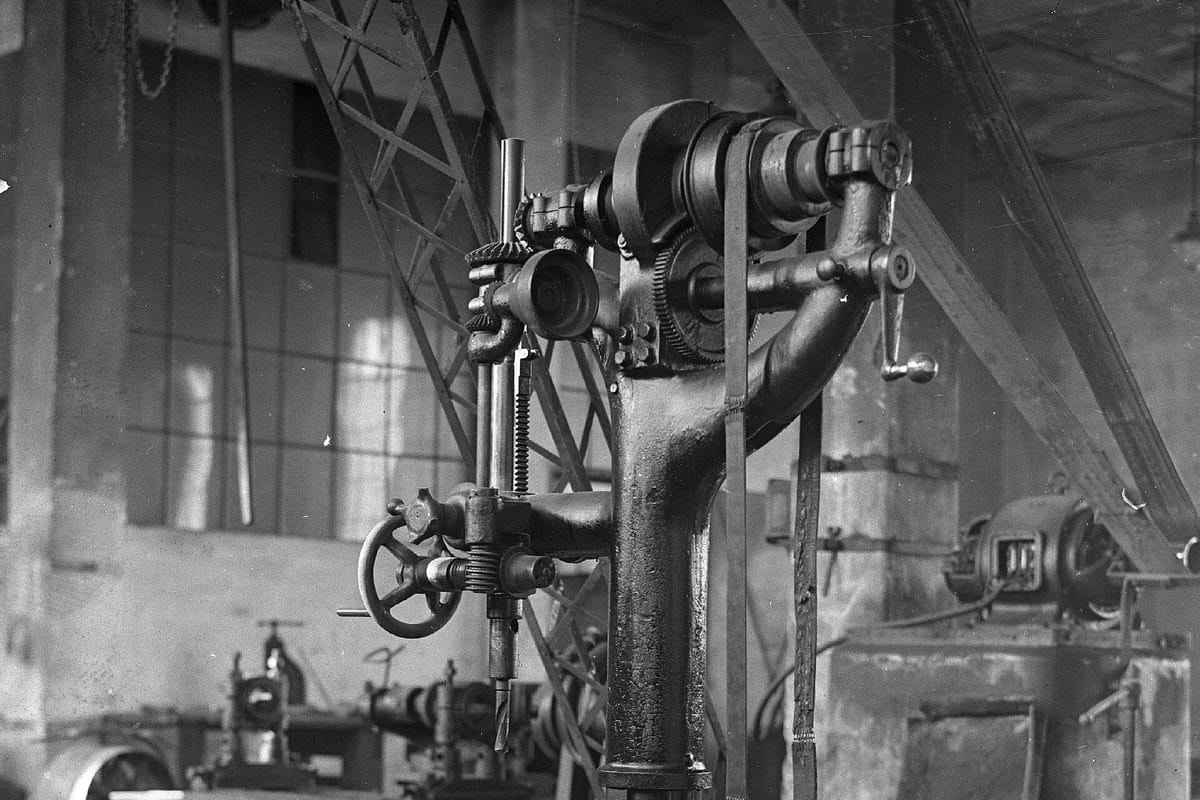
The best evidence for this comes from electricity, and it is the closest historical parallel to AI that economists have. In the 1880s and 1890s, factories were powered by a single steam engine or water wheel. Its power was carried around the building by long iron shafts along the ceiling, with leather belts dropping down to each machine. When electric motors arrived, many factories simply replaced the steam engine with one large electric motor and kept everything else the same: the same shafts, the same belts, the same building layout. They used the new technology to do the old work.
The results were disappointing for decades. Before 1899, more than 95% of the mechanical power in American manufacturing came from water and steam. It took until about 1919 for electricity to supply half of it, and by 1929 more than 75% was electric, according to a study by the economists Andrew Atkeson and Patrick Kehoe for the National Bureau of Economic Research. The big gains came only when factories were redesigned around electricity: a separate motor on each machine, and buildings laid out around the flow of work instead of around a central shaft. As the study explains, drawing on the historians Warren Devine and Paul David, the adoption of electricity required a complete redesign of the manufacturing plant.
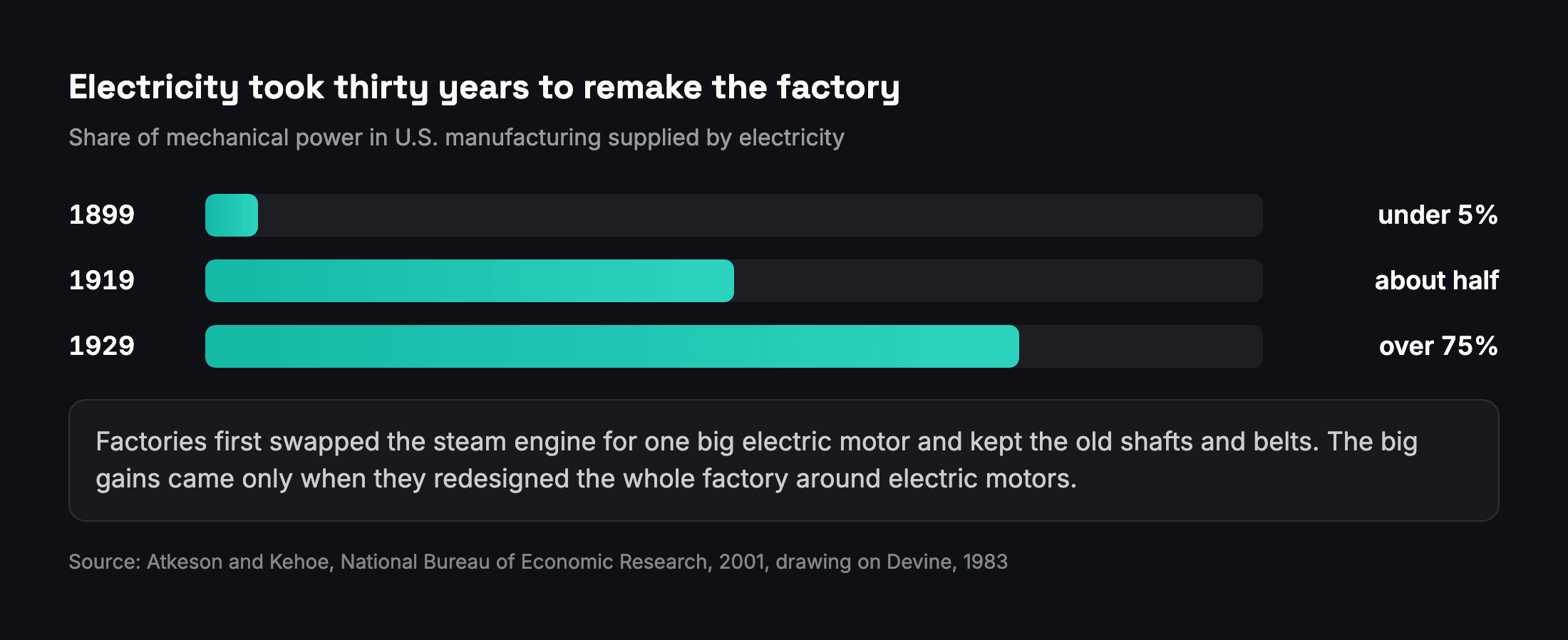
The economist Paul David made the comparison famous in a 1990 paper in the American Economic Review, “The Dynamo and the Computer”, which argued that computers would follow the same path: slow, disappointing gains while companies bolted the new technology onto old ways of working, then a surge once they rebuilt around it. That is exactly the situation many businesses are in with AI today. They have connected an electric motor to the old line shaft.
Is AI and superintelligence the same kind of shift?
Most economists describe AI as a general-purpose technology, like steam, electricity or the internet: a technology that does not belong to one industry but changes almost all of them. What makes the current moment different is the speed and the ambition. The companies building AI are no longer talking only about better tools. They are talking about superintelligence, AI that would be smarter than the best humans at almost everything.
The language has now reached governments. On 29 September 2026, President Donald Trump signed an executive order called “Inaugurating the Era of Super Intelligence”, which directs federal agencies to refer to artificial intelligence as “super intelligence”, or SI, in official communications, Nextgov reported. Five days later the president announced a “Super Intelligence Force”, a task force with 120 days to report on the risks and opportunities, TechCrunch reported. The order changed the name, not the technology: today’s AI is not superintelligent. But the leaders of the field believe it is coming, and they describe it in terms of things that were impossible before.
Sam Altman, the chief executive of OpenAI, wrote in his essay “The Gentle Singularity” that “we are past the event horizon; the takeoff has started”. He predicted that 2026 “will likely see the arrival of systems that can figure out novel insights” and that 2027 “may see the arrival of robots that can do tasks in the real world”. He also warned that there will be very hard parts, “like whole classes of jobs going away”, while arguing that we will figure out new things to do and new things to want, as people did after the industrial revolution.
Dario Amodei, the chief executive of Anthropic, described the goal in his essay “Machines of Loving Grace” as a “country of geniuses in a datacenter”. He argued that AI could help biologists and doctors compress the progress they would have made over the next 50 to 100 years into 5 to 10 years. Whether or not those timelines come true, notice what both of them are describing. Not faster horses. New things.
The scale of use is already huge. ChatGPT alone reached 900 million weekly active users in February 2026, TechCrunch reported. The question is what people are using it for. If you want the full background on how these companies and their founders got here, our articles on Dario Amodei and Anthropic and how technology changed from 1990 to 2026 tell that story.
Are most people still using AI as a faster horse?
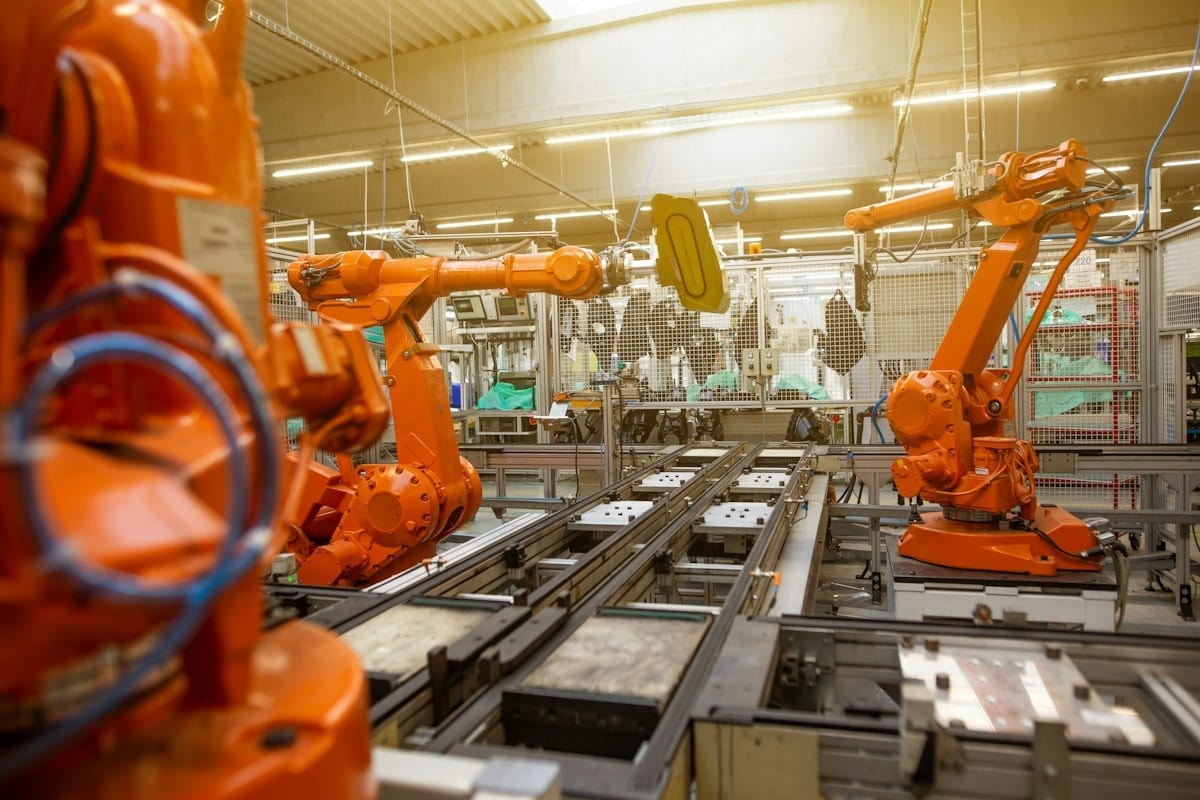
Most people use AI the way factories first used electricity: to do the old work a bit faster. They generate a nicer design, a quicker video, a professional-looking post or a cleaner email. There is nothing wrong with that. It saves time. But the evidence from 2026 shows that it rarely changes a business.
The clearest data comes from McKinsey’s survey “The state of AI in 2026: On the road to ROI”, published on 25 August 2026 and based on 1,719 respondents in 97 countries. Nearly nine in ten respondents say their organizations use AI regularly in at least one business function, and 80% say AI has improved their individual productivity. Yet only 37% attribute any impact on operating profit (EBIT) to AI, about the same as a year earlier, and the share of AI high performers, companies that attribute at least 5% of their EBIT to AI, has stayed flat at about 6%.
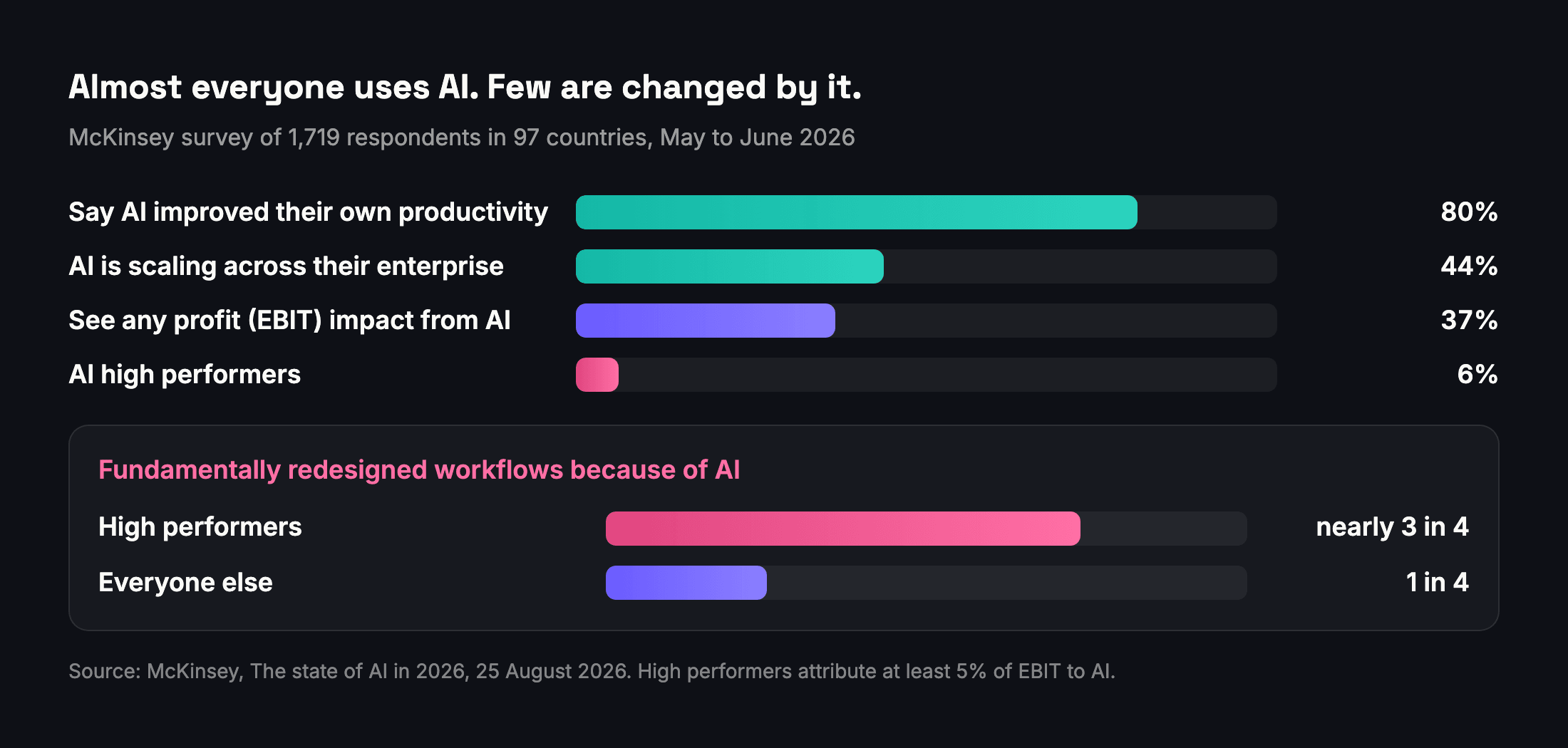
What separates the 6%? McKinsey’s answer is the same lesson as electricity. About 80% of both high performers and everyone else pursue efficiency with AI. But most high performers also use AI to pursue growth or innovation, they are 3.3 times as likely to intend to use AI to fundamentally transform their business within three years, and nearly three-quarters of them report fundamentally redesigning workflows because of AI, compared with just one-quarter of other respondents. In McKinsey’s words, high performers redesign workflows enabled by AI “rather than insert AI into existing ones”.
The Boston Consulting Group found the same pattern in its Applied AI Index 2026, published on 30 September 2026 and based on more than 1,300 senior executives. Only 7.5% of companies qualify as “future-built” for AI, while 41% are scaling, 47% are still emerging and 4.5% are stagnating. The future-built companies show 2.4 times the top-line growth of companies in the bottom half of the sample. Corporate AI spending has risen to 3.3% of revenue, and BCG recommends that most of the effort, 70%, go into changes to people, organization and processes rather than technology. In other words: the technology is the easy part. Redesigning the work is the hard part, and it is where the value is.
This is the core of our argument. Using AI to make the same design, the same video or the same report faster is the horseless-carriage stage. It is useful, but it is temporary, because everyone else can do it too, and the price of that work will fall toward zero. The power of AI is not that it lets you do the same thing faster and cheaper. It is that it lets you do things you could not do at all before.
What can AI do that was impossible before?
The clearest examples come from science, where AI is already producing results that no amount of extra human effort could have produced in the same time.
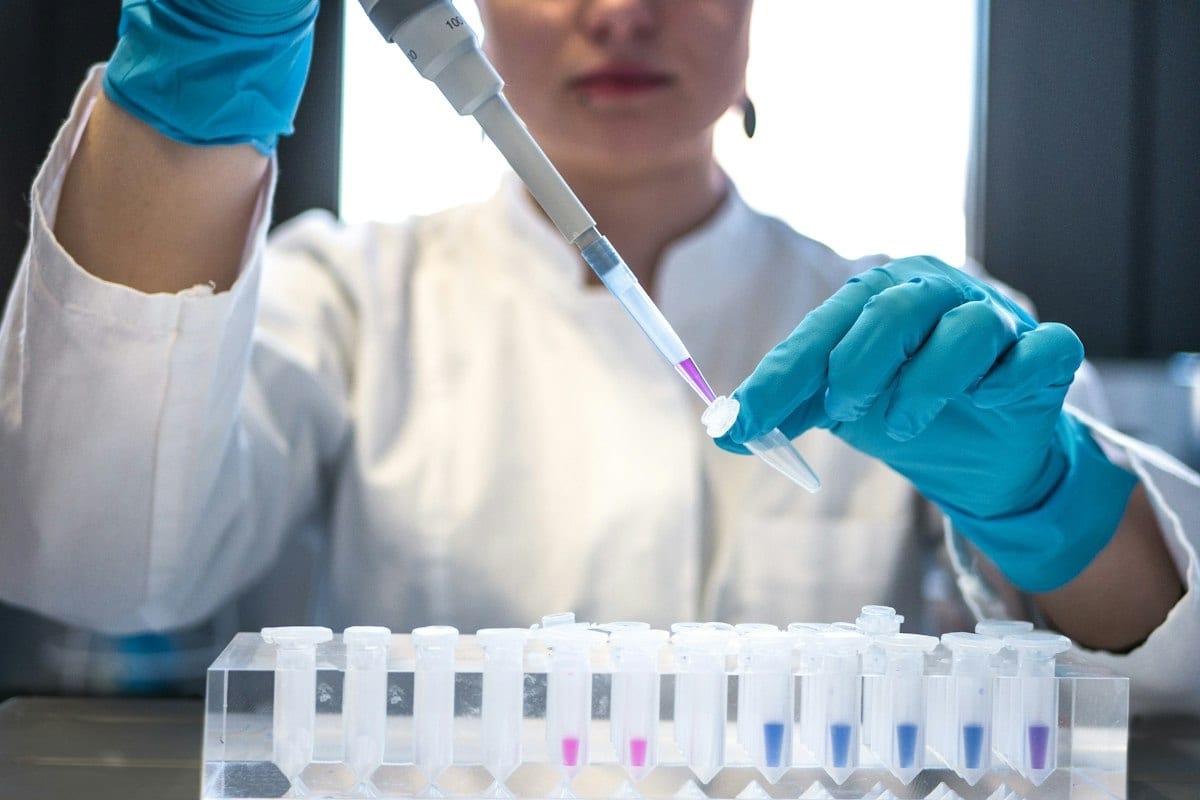
Protein structures. Determining the shape of a single protein in the lab can take several years and hundreds of thousands of dollars. DeepMind’s AlphaFold has predicted more than 200 million protein structures, nearly all the proteins known to science, and its database has more than three million users in over 190 countries, according to DeepMind. Its creators, Demis Hassabis and John Jumper, shared the 2024 Nobel Prize in Chemistry for the work. This is not a faster version of an old job. It is a map of biology that did not exist before.
New medicines. Insilico Medicine used generative AI to find a target for idiopathic pulmonary fibrosis, a lung disease, and to design a molecule against it. The target, a protein called TNIK, had never previously been linked to fibrosis, according to one of the trial’s lead investigators. On 9 September 2026 the company announced that the first patient had been dosed in a Phase III trial of the drug, rentosertib, planned for 320 participants at 47 centers in China, according to its announcement. Whether it succeeds or not, a new way of discovering drugs is being tested in front of our eyes.
New materials. In 2023 DeepMind’s GNoME system identified 2.2 million new crystal structures, which DeepMind described as equivalent to nearly 800 years’ worth of knowledge. Of these, 380,000 are the most stable and promising for synthesis, and outside researchers had already made 736 of them in labs, according to DeepMind. New materials mean new batteries, chips and solar cells.
Weather. On 25 February 2025 the European Centre for Medium-Range Weather Forecasts put its AI forecasting system, AIFS, into operation alongside its traditional physics-based model. The AI system outperforms physics-based models on many measures, with gains of up to 20% for tropical cyclone tracks, and uses about 1,000 times less energy to produce a forecast, according to ECMWF. Cheaper, better forecasts can reach farmers, shipping companies and poorer countries that could never afford supercomputers.
The same thing is happening outside the lab, in industries you can see from the street.
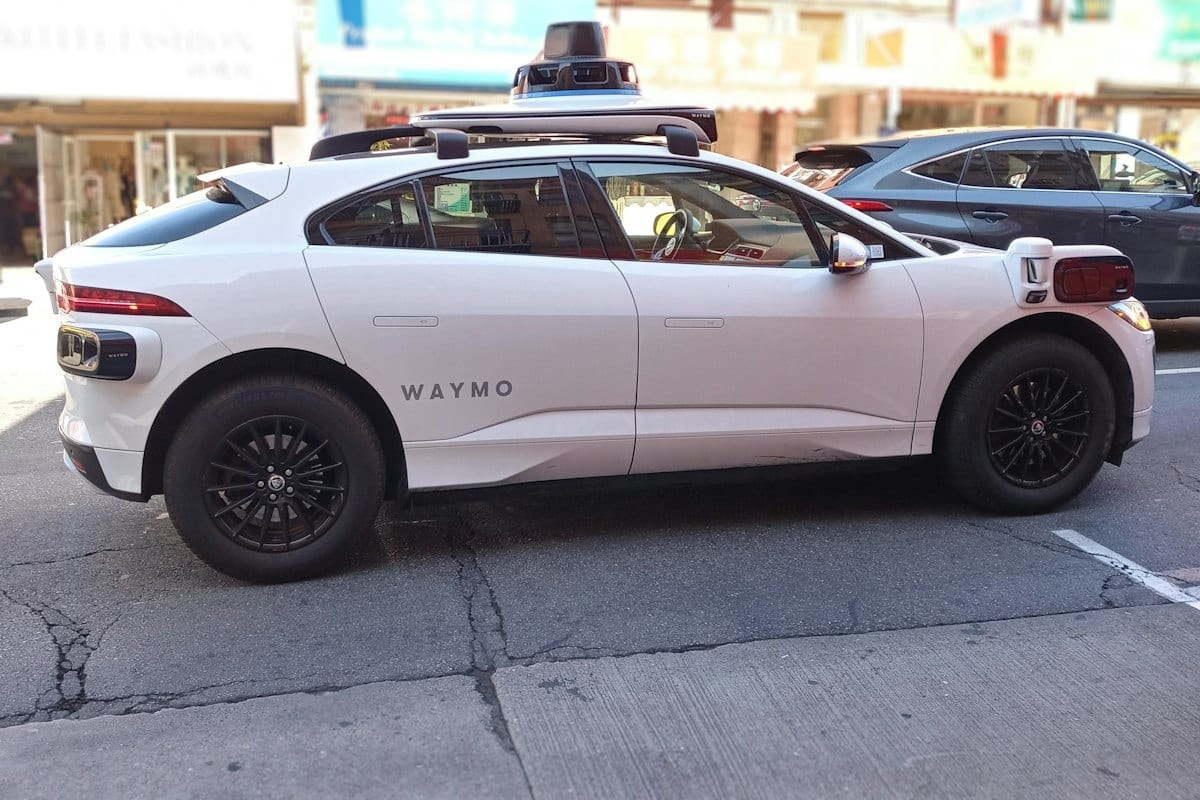
Cars without drivers. The car replaced the horse, and now AI is replacing the driver. Waymo now provides 500,000 paid robotaxi rides every week across 10 U.S. cities, up from 50,000 a week in May 2024, TechCrunch reported in March 2026. In May 2025 Aurora Innovation began commercial driverless trucking between Dallas and Houston, according to the company. The industry the car created a century ago is being rebuilt from the inside.
Software for everyone. For fifty years, building software required programmers. Now people describe what they want in plain language and AI writes the code. Collins Dictionary chose “vibe coding” as its Word of the Year for 2025, describing it as the use of artificial intelligence prompted by natural language to write computer code, according to its announcement. A shop owner, a teacher or a doctor can now build a tool for their own problem. That was impossible for most people even three years ago.
Machines that buy for you. In September 2025 Stripe and OpenAI launched a way for people to buy products directly inside ChatGPT, according to Stripe, and Google announced a protocol for payments made by AI agents, according to Google Cloud. If AI assistants start shopping on behalf of people, the whole chain of online selling, from product pages to ads to payments, has to be redesigned for a customer who is a machine.
None of these are faster horses. Each one is a new capability, and new capabilities are where new industries come from.
Which new industries is AI already creating?
When the car arrived, the new industries appeared around it: fuel, roads, finance, hospitality, repair. The same thing is happening around AI. Some of these industries are already large, and some are only beginning. The table below is our reading of the evidence in this article; it is not a forecast of which companies will win.
| New industry | Why it exists | The car-era parallel |
|---|---|---|
| Data centers and AI chips | AI needs huge amounts of computing power | Car factories and steel mills |
| Power for AI | Data centers need electricity on a national scale | Oil refining and gas stations |
| AI-discovered medicines and materials | AI finds targets and molecules humans missed | The chemical industry built on oil |
| Self-driving transport and robots | AI can drive, sort, lift and assemble | Trucking and logistics |
| AI agents for businesses | Software that answers, sells and organizes work by itself | Dealerships and service networks |
| Payments and commerce for AI agents | Customers who are machines need new ways to pay | Car loans and consumer credit |
| Testing, safety and insurance for AI | Every powerful machine creates new risks | Car insurance, traffic rules and inspections |
| Data and training for AI | Models need examples, checking and human feedback | Spare parts and maintenance |
| AI-built software for small businesses | Anyone can build tools by describing them | The used-car and repair-shop economy |
The first two rows are already among the largest building projects on earth. The International Energy Agency projects that electricity demand from data centers worldwide will more than double by 2030 to around 945 terawatt-hours, slightly more than the entire electricity consumption of Japan today, and that demand from AI-optimized data centers will more than quadruple, according to the IEA. That means new power plants, new transmission lines, new cooling technology and new jobs for electricians and engineers, exactly as cars created demand for oil, steel and roads.
The jobs are changing too. The World Economic Forum’s Future of Jobs Report 2025, based on a survey of more than 1,000 large employers, expects 170 million new jobs to be created and 92 million to be displaced between 2025 and 2030, a net gain of 78 million, according to the report. Many of the fastest-growing roles in that report did not exist as job titles a generation ago. If you want to know which existing jobs are most at risk, we covered that in detail in Which Jobs Will AI Replace?.
What does superintelligence change in this story?
There is an uncomfortable side to the horse story that we should face honestly. The horses did not find new jobs. In 1983 the economist Wassily Leontief, a Nobel Prize winner, warned that the role of humans as the most important factor of production could shrink the same way the role of horses in farming shrank and then disappeared once tractors arrived, at a 1983 symposium published by the National Academies. The number of farm horses and mules in the United States fell from more than 25 million to fewer than 3 million. For the horses, the car era was not an opportunity.
So which are we: the horses or the drivers? The difference between people and horses is that people can own the new machines, direct them, decide what to build with them and decide what they want. A horse could not become a mechanic or start a gas station. A carriage maker could, and some did. That is the hopeful reading of history, and so far it has held: every previous wave of automation created more new work than it destroyed, even though the transition was painful for the people caught in it.
Superintelligence raises the stakes. If AI eventually does most cognitive work better than people, the advantage will not go to the person who can do a task, because machines will do the task. It will go to the people who decide which problems are worth solving, who own the data, the customer relationships and the trust, and who build the systems that combine machines and people. Altman himself expects “whole classes of jobs going away”. Amodei has warned that AI could eliminate half of all entry-level white-collar jobs within one to five years, according to Fortune. Polls show that people are worried, as we described in Are People Afraid of AI and Superintelligence?. The honest conclusion is that nobody knows exactly how this ends.
What history does tell us is when the window is open. The best time to move from carriages to car bodies was before 1910, not after 1925. The best time to redesign a factory around electric motors was before your competitors did it. With AI, the window is now, while most businesses are still at the faster-horse stage and the new industries are still forming.
Our view: stop using tomorrow’s technology for yesterday’s work
This section is our opinion, based on the evidence above and on what we see every day working with marketers and agencies in Egypt and the Gulf.
The opportunity is not to use the technology of the future to do the work of the past. It is to discover the work of the future that this technology will create. Here is what that means in practice:
- Ask what was impossible, not what can be faster. “How can AI make my designs faster?” is a horse question. “What can I now offer that no one could offer before?” is a car question.
- Define your business by the need, not the product. A carriage maker who sold “comfortable travel” built car bodies. A designer who sells “more sales for the client” can build a system that tests a thousand ad ideas a week.
- Build systems, not outputs. One beautiful design is an output. A system that learns which designs sell, for which customers, and produces the next version automatically is an asset.
- Redesign the workflow, not just the task. The factories that won with electricity rebuilt the whole factory. Do not add AI to one step of an old process. Rethink the process.
- Own something the machine cannot copy. Data about your customers, relationships, a local language, a reputation, a niche you understand better than anyone. When intelligence becomes cheap, these become valuable.
- Move early, but test small. Studebaker built electric cars before gasoline ones and changed course. Early movers make mistakes. They also learn first.
- Keep humans where judgment and trust matter. The more decisions machines make, the more valuable it becomes to be the person people trust to check them.
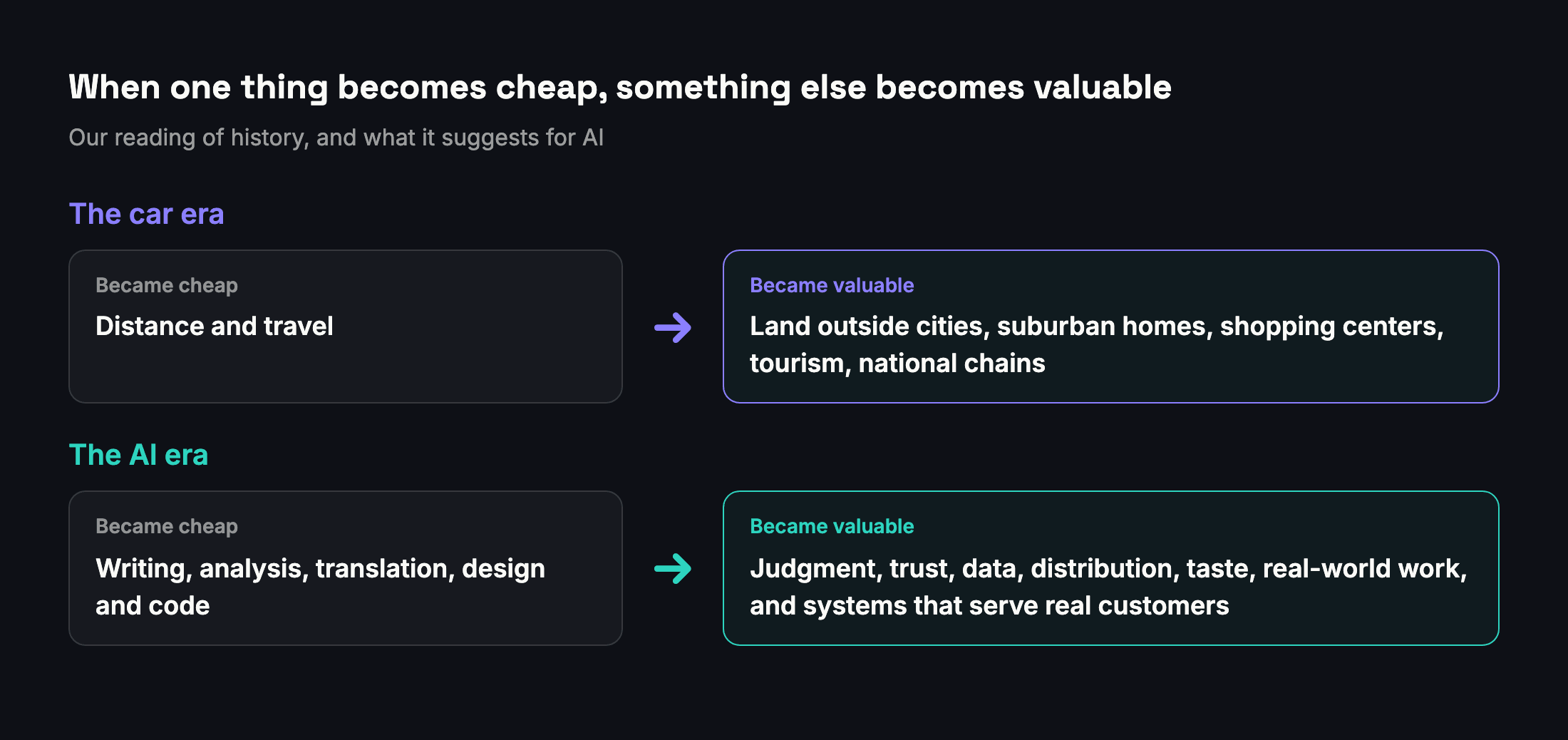
There is a simple way to apply this. Every technology makes something cheap, and when one thing becomes cheap, something else becomes valuable. Cars made distance cheap, so land outside cities, suburban homes, shopping centers, tourism and national retail chains became valuable. AI is making intelligence cheap: writing, analysis, translation, design and code. So the valuable things become judgment, trust, distribution, data, taste, physical-world work and the ability to turn all of that into a system that serves real customers.
What does this mean for Egypt and the Arab world?
The Arab world is not watching this shift from the outside. Governments in the region have made AI a national priority. Egypt’s second national AI strategy, for 2025 to 2030, aims for AI to contribute 7.7% of GDP by 2030, to train 30,000 specialists, to support 250 new startups, to have at least 36% of the population using AI-powered tools in daily life and to build an Arabic-language foundation model, according to the OECD’s summary of the strategy.

In Saudi Arabia, the Public Investment Fund launched HUMAIN in 2025, a company chaired by the Crown Prince to work across the AI value chain, from data centers to one of the world’s most powerful multimodal Arabic language models, according to the PIF. In the United Arab Emirates, G42, OpenAI, Oracle, NVIDIA, Cisco and SoftBank announced Stargate UAE, a 1-gigawatt computing cluster inside a 5-gigawatt AI campus in Abu Dhabi, with the first 200 megawatts expected to go live in 2026, Gulf News reported.
The biggest opportunity for the region may be the simplest one: language. Arabic is used daily by more than 400 million people, according to UNESCO, yet only about 0.6% of websites whose content language is known are in Arabic, according to W3Techs. AI systems learn from what is written. A region that is underrepresented online is underrepresented in AI, and that gap is a business opportunity for people who build Arabic AI products, Arabic voice agents, Arabic educational tools and Arabic content that answer engines can trust.
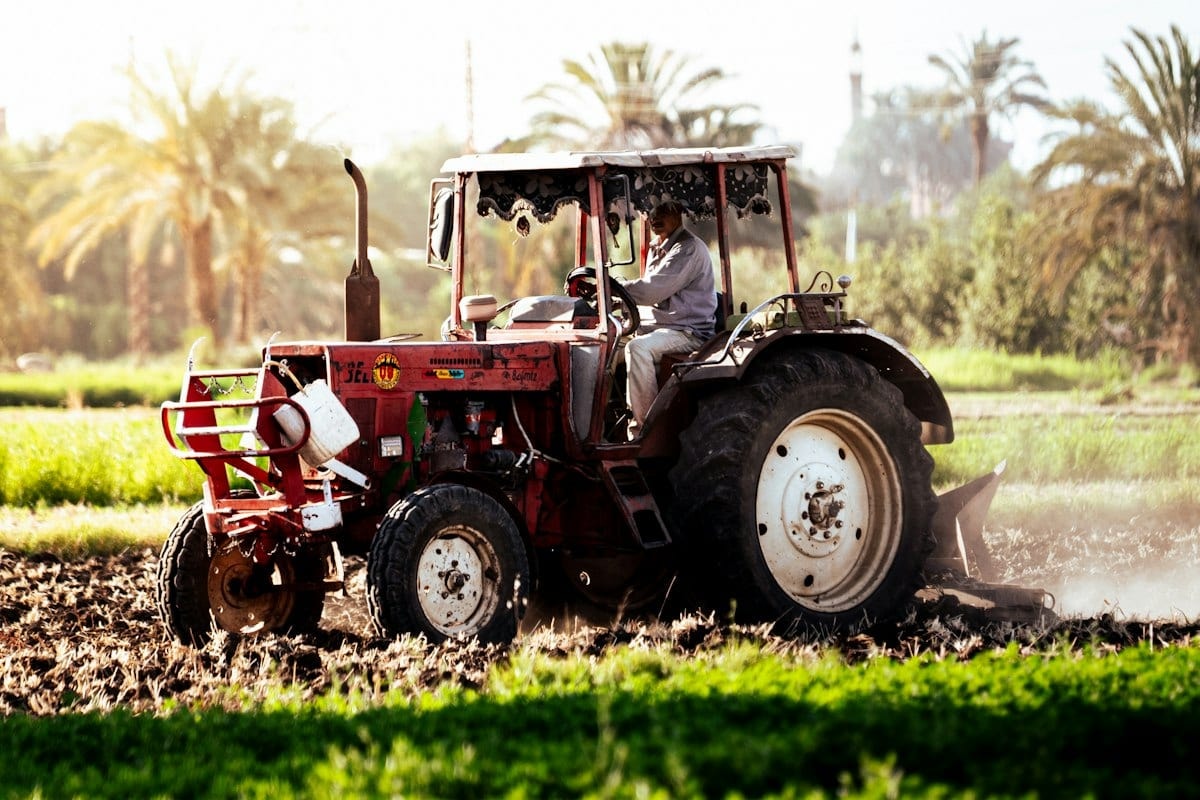
In our view, the danger for Egypt is to treat AI only as a cheaper way to produce the services the country already sells: cheaper content, cheaper call centers, cheaper design. That is a race to the bottom, because AI will make those services cheap everywhere. The opportunity is to build what did not exist: AI tools for Egyptian farmers that read soil, water and weather data; Arabic tutors that can teach millions of students individually; agents that let small Egyptian sellers serve customers in the Gulf and Europe in their own languages; health tools that bring specialist knowledge to villages; and services that Gulf and international companies cannot easily build without Arabic-speaking teams who understand the market.
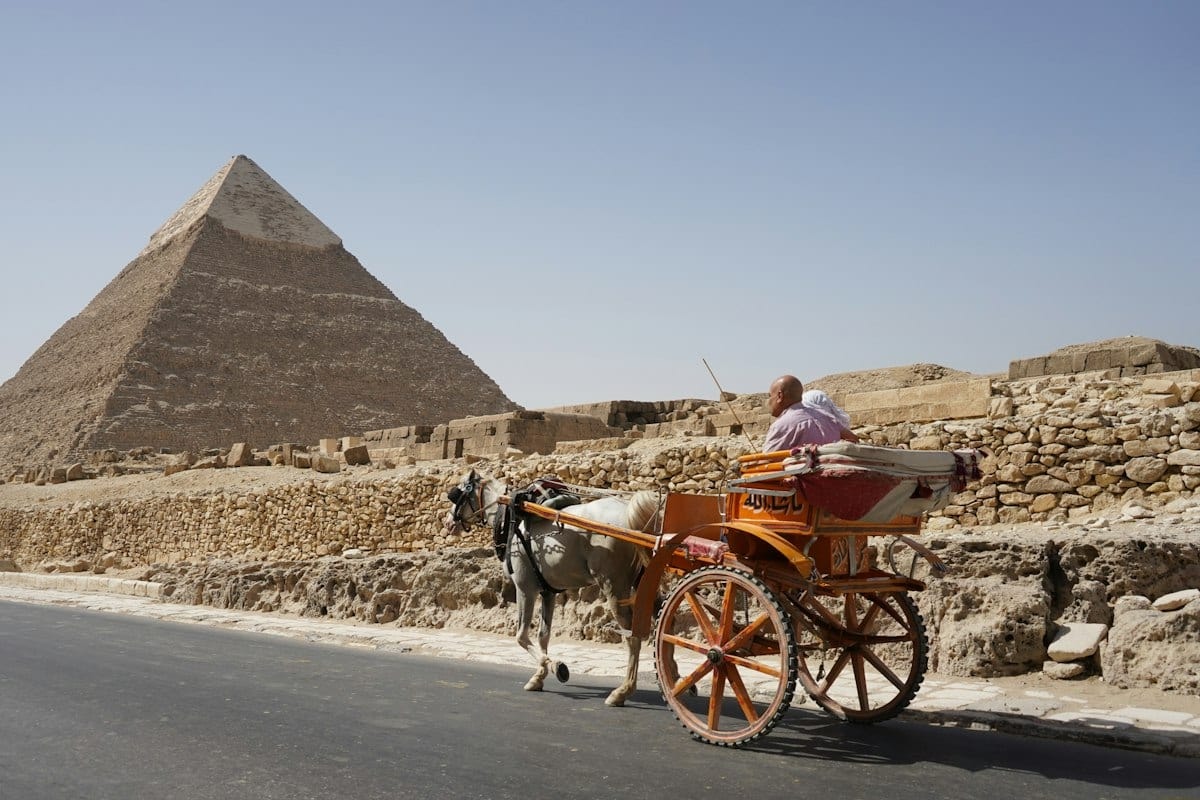
Egypt has young people, technical universities, a large digital workforce and a culture of entrepreneurship. Those are exactly the ingredients that matter when new industries form. If you want to see how young founders are already using AI to build businesses, our article on AI e-commerce and young founders looks at what is real and what is hype.

What does this mean for marketers, agencies and media buyers?
Marketing is one of the first industries where the horse-to-car shift is happening in plain sight. A large part of what agencies sold for decades, producing designs, videos and copy, is becoming cheap. Meta aims to let brands fully create and target ads with its AI tools by the end of 2026, The Wall Street Journal reported, and Gartner found in May 2026 that marketing leaders expect AI automation of marketing work to double to 36% by 2028, according to Gartner.
The horse version of an AI agency says: “We now make your designs faster and cheaper with AI.” That is a real improvement, but it is the same product at a lower price, and clients will soon be able to do it themselves. The car version of an AI agency builds things that did not exist before:
- AI sales agents that answer every WhatsApp and Messenger lead in Egyptian or Gulf Arabic in seconds, day and night, and pass serious buyers to a human.
- Creative testing systems that generate, launch and judge hundreds of ad ideas a week, and learn which messages sell to which audiences.
- Reporting that does not just show numbers but explains why results changed and what to do next, the kind of analysis we build into our own reports.
- Visibility in AI answer engines: making sure that when someone asks an AI assistant which brand to trust, your client is the one it recommends.
- New offers priced on results rather than hours, because AI changes what a unit of work costs.
The media buyer’s job is changing in the same way. Meta’s own AI now does much of the targeting and bidding that media buyers used to do by hand. The buyers who will matter most are the ones who understand the business behind the ads, the offer, the customer and the numbers, and who can build and supervise systems rather than click buttons. We explored this in detail in AI, Superintelligence and the Future of Media Buying.
How can you find the industries of the future?
You do not need to predict the whole future to take part in it. The people who built the car economy did not know it would produce suburbs and shopping malls. They solved the problem in front of them with the new tool, and the next opportunity appeared. Here are seven questions that help:
- What is expensive, slow or impossible today? The horse economy’s problems, manure on every street, the cost of feeding animals, slowness and limited range, became the car industry’s selling points. Look for the equivalent problems in your industry.
- What does AI make cheap, and what becomes valuable as a result? If analysis and writing become cheap, what becomes scarce? Usually trust, data, distribution and judgment.
- What new infrastructure will everyone need? Cars needed gas stations before they needed anything else. AI needs data, power, connections to other software and people who can set it up.
- What new risks does the technology create? Cars created insurance, traffic rules and inspections. AI creates the need for checking, security, verification and accountability.
- What does your customer actually need? Not “a design” but more sales. Not “a report” but a decision. Build for the need, as Levitt advised.
- Where is your unfair advantage? Your language, your local market knowledge, your relationships, your data. Global companies find these hard to copy.
- What can you test this month? Studebaker’s first cars were electric, not gasoline. The first version does not have to be right. It has to exist.
Key takeaways
- When cars replaced horses, whole industries disappeared and new ones appeared, many of which nobody predicted: fuel stations, car loans, motels, highways and suburbs.
- The people who gained most, like Durant, the Fisher brothers and Studebaker, came from the old industry but defined their business by the need, not the product.
- New technologies first get used to do old work. Electricity took about thirty years to transform factories because it only paid off once factories were redesigned around it.
- In 2026 almost every company uses AI, but only about 6% get significant profit from it, according to McKinsey, and the difference is that they redesign their work instead of adding AI to the old way.
- AI is already doing things that were impossible before, in medicine, materials, weather, transport and software, and new industries are forming around those capabilities.
- Superintelligence raises the stakes. The advantage will go to people who own problems, customers, data and trust, and who build systems, not to those who only do tasks.
- For Egypt and the Arab world, the opportunity is to build new Arabic AI products and services, not just to produce old services more cheaply.
The industries of 2040 are being started now, mostly by small teams that are trying things before everyone else. The question from the beginning of this article is the one that matters: will you use tomorrow’s technology to do yesterday’s work, or will you build what comes next?
Questions
What new industries will AI create?
The clearest ones are already forming: data centers and AI chips, power plants and grids for AI, medicines and materials discovered by AI, self-driving transport and robots, AI agents for businesses, payments for AI agents, and testing, safety and insurance for AI. The IEA expects data center electricity demand to more than double by 2030.
What happened to the industries built on horses?
They shrank and mostly disappeared. Horses and mules on U.S. farms fell from more than 25 million in 1920 to fewer than 3 million in 1959. Some firms adapted: a whip maker switched to fishing line, and carriage makers built car bodies and founded General Motors.
Which industries did the car create?
Car manufacturing itself, transformed by Ford’s 1913 assembly line, plus fuel stations (1913), car loans (GMAC, 1919), motels (1925), road building, repair shops, insurance, driving schools, trucking and the suburbs built around car travel.
Why do people use new technology to do old work first?
Because they understand it through the old technology it replaces. Factories first used electric motors to turn the same old line shafts, and electricity took about thirty years to pay off. The gains came when factories were redesigned around it.
Are companies getting real value from AI in 2026?
Few are. McKinsey’s 2026 survey found that nearly nine in ten organizations use AI and 80% of people feel more productive, but only 37% see any profit impact and about 6% are AI high performers. Those few redesign their workflows instead of adding AI to the old ones.
What does superintelligence change?
It raises the stakes. If AI does most cognitive work, the advantage goes to people who own problems, customers, data and trust, and who build systems around AI, rather than to people who only do tasks. Nobody knows exactly how fast this will happen.
What opportunities does AI create in Egypt and the Arab world?
Arabic is used daily by more than 400 million people but only about 0.6% of websites are in Arabic, so Arabic AI products are a real gap. Egypt’s AI strategy targets 7.7% of GDP from AI by 2030. Agriculture, education, health and services for the Gulf are strong areas to build in.
How can a marketer or agency use AI to build something new?
Instead of only making designs faster, build systems: AI sales agents that answer WhatsApp leads in Arabic, creative testing machines, reports that explain why results changed, visibility in AI answer engines, and offers priced on results.
Sources
- U.S. Census of Agriculture 1940 — Livestock and livestock products: horses and mules
- Olmstead and Rhode — Reshaping the Landscape: The Impact and Diffusion of the Tractor in American Agriculture, 1910–1960
- United States Whip Company Complex, Westfield, Massachusetts
- U.S. Census of Agriculture 1959 — A graphic summary: farm power, horses and mules
- Federal Highway Administration — State motor vehicle registrations, by years, 1900–1995
- The Henry Ford — The moving assembly line and the Model T
- American Oil & Gas Historical Society — First gas pump and service stations
- Ally Financial — Our history (GMAC, 1919)
- KSBY — World’s first motel in San Luis Obispo marks 100 years
- Genesee County Historical Society — Durant-Dort Carriage Company
- Fisher Body — company history
- Studebaker — company history
- Locomotive Acts (United Kingdom, 1861–1896)
- London to Brighton Veteran Car Run and the Emancipation Run of 1896
- Theodore Levitt — Marketing Myopia, Harvard Business Review
- Quote Investigator — My customers would have asked for a faster horse
- Atkeson and Kehoe — The Transition to a New Economy After the Second Industrial Revolution (NBER, 2001)
- Nextgov — White House unveils super intelligence executive order and industry accord (September 2026)
- TechCrunch — Trump unveils his new Super Intelligence Force (4 October 2026)
- Sam Altman — The Gentle Singularity
- Dario Amodei — Machines of Loving Grace (October 2024)
- TechCrunch — ChatGPT reaches 900M weekly active users (February 2026)
- McKinsey — The state of AI in 2026: On the road to ROI (25 August 2026)
- Boston Consulting Group — The Formula for Agentic AI Value, Applied AI Index 2026 (30 September 2026)
- Google DeepMind — AlphaFold
- The Nobel Prize in Chemistry 2024 — summary
- Insilico Medicine — First patient dosed in the Phase III trial of rentosertib (9 September 2026)
- Google DeepMind — Millions of new materials discovered with deep learning (November 2023)
- ECMWF — ECMWF’s AI forecasts become operational (25 February 2025)
- TechCrunch — Waymo’s skyrocketing ridership in one chart (March 2026)
- Aurora Innovation — Aurora begins commercial driverless trucking in Texas (1 May 2025)
- Collins Dictionary — Word of the Year 2025: vibe coding
- Stripe — Stripe powers Instant Checkout in ChatGPT
- Google Cloud — Announcing the Agent Payments Protocol (AP2)
- International Energy Agency — AI is set to drive surging electricity demand from data centres (10 April 2025)
- World Economic Forum — Future of Jobs Report 2025
- National Academies — The Long-Term Impact of Technology on Employment and Unemployment (1983): Wassily Leontief, National Perspective
- Fortune — Anthropic CEO warns AI could eliminate half of entry-level white-collar jobs (May 2025)
- OECD.AI — Egypt National Artificial Intelligence Strategy, second edition 2025–2030
- Public Investment Fund — HRH Crown Prince launches HUMAIN as global AI powerhouse (May 2025)
- Gulf News — OpenAI will build a massive Stargate AI center in Abu Dhabi (May 2025)
- UNESCO — World Arabic Language Day
- W3Techs — Usage statistics of Arabic as content language for websites
- The Wall Street Journal via AOL — Meta aims to fully automate advertising with AI by 2026
- Gartner — Marketing leaders expect AI automation of marketing work to double to 36% by 2028 (May 2026)
Send your next client report in minutes
Adams Analytics connects to your Meta ad accounts and builds branded PDF reports in English or Arabic. Free for 7 days — no credit card.
Start free trialWritten by the Adams Analytics team and checked against Meta’s documentation and our own product. Spotted something out of date? Tell us at support@buildincairo.com.