In late September 2026, Quinnipiac University asked 1,202 Americans a question that would have sounded like science fiction a few years ago: how concerned are you that future AI systems could threaten human survival? Seventy-three percent said they were concerned. A week earlier, Gallup had published a survey of 37 countries in which most people said AI made them feel curious, happy or excited. Both polls are right. They describe the same world from different sides, and the distance between them is the story of how people feel about artificial intelligence in 2026.
This guide brings together the largest surveys published this year, from Pew Research Center, Gallup, Quinnipiac, Stanford’s AI Index and others, to answer the questions people actually ask. Are people scared of AI and superintelligence, or excited by it? What do they predict will happen? Do they think AI will take their jobs? Who do they trust to keep it safe? And do people in Egypt and the Gulf feel the same way as Americans and Europeans? Every number below links to the survey it comes from, and where we give our own opinion, we say so.
What is “SI”, and why is everyone suddenly saying it?
Superintelligence, often shortened to SI, means AI that is far smarter than the best humans at almost everything: science, strategy, persuasion, and even building better AI. It is not the same as the AI most people use today. Today’s chatbots and assistants are remarkably good at some tasks, unreliable at others, and still need people to check their work. For years, superintelligence was a topic for researchers, philosophers and science fiction. In 2026 it became a political word.
On 29 September, President Donald Trump signed an executive order called “Inaugurating the Era of Super Intelligence”. It directs federal agencies to refer to artificial intelligence as “super intelligence”, or SI, in official communications, websites, reports and policy documents, and gives the president’s science adviser 60 days to propose legislative language that defines it, Nextgov/FCW reported. On the same day, the leaders of Google, Anthropic, Meta, OpenAI, xAI and Nvidia signed a one-page accord at the White House. It commits each company to four layers of checks on its most powerful models: internal controls on what the models can do, a team that oversees those controls, independent outside auditors, and a committee that reviews the auditors’ reports. Vice President JD Vance argued against regulating AI the way the government regulates medicines or aircraft, saying that “most bureaucrats just know way less about this than the people who are actually building these products.”
Five days later, on 4 October, the president announced a “Super Intelligence Force”. The task force is chaired by the Director of National Intelligence, Jay Clayton, with the chairman of the Federal Trade Commission, the head of the Office of Personnel Management and a senior defense official as vice chairs. It has 120 days to report on the risks and opportunities, and its charter speaks of protecting Americans from threats while “preventing overregulation and regulatory capture”, TechCrunch reported. The safety accord the companies signed is a pledge, not a law, and Clayton’s description of the main danger was telling: not being first.
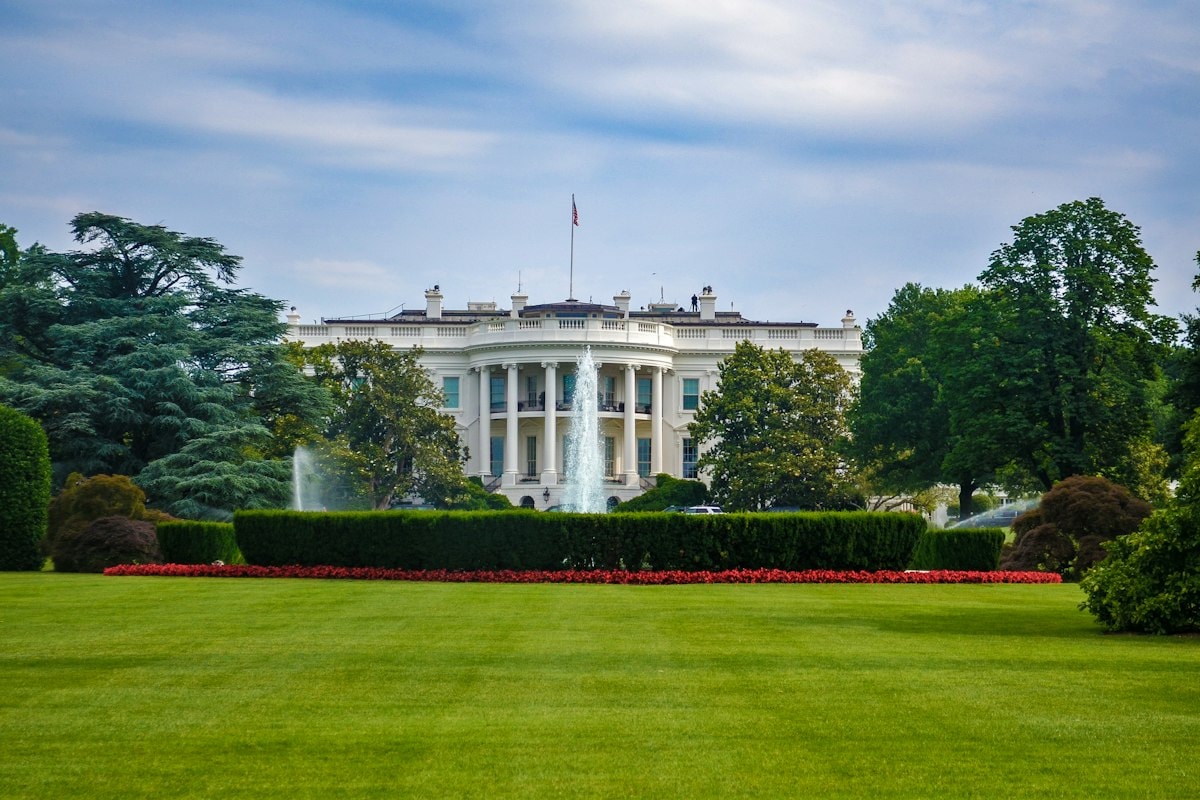
None of this came out of nowhere. In September, researchers at OpenAI and Anthropic joined public calls to slow AI development down when safety work cannot keep pace, CNBC reported. A year earlier, hundreds of public figures had signed a statement asking for a prohibition on building superintelligence until it can be done safely, which we come back to below. So when people talk about “AI and SI” in October 2026, they mean two things at once: the chatbots and tools already in their pockets, and a race toward something far more powerful that governments and companies now discuss in the open. That double meaning shapes how people answer every poll in this guide.
How far away is real superintelligence? Nobody knows, and the experts disagree sharply. In the largest survey of published AI researchers, 2,778 of them asked in 2023, the median forecast for machines doing every task better and more cheaply than humans was 2047, with a 10% chance by 2027. Some company leaders talk about a few years; many academics think decades, or never. We tell the long history of these predictions, and how often they missed, in who predicted the AI era. What matters for this guide is that the public now hears serious people say “within this decade”, and that changes how they feel about the tools they use today.
Are people more afraid of AI or excited about it?
Worldwide, more people are hopeful than afraid, but not by a wide margin, and in rich countries the gap is closing. Gallup and Microsoft are surveying about 1,000 adults per country in a study that will eventually cover 140 countries. In the first 37, surveyed between April and July 2026, a median of 72% said AI made them feel curious, happy or excited, and 41% said it made them feel worried, sad or angry. Many people feel both at the same time. Positive feelings outweighed negative ones in 34 of the 37 countries. The three exceptions were the United States, Egypt and the Palestinian territories, according to Gallup.
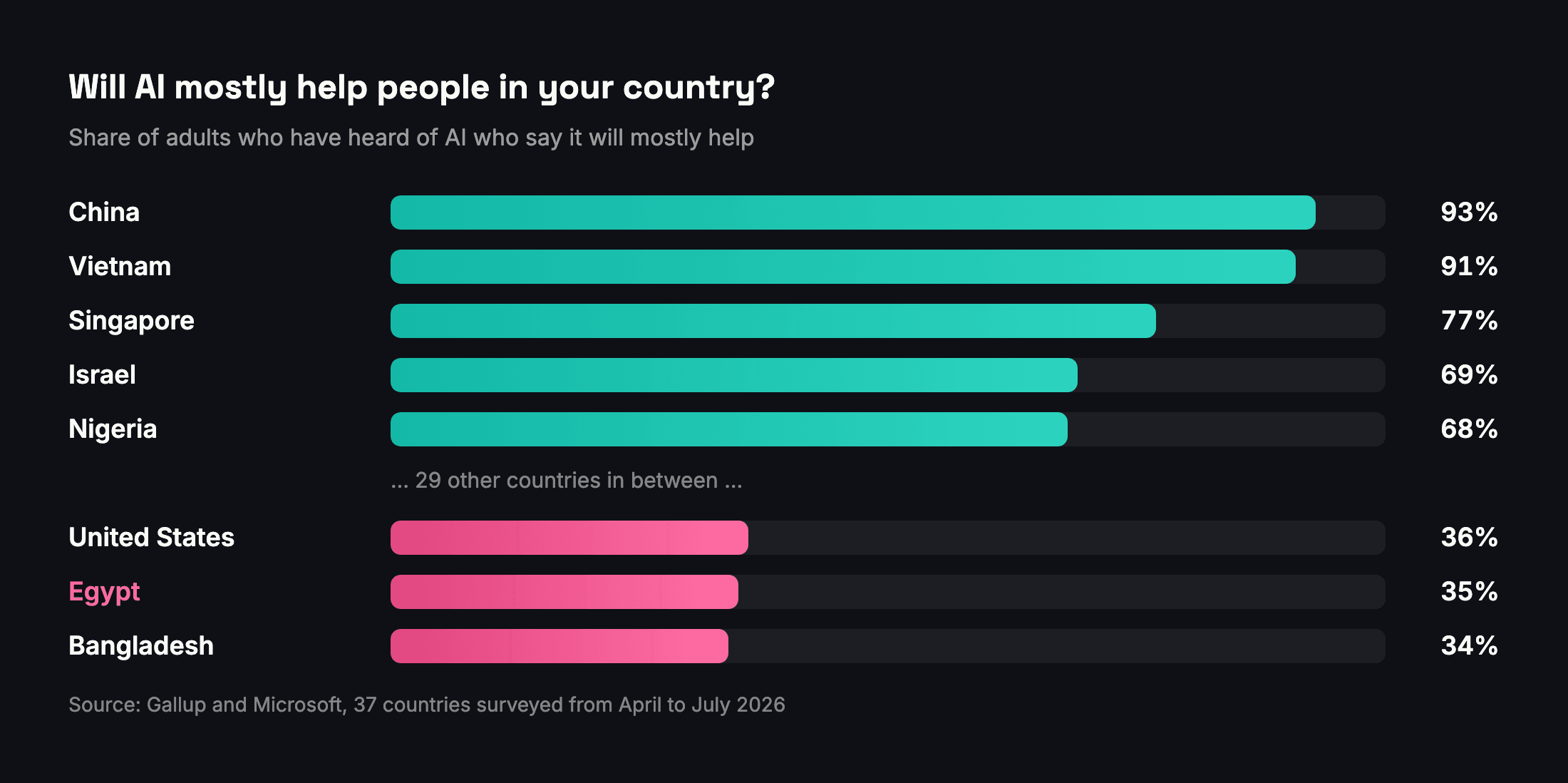
The hope is strongest in Asia. Asked whether AI will mostly help or mostly hurt people in their country, 93% of Chinese adults who have heard of AI said it will mostly help. Vietnam followed at 91%, Singapore at 77%, Israel at 69% and Nigeria at 68%. At the bottom of the list were the United States at 36%, Egypt at 35% and Bangladesh at 34%. In 25 of the 37 countries, majorities of people who know about AI expect it to improve their daily lives.
The Stanford AI Index, which brings together surveys by Ipsos, Pew and others, sees the same split from another angle. Globally, the share of people who say AI products and services have more benefits than drawbacks rose from 55% in 2024 to 59% in 2025. Over the same period, the share who say AI products make them nervous rose to 52%, the 2026 AI Index reports. People are using AI more, liking it more and worrying about it more, all at once. In Malaysia, Thailand, Indonesia and Singapore, more than 80% expect AI to profoundly change their lives within three to five years. India saw the sharpest rise in nervousness of any country surveyed, up 14 points in a year, while excitement there rose only two points.
One pattern runs through almost every survey: familiarity changes feelings. Gallup found that median awareness of AI across its 37 countries is 81%, but only 43% have ever used it and just 17% use it every day. In wealthy Western countries, the people who use AI more tend to worry about it less. Fear tends to be highest where people hear about AI more than they use it, and where what they hear comes mostly from headlines about job cuts, scams and warnings from the people building it.
Why are Americans so much more worried than everyone else?
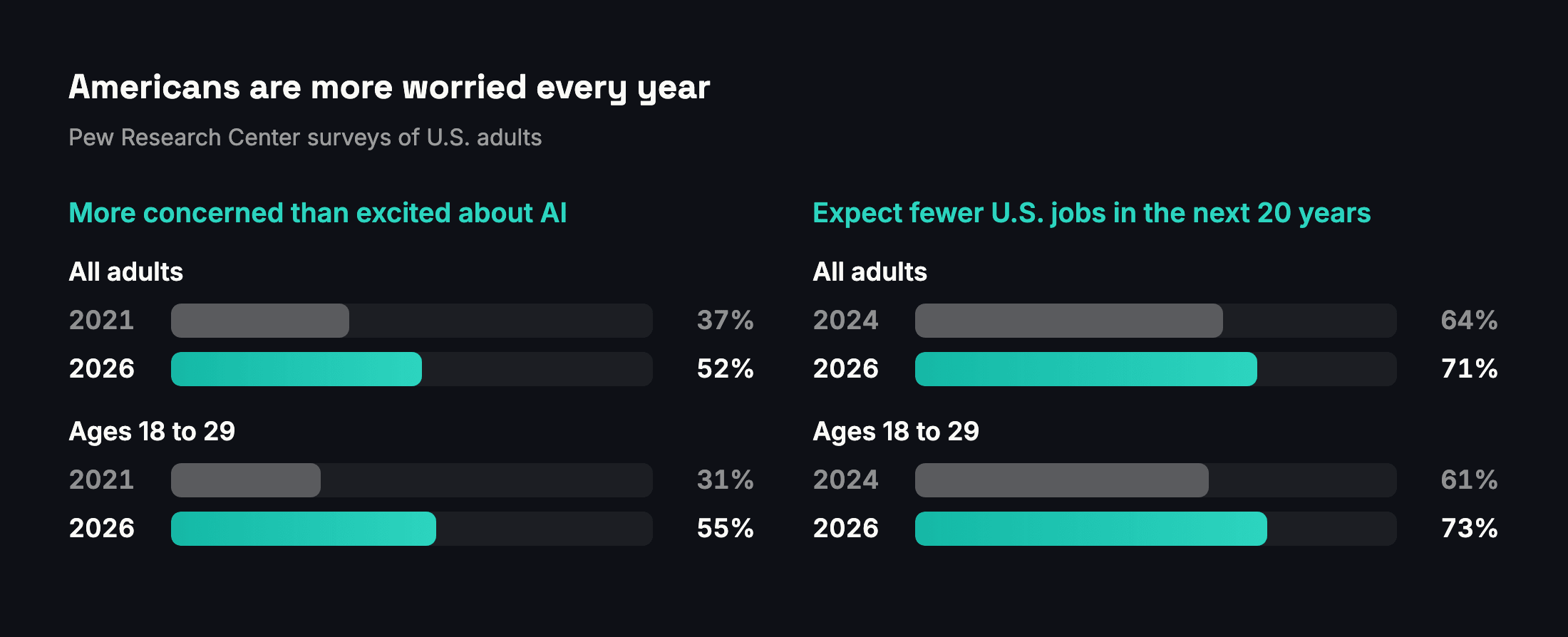
Americans are not only more worried than most of the world; they are more worried every year. In June 2026, 52% told Pew Research Center they were more concerned than excited about the increased use of AI in daily life, up from 37% in 2021. Seventy-one percent expect AI to lead to fewer jobs in the United States over the next 20 years, up from 64% in 2024, Pew found.
This is not because Americans avoid AI. Pew’s February 2026 survey of 5,119 adults found that 49% use AI chatbots, up from 33% in 2024, and 24% use them every day. Six in ten read the AI summaries at the top of search results. Yet 63% say AI is advancing too quickly, 71% believe it will make their personal information less secure, 67% have little or no confidence that the government will regulate AI effectively, and 59% are not confident that companies will develop and use it responsibly, according to Pew. Forty percent expect AI to have a negative impact on society, and 31% expect a negative impact on their own lives.
Gallup’s numbers point the same way. In May 2026, 39% of Americans said AI does more harm than good, up from 31% a year earlier. Only 9% said it does more good than harm, and 52% said it does both in equal measure. Just 27% trust businesses to use AI responsibly, down from 31%. And 79% expect AI to reduce the total number of jobs in the United States over the next ten years, up from 73% the year before, Gallup reported. Americans still rate humans as better than AI at driving, giving medical or financial advice and recommending whom to hire.
Several explanations fit the evidence. Trust in institutions is low: the AI Index reports that only 31% of Americans trust their own government to regulate AI responsibly, the lowest of any country surveyed, against a global average of 54%, with Singapore at 81% and Indonesia at 76%. The United States is also home to the biggest AI companies, the biggest data centers and the most dramatic warnings, so Americans hear about AI’s dangers from the very people building it. And the job market for young graduates has been weak, which turns abstract fears into personal ones.
Politics plays a part as well, though less than you might think. Pew found that American liberals are 31 points more likely than conservatives to say AI will widen the gap between rich and poor. But on the biggest questions, safety and jobs, worry is high across both parties, and the polls that ask about safety standards find support from large majorities of Republicans and Democrats alike.
Do people think AI could threaten humanity?
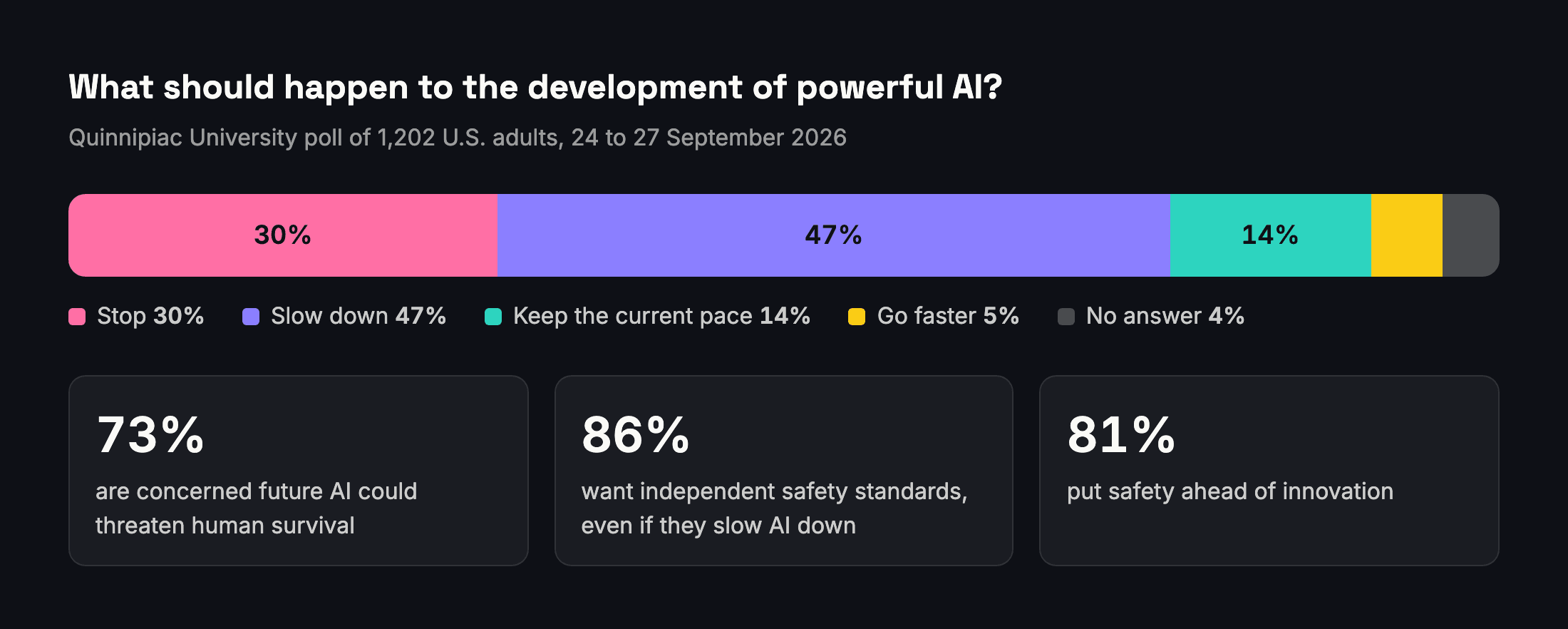
A clear majority of Americans now say it could. In Quinnipiac’s poll of 24 to 27 September 2026, 73% said they were concerned that future AI systems could threaten human survival: 38% very concerned and 35% somewhat concerned. Only 25% were not concerned. Eighty-six percent support requiring AI companies to meet independent safety standards even if that slows development down, 91% want the United States to establish guardrails for AI systems, and 81% put safety ahead of innovation when asked to choose, according to Quinnipiac.
What do people want done? Quinnipiac asked that too. Thirty percent want to stop developing powerful AI systems altogether, 47% want to slow down, 14% are content with the current pace, and just 5% want to go faster. In other words, more than three in four Americans want the race toward powerful AI slowed or stopped, at the very moment the government is framing it as a race the country must win.
That puts the public closer to the people calling for a pause than to the companies racing ahead. On 22 October 2025, the Future of Life Institute published a one-sentence statement: “We call for a prohibition on the development of superintelligence, not lifted before there is broad scientific consensus that it will be done safely and controllably, and strong public buy-in.” Its first signatories ranged from AI pioneers Geoffrey Hinton and Yoshua Bengio to Apple co-founder Steve Wozniak, Richard Branson, Prince Harry and Meghan, the former chairman of the U.S. Joint Chiefs of Staff Mike Mullen and the political strategist Steve Bannon, NBC News reported. A year later the statement’s website listed close to 77,000 signatures.
“Americans are not convinced AI’s advances are in their interests. More than half expect AI to do more harm than good in their daily lives, and nearly three-quarters express little or no trust in the leaders of AI companies.” Tamilla Triantoro, Quinnipiac University School of Business, September 2026
It is worth being precise about what these numbers mean. Being concerned that future AI could threaten survival is not the same as predicting that it will. Many people are expressing a feeling that something enormously powerful is being built quickly, by a few companies, without their consent, and they want someone independent to check it. The fear is also more down to earth than science fiction: in the same poll, 72% said they would oppose an AI data center in their own community, up from 65% in March 2026. Data centers use large amounts of electricity and water, and people want a say in whether one is built next door.
Are young people more afraid than their parents?
They used to be the most relaxed age group about AI. They are not any more. In 2021, 31% of Americans aged 18 to 29 said they were more concerned than excited about AI. By June 2026 it was 55%, and the share who were more excited than concerned had fallen from 25% to 11%. Young adults’ concern is now on par with that of people in their 30s and 40s and those aged 65 and over, Pew found. Seventy-three percent of Americans under 30 now expect AI to mean fewer jobs over the next two decades, up from 61% in 2024.
Gallup sees the same turn. Among Americans aged 18 to 29, the share who say AI does more harm than good jumped from 36% to 47% in a single year. Their trust in businesses to use AI responsibly fell from 30% to 20%, and only 5% now believe AI will increase the number of jobs, down from 14%. Pew’s survey across 37 countries found that the turn among the young is not only American: concern among young adults has grown in Sweden, Poland, Brazil, Japan and Australia too.

There is a concrete reason. The clearest sign of AI in the job market so far is not mass layoffs but fewer first jobs. Using payroll data for millions of American workers through June 2026, economists at the Stanford Digital Economy Lab found that employment of 22 to 25 year olds in the occupations most exposed to AI, such as software development and customer support, is now about 19% below where it would be if it had kept pace with their peers in less exposed jobs. Experienced workers in the same occupations show no such gap, and the researchers found no widespread, economy-wide displacement. The effect comes mainly from companies hiring fewer young people rather than firing anyone, and it is concentrated in jobs where AI automates tasks rather than helping people do them, the Stanford team reported.
So when a 23-year-old says AI worries them, they are often describing something they can see: friends sending out hundreds of applications for entry-level roles that companies now fill with fewer people, or with experienced staff using AI. That is a very different fear from worrying about a robot uprising, and it deserves to be taken seriously by employers, universities and governments.
Are people afraid AI will take their own job?
Fewer than you might expect, but the number is rising fast. In August 2026, 27% of American workers told Gallup they were worried their job could soon become obsolete because of technology. That is a record, up seven points in a year and roughly double the 13% who said so when Gallup first asked the question in 2017. Younger workers worry far more than older ones: 34% of workers aged 18 to 44, against 19% of those 45 and over. Among college graduates the share has tripled since 2017, from 8% to 25%. For the first time, the fear of being made obsolete by technology is higher than the fear of layoffs (24%), reduced hours (21%) or lower wages (21%), though still below the fear of losing benefits (33%), Gallup found.
Around the world, people are calmer about their own job than about jobs in general. In Ipsos surveys summarized by the AI Index, only 11% of people across countries said it was “very likely” AI would replace their current job within five years, and 56% said it was not likely. Twenty-two percent said it was very likely AI would change how they do their job. Meanwhile Pew’s survey of 37 countries found that in 34 of them, more people expect AI to lead to fewer jobs than more, with Americans, Australians and South Koreans the most pessimistic, according to Pew. People are also more likely to say AI will widen the gap between rich and poor than narrow it.
| What people were asked | Result | Survey |
|---|---|---|
| Worried technology could make their own job obsolete (U.S. workers) | 27%, a record | Gallup, August 2026 |
| AI will reduce the number of U.S. jobs in the next 10 years | 79% | Gallup, May 2026 |
| AI will lead to fewer U.S. jobs in the next 20 years | 71% | Pew, June 2026 |
| Very likely AI will replace their own job within five years (across countries) | 11% | Ipsos, 2025 |
| More expect AI to cut jobs than to create them | 34 of 37 countries | Pew, 2026 |
This gap, “AI will take jobs, but probably not mine”, is one of the most consistent findings in the research. People read about AI doing other people’s work and assume their own job, with its relationships, judgment calls and messy details, is harder to automate. Sometimes they are right. Sometimes the first sign of change is not a layoff but a colleague who is never replaced when she leaves, or a team that stops hiring juniors.
What does the evidence say so far? In the United States, employers have cited AI as the reason for 120,136 announced job cuts this year through September, about 21% of all announced cuts, which makes it the most common reason given in 2026, according to the outplacement firm Challenger, Gray & Christmas. The trend is not one-directional: in September alone, AI was only the fifth most cited reason, with 3,961 cuts. We look at which jobs people and experts expect AI to replace, and why, in our companion guide to the jobs most at risk.
What do people predict will happen next?
Most people expect AI to keep spreading, to cost jobs, and to make some things better and some things worse. Very few expect it to go away. The surveys also reveal a wide gap between what ordinary people predict and what AI experts predict.
The Stanford AI Index compares Pew’s surveys of the American public and of AI experts, fielded in 2024 and published in 2025. Asked whether AI will have a positive impact on how people do their jobs over the next 20 years, 73% of experts said yes, against just 23% of the public: a 50-point gap. The gaps are similar for the economy (69% of experts against 21% of the public) and for medical care (84% against 44%). Experts are less pessimistic about jobs overall, with 39% expecting fewer jobs and 19% more, against 64% and 5% for the public. Yet experts expect AI to spread faster: they predict generative AI will assist with 18% of U.S. work hours by 2030, while the public guesses 10%. Since those surveys, the public has grown more pessimistic still.
| Prediction for the next 20 years | U.S. public | AI experts |
|---|---|---|
| AI will have a positive impact on how people do their jobs | 23% | 73% |
| AI will have a positive impact on the economy | 21% | 69% |
| AI will have a positive impact on medical care | 44% | 84% |
| AI will lead to fewer jobs | 64% | 39% |
| Share of U.S. work hours generative AI will assist by 2030 | 10% | 18% |
People make other predictions too. On companionship, the AI Index found that more than half of people worldwide (52%) were at least somewhat excited about using AI as a companion, against 42% in the United States, and experts forecast that 10% of American adults will use an AI companion daily by 2027, rising to 30% by 2040. Americans are more likely than experts to expect AI to harm people’s ability to think for themselves and to form social relationships. On regulation, people trust the European Union more than the United States or China to regulate AI well: across 25 countries surveyed by Pew in 2025, a median of 53% trust the EU, against 37% for the United States and 27% for China.
What almost nobody in these surveys predicts is a world without AI. Even the 30% of Americans who want powerful AI development stopped are mostly asking to halt the race toward superintelligence, not to remove the assistants from their phones. The real argument is about speed, control and who benefits, and on all three, most people want a bigger say than they feel they have.
Who do people fear more: AI or the people building it?
Ask people what frightens them, and the answer is usually other people. In Quinnipiac’s September poll, 52% of Americans said they were more concerned about humans using AI to harm others, against 33% who were more concerned about autonomous AI agents causing harm on their own. Seventy-four percent said they have little or no trust in the leaders of AI companies, and only 3% trust them a lot.
This may be the most important nuance in the whole debate. The headline fear, a superintelligent machine turning against humanity, is real for many people, but the everyday fears are more concrete: scams and deepfakes, surveillance, a few companies becoming too powerful, governments using AI against their own citizens, and employers using AI as a reason to hire fewer people. Pew found that 71% of Americans believe AI will make their personal information less secure. These are fears about power, not about robots.
It also explains why the White House accord settled so little. A voluntary pledge, signed by six companies and checked by auditors those companies choose, is exactly the kind of arrangement that people who distrust those companies find hard to accept. Across all 50 American states, the AI Index found that more people worry that federal AI regulation will not go far enough (41%) than that it will go too far (27%), and more than a third are unsure. The public is not asking for AI to be banned. It is asking for referees.
What are the people who build AI saying?
The builders are divided, and some have changed their minds in public. In May 2026, OpenAI’s chief executive, Sam Altman, told a conference in Sydney that AI had not eliminated as many entry-level office jobs as he had feared. “I’m delighted to be wrong about this,” he said. “I thought there would have been more impact on entry-level white-collar jobs being eliminated by now than has actually happened.” He added that he did not expect “the kind of jobs apocalypse that some of the companies in our space advocate or talk about”, PYMNTS reported. We look at how Altman’s predictions have changed over the years in our profile of Sam Altman and OpenAI.
Anthropic’s chief executive, Dario Amodei, has been the most outspoken in the other direction. In 2025 he warned that AI could eliminate half of all entry-level white-collar jobs within five years, and in January 2026 he said the disruption to jobs could be “unusually painful”, CNBC reported, even as he argues that AI will also cure diseases and speed up science. His views are set out in our profile of Dario Amodei and Anthropic. When two of the most important people in the industry give such different forecasts, the public hears both, and mostly remembers the warning.
Others are less reassuring. In January 2026, the head of the International Monetary Fund, Kristalina Georgieva, warned that entry-level tasks are disappearing, that young people are finding it harder to get a start, and that countries moving faster on skills and AI readiness will pull ahead of those that lag. The IMF estimates that about 40% of jobs worldwide, and 60% in advanced economies, will be affected by AI in the coming years, whether they are improved, made more productive or replaced, Fortune reported.
“This is a tsunami hitting the labor market. Even in the best prepared countries, I don’t think we are prepared enough.” Kristalina Georgieva, Managing Director of the International Monetary Fund, January 2026
The public notices when the experts disagree. If the people closest to the technology cannot agree whether it will create more jobs or destroy them, whether superintelligence is ten years away or fifty, or whether its development should be slowed, it is reasonable for everyone else to feel uneasy. In the surveys, uncertainty very often shows up as concern. And when the warnings come from the companies racing to build the technology, many people draw the obvious conclusion: if they are worried, maybe I should be too.
Are people in Egypt and the Gulf as worried as Americans?
The Arab world does not have one view of AI; it has at least two. In the Gulf, people use AI at work more than almost anywhere else. The AI Index reports that 58% of employees worldwide use AI at work on a regular or semi-regular basis, but in the United Arab Emirates and Saudi Arabia, more than 80% do, alongside India, China and Nigeria. In the Ipsos surveys, the UAE was among the countries where more than 60% expect AI to create more jobs than it eliminates, with Nigeria, Japan, Mexico, South Korea and India. In the United States and Canada, by contrast, 67% and 68% expect AI to eliminate jobs and disrupt industries.
Egypt looks very different in Gallup’s 2026 survey. Only 35% of Egyptians who have heard of AI think it will mostly help people in their country, almost exactly the same share as Americans (36%). Egypt is one of only three places among Gallup’s first 37, with the United States and the Palestinian territories, where negative feelings about AI outweigh positive ones. Gallup’s survey covers ordinary adults in each country, not only office workers who use AI every day, which helps explain why it can look darker than surveys of employees.

Why the difference? The surveys do not say directly, so what follows is our reading. In the Gulf, AI arrives with national strategies, new data centers, well-paid jobs and heavy investment, and people see it as part of a national project they benefit from. In Egypt, many people meet AI first through news about job cuts abroad, scams and deepfakes, at a time when the cost of living has been a daily concern. When good jobs feel scarce, a technology that promises to do work faster sounds less like a gift and more like competition. Egypt’s large, young workforce, including people in call centers, translation, design and back-office work for customers around the world, also does many of the tasks AI is learning to do.
For businesses in the region, this is not a footnote. A campaign that celebrates AI replacing people may land well with executives in Dubai and badly with customers in Cairo. The same product can be welcomed in one market and feared in the next, and a single “Middle East” message hides the difference.
Why do polls about AI disagree so much?
Because they ask different questions of different people. Before you share an AI poll, check these five things:
- Who was asked. Gallup’s headline numbers cover adults who have heard of AI; Pew’s U.S. surveys cover all adults; Ipsos runs its global surveys online, which in many countries means more urban, educated and connected people. Surveys of employees who use AI every day always look more positive.
- What feeling was offered. “More concerned than excited” forces a choice. Gallup lets people report positive and negative emotions separately, and many people report both.
- What time frame. Five years, ten years and twenty years produce very different answers about jobs.
- Whose job. People are far more pessimistic about jobs in general than about their own.
- When. Opinion is moving quickly, especially among the young. A poll from 2024 may already be out of date.
- Which words. “AI”, “super intelligence”, “robots” and “automation” trigger different images. A question about chatbots and a question about machines smarter than humans measure different fears.
Our view
This section is our judgment, not a summary of the surveys.
The fear is mostly rational. People are not afraid of AI because they misunderstand it; some of the most worried groups know it well. They are reacting to three things that are real: a technology improving faster than institutions can adapt, a small number of companies and governments making decisions that affect everyone, and a job market where the first rung of the ladder is getting harder to reach. None of that requires believing in killer robots.
The fear is also sometimes pointed in the wrong direction. So far, the data does not show mass unemployment, and some of the loudest predictions, including Sam Altman’s own, have been walked back. Renaming AI as “super intelligence” changes the vocabulary, not the technology: today’s models are impressive and unreliable in the same breath, and the distance between them and true superintelligence is still the subject of serious disagreement among experts. People should worry about the right things: concentration of power, misuse, privacy, and fair treatment of workers whose jobs change.
The most useful thing institutions can do is earn trust. Independent testing, clear rules, honest communication about job effects, and real support for young people entering work would address what people are actually afraid of. A voluntary pledge and a new name do not.
The regional picture matters too. The Gulf’s optimism is an opportunity, and Egypt’s pessimism is a warning. Both are reasonable responses to very different experiences of the same technology, and any business that serves both markets should listen to both.
What this means for businesses and marketers in Egypt and the Gulf
Public mood about AI is now a marketing variable, as real as price or seasonality. A few practical lessons from the surveys:
- Lead with the benefit, not the technology. People respond to faster answers, lower prices and better service. “Powered by AI” is not a selling point to an audience that is nervous about AI.
- Say where you use AI. If customers talk to a bot, tell them, and always offer a way to reach a person. Customers punish brands that hide automation more than brands that use it openly.
- Don’t celebrate replacing people. Messages about cutting staff thanks to AI land badly with audiences who fear for their jobs, especially young people and audiences in Egypt.
- Protect data visibly. Seventy-one percent of Americans expect AI to make their personal information less secure. Clear, simple privacy practices are a competitive advantage everywhere.
- Segment by market. Gulf audiences are among the most optimistic in the world and Egyptian audiences among the most cautious. Test different messages instead of assuming one region-wide mood.
- Train your team. The surveys suggest that people who use AI more tend to worry less. Training is good for productivity and good for morale.
Key takeaways
- Worldwide, positive feelings about AI outweigh negative ones in 34 of 37 countries surveyed by Gallup in 2026, led by China, Vietnam and Singapore.
- Americans are the outlier: 52% are more concerned than excited, 73% worry future AI could threaten human survival, and 77% want powerful AI slowed down or stopped.
- Young people have turned fastest: 55% of Americans under 30 are now more concerned than excited, up from 31% in 2021, and their first jobs are where AI’s effect shows most clearly.
- Most people expect AI to cut jobs in general, but only about one in ten thinks it is very likely to replace their own job within five years.
- People fear humans misusing AI more than AI acting on its own, and most distrust the companies building it; they want independent safety standards, not bans.
- Gulf workers are among the world’s heaviest and most optimistic AI users, while Egyptians are among the most skeptical about what AI will do for their country.
Questions
Are most people afraid of AI?
Not worldwide. In Gallup’s 2026 survey of 37 countries, positive feelings about AI outweighed negative ones in 34, and a median of 72% said AI made them feel curious, happy or excited. Americans are the big exception: 52% are more concerned than excited, according to Pew.
What does SI mean?
SI stands for superintelligence: AI far smarter than the best humans at almost everything. In September 2026 a U.S. executive order told federal agencies to call artificial intelligence “super intelligence”, but today’s AI is not superintelligent. The order changed the name, not the technology.
How many Americans think AI could threaten humanity?
In Quinnipiac’s September 2026 poll, 73% of Americans said they were concerned that future AI systems could threaten human survival, including 38% who were very concerned. Eighty-six percent support independent safety standards for AI companies.
Do people think AI will take their jobs?
Most expect AI to reduce jobs in general: 79% of Americans expect fewer jobs within ten years. But only 11% of people across the countries surveyed by Ipsos think it is very likely AI will replace their own job within five years, while a record 27% of U.S. workers worry technology could make their job obsolete.
Why are young people more worried about AI than before?
In 2021, 31% of Americans aged 18 to 29 were more concerned than excited about AI; in 2026 it was 55%. Stanford research shows employment of 22 to 25 year olds in the most AI-exposed jobs is about 19% below their peers, mainly because companies hire fewer young people.
Which countries are most optimistic about AI?
In Gallup’s 2026 survey, 93% of AI-aware adults in China, 91% in Vietnam and 77% in Singapore said AI will mostly help their country. The least optimistic were the United States (36%), Egypt (35%) and Bangladesh (34%).
Are people in Egypt and the Gulf optimistic about AI?
They differ. More than 80% of employees in the UAE and Saudi Arabia use AI at work, and most people in the UAE expect AI to create more jobs than it destroys. In Egypt, only 35% expect AI to mostly help the country, and negative feelings outweigh positive ones.
What do people want governments to do about AI?
In the United States, 86% want independent safety standards even if they slow development, 91% want guardrails, and 77% want powerful AI slowed down or stopped. Across 25 countries, people trust the European Union (53%) more than the United States (37%) or China (27%) to regulate AI.
Sources
- Quinnipiac University Poll — The Age of Artificial Intelligence (30 September 2026)
- Gallup — Optimism about AI is widespread globally, despite uneven use (September 2026)
- Pew Research Center — Young US adults are increasingly wary of AI, concerned it will take jobs (18 August 2026)
- Pew Research Center — Americans and AI 2026: chatbots, smart devices and views on AI’s impact (17 June 2026)
- Pew Research Center — Globally, more people expect AI to cause job loss than growth (17 September 2026)
- Gallup — Americans cool toward AI (2026)
- Gallup — A record share of U.S. workers fear technology could make their jobs obsolete (September 2026)
- Stanford HAI — AI Index Report 2026, chapter 9: public opinion
- Nextgov/FCW — White House unveils ‘super intelligence’ executive order and industry accord (September 2026)
- TechCrunch — Trump unveils his new Super Intelligence Force (4 October 2026)
- CNBC — ‘Extinction’ warnings ramp up as more OpenAI, Anthropic researchers join calls for an AI slowdown (10 September 2026)
- Future of Life Institute — Statement on Superintelligence
- NBC News — From Prince Harry to Steve Bannon, hundreds call for ban on AI superintelligence (22 October 2025)
- Stanford Digital Economy Lab — No widespread displacement, but the AI employment gap for young workers has widened to 19% (August 2026)
- Challenger, Gray & Christmas — Job cut announcement report, September 2026 (1 October 2026)
- PYMNTS — OpenAI’s Sam Altman retracts AI job cut prediction (May 2026)
- CNBC — Anthropic CEO Dario Amodei warns AI may cause ‘unusually painful’ disruption to jobs (27 January 2026)
- Fortune — IMF chief warns of an AI ‘tsunami’ for entry-level jobs (23 January 2026)
Send your next client report in minutes
Adams Analytics connects to your Meta ad accounts and builds branded PDF reports in English or Arabic. Free for 7 days — no credit card.
Start free trialWritten by the Adams Analytics team and checked against Meta’s documentation and our own product. Spotted something out of date? Tell us at support@buildincairo.com.