In September 2025, Salesforce’s chief executive, Marc Benioff, confirmed that the company had cut about 4,000 customer support roles, from roughly 9,000 to about 5,000, because AI agents now handled around half of its customer conversations. A year earlier, the payments company Klarna had announced that its AI assistant was doing the work of 700 customer service agents, and then, in 2025, said it was hiring humans again because customers wanted a person to talk to. And in May 2026, OpenAI’s Sam Altman admitted he had expected AI to eliminate far more entry-level office jobs by now than it has. Each of these stories is true, and together they explain why people are so unsure about which jobs AI will really take.
This guide does two things. First, it shows what people think: what workers, the public and AI experts expect AI and superintelligence to do to jobs, based on the largest surveys of 2025 and 2026. Second, it lists the 15 jobs most at risk, explains why each one is exposed, and shows what the evidence says so far. It is a companion to our guide on whether people are afraid of AI, which covers how people feel about AI more broadly. Every claim links to its source, and our own judgments are labelled as such.

What do people think AI will do to jobs?
Most people expect fewer jobs, and the share is growing. In the United States, 79% of adults told Gallup in May 2026 that AI will reduce the total number of jobs over the next ten years, up from 73% a year earlier, and only a small minority expect more jobs, Gallup reported. Pew Research Center found in June 2026 that 71% of Americans expect AI to lead to fewer jobs over the next 20 years, up from 64% in 2024, with young adults moving fastest, according to Pew. And 27% of American workers now worry that technology could make their own job obsolete, a record and double the share in 2017, Gallup found.
Around the world the picture is similar but less extreme. In Pew’s 2026 survey of 37 countries, more people expect AI to lead to fewer jobs than more in 34 of them, with Americans, Australians and South Koreans the most pessimistic, according to Pew. Yet when Ipsos asked people about their own job, only 11% said it was very likely AI would replace it within five years, and 56% said it was not likely, the Stanford AI Index reports. In a handful of countries, including the United Arab Emirates, Nigeria, India and Mexico, more than 60% expect AI to create more jobs than it destroys.
This is the central paradox of public opinion on AI and work: people believe AI will take jobs, but mostly other people’s jobs. Part of that is optimism and part is knowledge. People know the hidden parts of their own work, the judgment calls, relationships and exceptions that do not appear in a job description, and they assume those parts protect them. Sometimes they do. The rest of this guide looks at which jobs have the fewest of those protections.
Which jobs do people and experts expect to disappear?
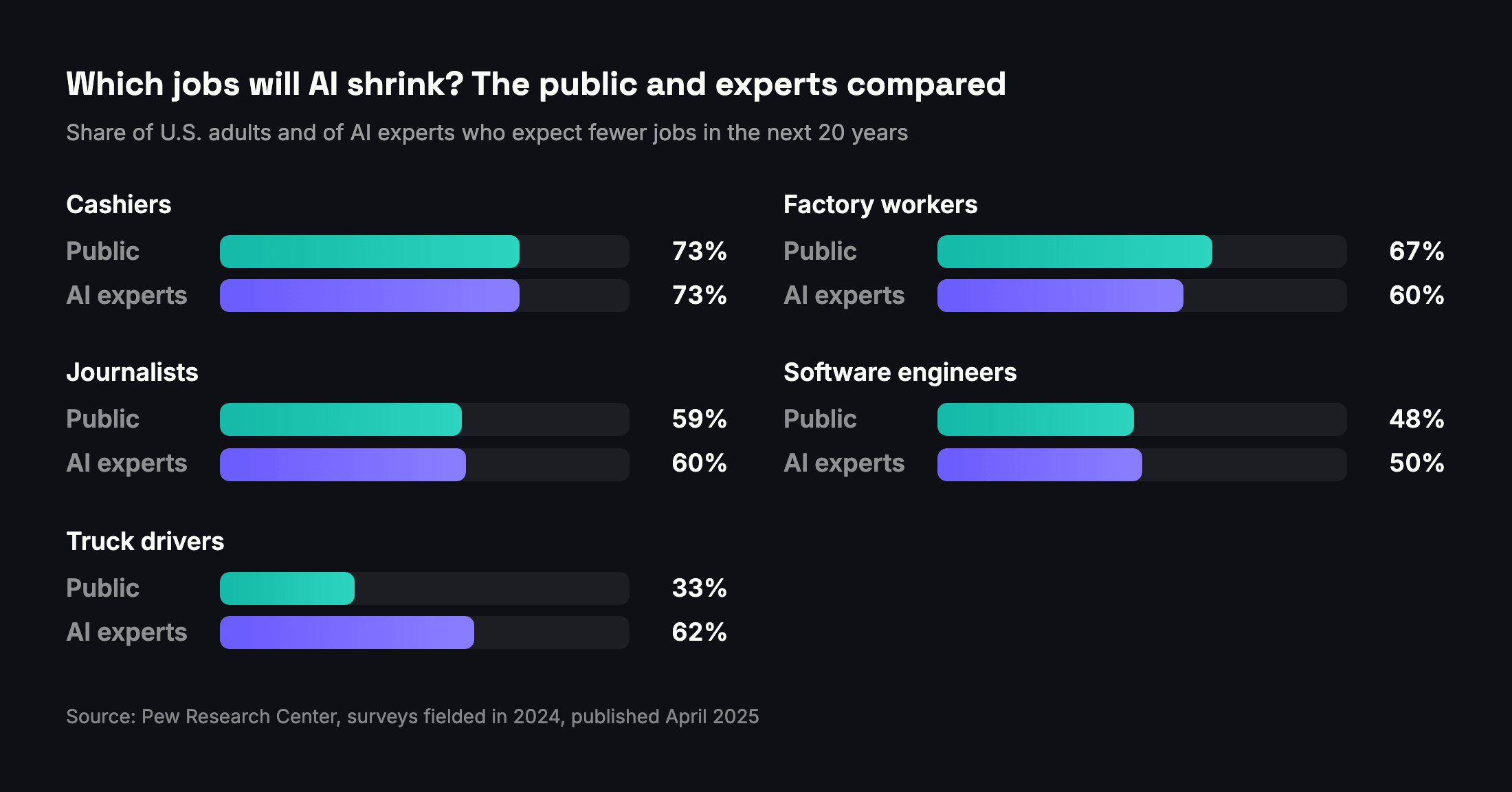
The most useful comparison comes from Pew Research Center, which in 2024 asked both the American public and more than 1,000 AI experts which occupations will have fewer jobs over the next 20 years because of AI. The two groups agree more than you might expect. Both put cashiers at the top: 73% of the public and 73% of experts expect fewer cashier jobs. Large shares of both also expect fewer jobs for factory workers, journalists and software engineers, according to Pew.
| Occupation | U.S. public expecting fewer jobs | AI experts expecting fewer jobs |
|---|---|---|
| Cashiers | 73% | 73% |
| Factory workers | 67% | 60% |
| Journalists | 59% | 60% |
| Software engineers | 48% | 50% |
| Truck drivers | 33% | 62% |
The biggest disagreement is about truck drivers: 62% of experts expect fewer driving jobs, against only 33% of the public. Experts are thinking about self-driving vehicles and robots; the public sees how far those still have to go. On the other hand, the public is more likely than experts to expect job losses for musicians, teachers and medical doctors, jobs that experts consider more protected because they depend on trust, care and physical presence. Overall, 64% of the public expected AI to mean fewer jobs in general at the time, against 39% of experts.
Replaced or changed? How to read job-loss predictions
Before looking at specific jobs, it helps to understand what the studies actually measure. Almost none of them measure jobs lost. They measure exposure: how many of the tasks in a job AI could perform or speed up. A job made of tasks that AI does well is exposed. Whether that job then disappears, shrinks, or simply changes depends on the cost of AI, the quality of its work, regulation, customer expectations and how employers decide to use the time it saves.
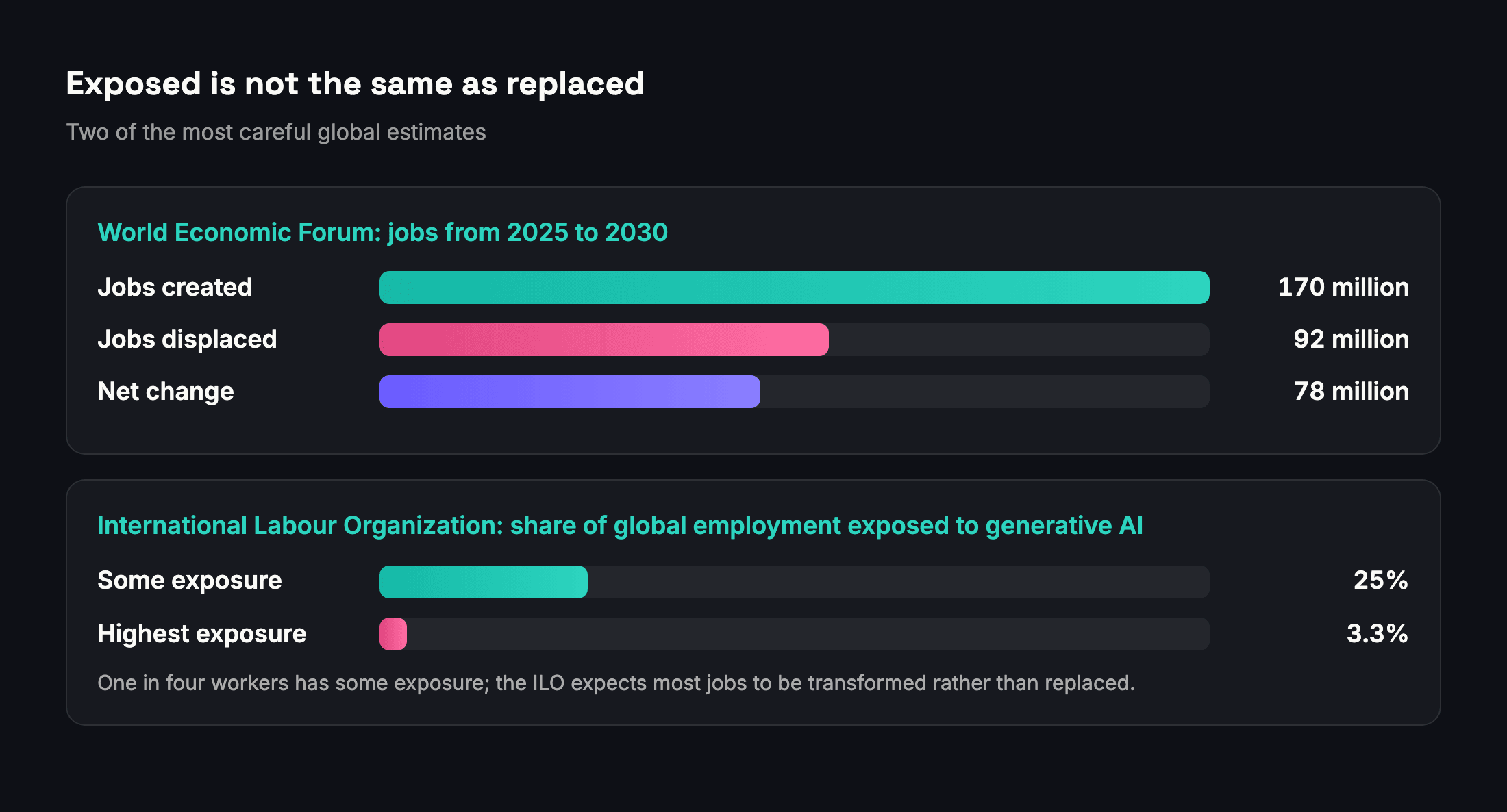
The International Labour Organization’s 2025 index is the most careful global estimate. It finds that one in four workers worldwide is in an occupation with some exposure to generative AI, but only 3.3% of global employment falls in the highest exposure category. Exposure is much higher in rich countries (34% of employment) than in low-income countries (11%), clerical occupations are the most exposed group, and in high-income countries the most exposed jobs make up 9.6% of women’s employment against 3.5% of men’s, because women are more often employed in clerical and administrative work. The ILO’s conclusion is that “transformation of jobs is the most likely impact”, because most occupations consist of tasks that still require human input, according to the ILO.
Researchers at Microsoft took a different approach. They analyzed 200,000 anonymized conversations with Bing Copilot to see which work activities people actually use AI for, and how successfully. The occupational groups with the highest “AI applicability” were media and communication workers, which include writers, editors, interpreters and translators, followed by sales representatives, information and record clerks, mathematical science occupations, and tour and travel guides. The lowest scores went to jobs that are physical or hands-on, such as forestry workers, groundskeepers, nursing assistants, plant operators and construction trades, the Microsoft researchers found. But the authors warned explicitly against reading their scores as a list of jobs to be eliminated.
“This would be a mistake, as downstream consequences of new technologies are very hard to predict and often counterintuitive.” Kiran Tomlinson and colleagues, Microsoft Research, on treating AI applicability scores as job-loss predictions
Their example is a good one. When automated teller machines spread, they took over the core task of bank tellers, counting out cash. But they also made it cheaper to open branches, so for years the number of bank teller jobs actually increased, and tellers moved toward customer service and sales. Technology changes what a job is before it changes how many people do it.
The World Economic Forum’s Future of Jobs Report 2025, based on a survey of more than 1,000 large employers covering 14 million workers, puts numbers on that churn. Between 2025 and 2030, employers expect structural changes to touch 22% of today’s jobs: 170 million new jobs created and 92 million displaced, a net gain of 78 million. Workers can expect 39% of their existing skills to change or become outdated, and 40% of employers plan to reduce staff whose skills become less relevant, according to the WEF. In other words, the same forecast that predicts millions of losses also predicts a larger number of new jobs; the people who lose old jobs are not automatically the ones who get the new ones.
The 15 jobs most at risk, and why
The list below combines four kinds of evidence: what employers told the World Economic Forum about the jobs they expect to decline fastest, which occupations are most exposed according to the ILO and Microsoft studies, which jobs the public and experts name in Pew’s surveys, and what companies have actually done. A job made the list when several sources point the same way. The order and the timing are our judgment, not a forecast from any one study, and “at risk” means the number of people doing the job is likely to fall, not that every such job will vanish.
Timing differs a lot. Some of these jobs are already shrinking, mainly because of software and self-service rather than generative AI: postal clerks, bank tellers, cashiers and data entry clerks. Others are changing quickly now, as generative AI takes over drafting, answering and translating: customer service, administrative work, bookkeeping, sales calls, translation, writing, journalism, design, legal support and junior programming. The last group, drivers and factory workers, depends on robots and self-driving vehicles, which move more slowly because they must work safely in the physical world.
1. Data entry clerks
Data entry is the purest example of work that AI and automation do well: reading information from one place, such as an invoice, a form or an email, and typing it correctly into another. Modern AI can read scanned documents, handwriting and messy emails, extract the fields that matter and check them against rules, at a fraction of the cost and almost instantly. The World Economic Forum lists data entry clerks among the fastest-declining jobs of 2025 to 2030, and clerical work is the most exposed occupational group in the ILO’s index. What remains human is handling exceptions: the document that does not fit the template, the number that looks wrong, the supplier who needs a phone call. Those tasks exist, but they need far fewer people.
2. Customer service and call center agents
Customer service has become the front line of AI in the workplace. Chatbots and voice agents can now answer common questions, look up orders, change bookings and process simple refunds in many languages, around the clock. Salesforce cut about 4,000 support roles as AI agents took over roughly half of its customer conversations, Computing reported, and the Stanford research on young workers names customer support as one of the occupations where hiring of 22 to 25 year olds has fallen most. Geoffrey Hinton, the Nobel-winning AI pioneer, said in 2025 that he would be “terrified” to work in a call center.
But customer service also shows the limits. Klarna said in early 2024 that its AI assistant was doing the work of 700 agents, then reversed course in 2025 and began hiring people again after complaints about quality, because customers wanted to be able to talk to a human, Tech.co reported. The likely future is fewer agents handling the hardest, most emotional or highest-value conversations, with AI doing the routine ones. In countries such as Egypt, where call centers serving customers in Europe and the Gulf employ many young graduates, that shift matters a great deal.
3. Bank tellers
Bank tellers were already declining before generative AI, as people moved to mobile banking, cards and instant payments. Now AI chat assistants can answer account questions, explain fees and walk customers through transfers, and identity checks are increasingly automated. The World Economic Forum lists bank tellers and related clerks as the second fastest-declining job in its 2025 report. The ATM story is a reminder that this decline can take decades and that tellers can move into advice and sales, but the direction is clear: branches are fewer, and each needs fewer people behind the counter.
4. Cashiers and ticket clerks
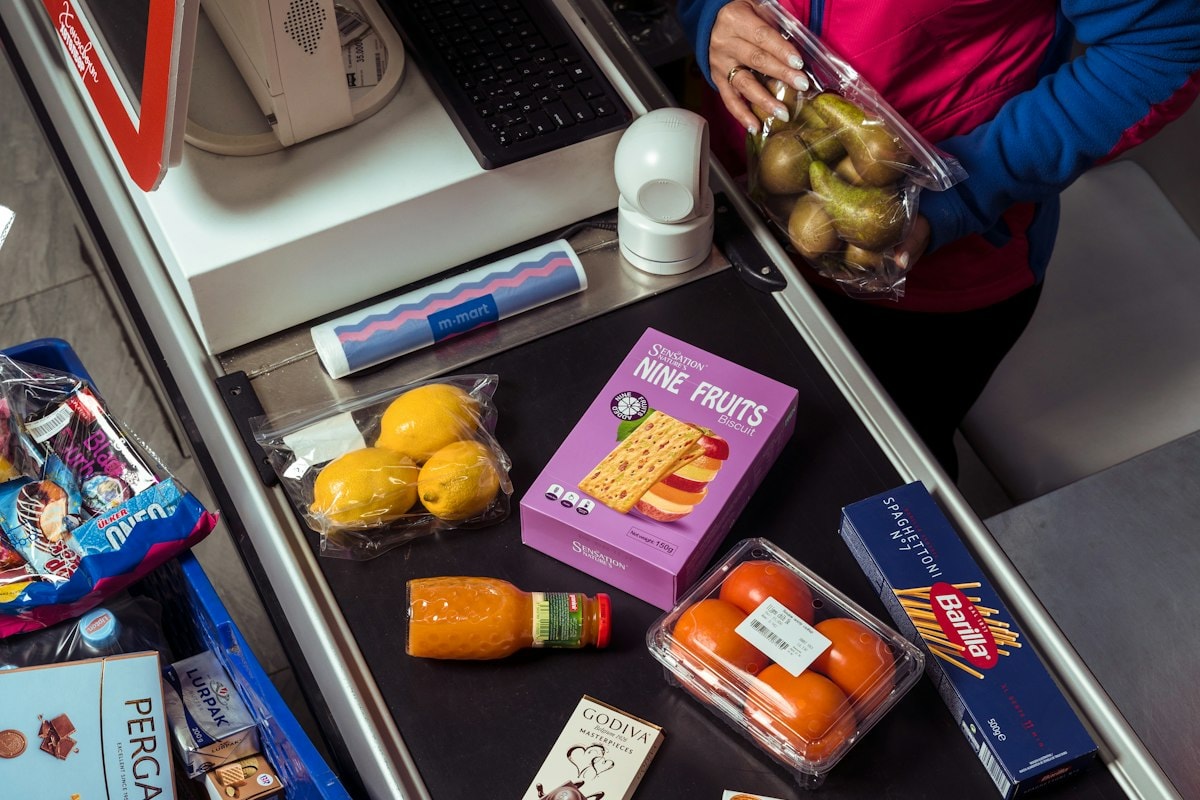
Cashiers top both lists in Pew’s survey: 73% of the public and 73% of AI experts expect fewer cashier jobs over the next 20 years. Much of this is not even generative AI but self-checkout, scan-as-you-shop apps, cameras that recognize products and online ordering. The World Economic Forum names cashiers and ticket clerks among the jobs expected to fall the most in absolute numbers. What remains is the human part of retail: helping customers, preventing theft, handling problems and making a store feel welcoming. Stores will still need people; they will need fewer of them standing at a till.
5. Administrative assistants and executive secretaries
Scheduling meetings, drafting routine letters, taking minutes, filing documents, booking travel and preparing expense reports are tasks that AI assistants built into email, calendars and office software now perform well. The World Economic Forum expects administrative assistants and executive secretaries to see one of the largest declines in absolute numbers by 2030, and the ILO notes that this kind of clerical work is where women in high-income countries are most exposed. The best assistants have always done far more than the tasks in their job description: they manage relationships, protect their boss’s time and spot problems early. Those parts will be valued more; the routine parts are disappearing.
6. Bookkeeping, accounting and payroll clerks
Bookkeeping is rule-based, repetitive and digital, the ideal territory for automation. Accounting software already matches bank transactions to invoices, flags anomalies, calculates payroll and prepares draft reports, and AI makes it better at reading receipts and explaining discrepancies. The World Economic Forum lists accounting, bookkeeping and payroll clerks among the fastest-declining jobs. The work that remains is judgment: interpreting tax rules for a specific business, advising on cash flow, and taking responsibility for the numbers. That is accountancy, not bookkeeping, and it needs more skill and fewer people.
7. Postal service and mail clerks
Postal service clerks top the World Economic Forum’s list of fastest-declining jobs. The reason is less about clever AI than about everything moving online: letters replaced by email, bills by apps, and parcels sorted by machines that read addresses and route packages automatically. AI adds better address recognition, smarter routing and automated customer queries. Delivery itself, getting a parcel to a door, still needs people for now, but the counter and sorting jobs behind it are shrinking quickly.
8. Telemarketers and sales representatives
Telemarketers appear on the World Economic Forum’s list of declining jobs, and sales representatives rank second among occupational groups in Microsoft’s AI applicability scores. AI can now write personalized sales emails, qualify leads, answer product questions, and even hold simple sales calls in a natural voice. Scripted, high-volume selling is the most exposed. Complex sales, where trust, negotiation and understanding a client’s business matter, are far harder to automate, and good salespeople who use AI to prepare will likely outperform those who do not.
9. Translators and interpreters
Translation is one of the clearest cases where AI quality has risen dramatically. Machine translation for common language pairs is now good enough for most everyday documents, websites and product descriptions, and live speech translation is improving quickly. Media and communication workers, the group that includes translators and interpreters, had the highest AI applicability score of all occupational groups in Microsoft’s study. What remains human is high-stakes work: legal and medical documents, literary and marketing texts where tone and culture matter, and interpreting in sensitive settings. For Arabic in particular, dialects, cultural nuance and regional terminology still trip up machines, which creates a role for translators who edit and certify AI output rather than starting from a blank page.
10. Writers, copywriters and editors
Generative AI writes product descriptions, social media posts, emails and reports in seconds. That has already reduced demand for routine content writing, especially low-paid freelance work. Writers and editors belong to the most exposed occupational group in Microsoft’s study. What AI does not do well is original reporting, real expertise, a distinctive voice, and knowing what is true and what matters to a specific audience. Writers who bring those things, and who use AI to research and draft faster, remain valuable. Writers whose work was mostly producing volume are in the most difficult position.
11. Journalists
Fifty-nine percent of the American public and 60% of AI experts expect fewer journalism jobs because of AI, according to Pew. AI can summarize press releases, write routine news such as earnings and sports results, and repackage stories for different platforms. At the same time, AI-written summaries in search results can answer a reader’s question without a click, which threatens the traffic and advertising that pay for journalism. What AI cannot do is attend a court hearing, cultivate a source, verify a claim on the ground or hold power to account. The risk for journalism is less that AI replaces reporters than that it undermines the money that pays for reporting.
12. Graphic designers
Graphic designers are on the World Economic Forum’s list of fastest-declining jobs, which surprised many people who thought creative work was safe. Image generators can produce illustrations, banners, social media graphics and product mockups in seconds, and design tools now include AI that removes backgrounds, resizes layouts and creates variations automatically. Routine production design, the hundredth version of a banner, is most exposed. Brand strategy, art direction, and understanding what will move a particular audience remain human work, and designers who master AI tools can produce far more. For agencies, the change is already visible in how ad creative is made.

13. Legal secretaries and paralegals
The World Economic Forum lists legal secretaries and legal officials among the fastest-declining jobs, and Geoffrey Hinton singled out paralegals as being at risk. AI is good at reviewing large volumes of documents, finding relevant clauses, summarizing case files and drafting standard contracts. Interestingly, Microsoft’s study gave legal support workers a low applicability score, probably because legal teams use specialized legal software rather than a general assistant. The evidence is mixed, and the profession’s rules about responsibility slow change down. Still, routine document work is shrinking, and junior legal roles are where firms are likely to hire less.
14. Junior software developers
Software developers are the most surprising entry on this list, because they build the technology. AI coding assistants now write, test and fix a large share of routine code, and experienced developers using them can do work that once needed junior help. The Stanford Digital Economy Lab found that employment of 22 to 25 year olds in the most AI-exposed occupations, including software development, is about 19% below what it would be had it kept pace with less exposed jobs, while experienced developers show no such gap, the Stanford team reported. Nearly half of the public and of experts in Pew’s survey expect fewer software engineering jobs. Demand for people who can design systems, understand users and take responsibility for software remains strong; the question is how young developers will gain that experience if fewer entry-level jobs exist.
15. Drivers and factory workers
The last group is different, because the threat comes from robots and self-driving vehicles rather than chatbots, and it is moving more slowly. Sixty-two percent of AI experts expect fewer truck driver jobs, and both the public (67%) and experts (60%) expect fewer factory jobs, according to Pew. Robotaxis now operate in several cities and warehouses use more robots every year, but physical work in messy, unpredictable environments remains very hard for machines. Expect change here to be gradual and uneven: first in controlled settings such as warehouses, highways and repetitive assembly, much later in crowded city streets and small workshops.
| Job | Why AI and automation threaten it | What stays human |
|---|---|---|
| Data entry clerks | Reading and retyping information is fully automatable | Exceptions and checks |
| Customer service agents | Chat and voice agents answer routine questions | Complex, emotional and high-value cases |
| Bank tellers | Mobile banking and AI assistants | Advice and problem solving |
| Cashiers and ticket clerks | Self-checkout, cameras, online orders | Helping customers in store |
| Administrative assistants | AI handles scheduling, drafting and filing | Judgment, relationships, priorities |
| Bookkeeping and payroll clerks | Rule-based, digital and repetitive | Interpretation and responsibility |
| Postal and mail clerks | Digital mail and automated sorting | Delivery and service |
| Telemarketers and sales representatives | AI writes, qualifies and calls | Complex sales and negotiation |
| Translators and interpreters | Machine translation quality jumped | High-stakes, cultural and legal work |
| Writers and editors | Generative AI drafts content in seconds | Original reporting, expertise, voice |
| Journalists | Routine news and summaries automated | Investigation and verification |
| Graphic designers | Image generation and automated layouts | Strategy and art direction |
| Legal secretaries and paralegals | Document review and drafting | Accountability and complex cases |
| Junior software developers | AI coding assistants | System design and responsibility |
| Drivers and factory workers | Robots and self-driving vehicles, more slowly | Unpredictable physical work |
Which jobs are hardest for AI to replace?
The safest jobs share three features: they are physical, they happen in unpredictable places, and they depend on human trust or care. In Microsoft’s study, the occupational groups with the lowest AI applicability were forest and conservation workers, groundskeepers, home health aides and nursing assistants, plant and system operators, extraction workers, construction trades, firefighters, and building cleaning and pest control workers. These jobs involve hands, bodies and situations that are different every time.
Geoffrey Hinton made the same point more bluntly in a 2025 interview. “It’s going to be a long time before it’s as good at physical manipulation as us,” he said, “so a good bet would be to be a plumber”, Legal Cheek reported. He added an important qualification: the advantage lasts only until humanoid robots arrive. Skilled trades, care work and jobs that require a licence and personal responsibility are likely to be among the last affected.

At the same time, AI creates new work. The World Economic Forum expects the fastest-growing jobs between 2025 and 2030 to be big data specialists, fintech engineers, AI and machine learning specialists, software and applications developers, and security management specialists, while frontline jobs such as farmworkers, delivery drivers and construction workers will grow most in absolute numbers, along with nursing, social work, personal care and teaching. The jobs growing fastest are those that build, secure and apply technology, and those that technology cannot easily do.
Is AI already taking jobs? What the 2026 data shows
Yes, but not in the way most people imagine. In the United States, employers have cited AI in 120,136 announced job cuts so far in 2026 through September, about 21% of all announced cuts, making it the leading reason given this year, according to Challenger, Gray & Christmas. That is a large number, but it is spread over a workforce of more than 160 million people, and it has varied month to month: in September, AI was only the fifth most cited reason, with 3,961 cuts.
The clearer effect is on hiring. The Stanford Digital Economy Lab found no widespread, economy-wide displacement through June 2026, but a growing gap for young workers in AI-exposed occupations, now about 19%. The gap comes mainly from companies hiring fewer young people, not from firing existing staff, and it is concentrated in jobs where AI automates tasks. In jobs where AI is used to help people rather than replace their work, employment is flat or rising.
The people who build AI have changed their tone. Sam Altman said in May 2026 that he was “delighted to be wrong” about how many entry-level office jobs AI would eliminate, and that he did not expect a “jobs apocalypse”, PYMNTS reported. Others warn that the full effect has not arrived yet: the head of the International Monetary Fund, Kristalina Georgieva, called AI “a tsunami hitting the labor market” in January 2026 and warned that entry-level tasks are disappearing, Fortune reported. Both can be right: the change so far is slower than the loudest predictions and faster than the reassurances.
What would superintelligence mean for jobs?
Everything above describes AI as it exists in 2026: powerful, uneven and dependent on human checking. Superintelligence, AI far better than humans at almost all intellectual work, would be different. If it arrived, very few office jobs would be protected by their complexity, and the debate would shift from which jobs are exposed to how a society shares the wealth that machines produce.
The leaders of the industry disagree sharply about this future. Anthropic’s Dario Amodei warned in 2025 that AI could eliminate half of all entry-level white-collar jobs within five years, and said in January 2026 that the disruption could be “unusually painful”, CNBC reported. Nvidia’s Jensen Huang has argued the opposite, that AI will create more and better jobs, Axios reported. Physical work would follow later, as Hinton’s warning about humanoid robots suggests, because robots depend on factories, materials and energy, not only on software.
Our own view, which is a judgment rather than a forecast, is that nobody can tell you when or whether superintelligence will arrive, so the sensible approach is to plan for the AI that exists now while watching for signs of something bigger. For most workers, the practical question for the next five years is not whether a superintelligence will take their job but whether a colleague using today’s AI will do it faster.
Which jobs are most exposed in Egypt and the Gulf?
The global studies have a regional twist. The ILO finds that exposure to generative AI is three times higher in high-income countries, where 34% of employment is exposed, than in low-income countries, at 11%, because rich economies have more office and clerical work. The Gulf states are high-income economies with large administrative sectors, many government and back-office roles, and a big share of customer-facing service jobs, so a larger part of their workforce does exposed work. At the same time, Gulf workers are among the heaviest users of AI at work, and in Ipsos surveys the UAE is one of the countries where most people expect AI to create more jobs than it destroys.
Egypt’s exposure is different in kind. Much of its workforce is in agriculture, construction, retail and informal work, which AI barely touches. But Egypt has also built a large outsourcing industry, with young graduates working in call centers, translation, content moderation, design and back-office services for clients in Europe, the Gulf and North America. Those are precisely the services that AI is learning to provide, which means Egypt could feel AI through lost export contracts before it feels it in local offices. This is our reading of the evidence rather than a finding of any single study, and it suggests that Arabic-language skill, cultural judgment and the ability to supervise AI output are the best protection for that workforce.
What should workers do now?
The surveys contain a useful clue. Workers who use AI daily or several times a week report acute fear that their job will be eliminated within five years at more than twice the rate of less frequent users, probably because they can see what it does, and a respectful, supportive manager makes that fear significantly smaller, Gallup found. That awareness is an advantage if it leads to action. Practical steps for anyone whose job appears on the list above:
- Learn the AI tools of your own job first. The biggest short-term risk is not AI itself but a colleague who uses it well. Become that colleague.
- Move toward the parts of your job AI does badly. Exceptions, judgment calls, relationships, negotiation and responsibility are the parts employers will still pay for.
- Build proof, not just credentials. A portfolio, a track record of results and references matter more when AI can produce polished work on demand.
- Combine skills. A translator who understands marketing, a designer who understands data, or a customer service agent who understands the product deeply is harder to replace than a specialist in one routine task.
- For students and graduates: look for the second rung. Entry-level hiring is where AI bites first. Internships, apprenticeships, freelance projects and smaller companies can offer the experience large employers now hire less of.
- Consider hands-on and care careers seriously. Skilled trades, health care and roles that require physical presence and trust are among the least exposed.
Our view
This section is our judgment, not a summary of the studies.
The most honest answer to “which jobs will AI replace?” is: fewer whole jobs than people fear, and more tasks than people expect. The jobs at real risk are those where the work is mostly routine information processing and where nobody is paid to take responsibility for the result. In those jobs, the number of people will fall, sometimes sharply.
The greatest danger right now is not unemployment but a broken ladder. If companies stop hiring juniors because AI does junior work, there will be no experienced professionals in ten years. Employers, universities and governments need to treat entry-level hiring and training as a shared problem, not an individual one.
Superintelligence would change these conclusions, but nobody knows when, or whether, it will arrive. Until then, the evidence favors people who learn to use AI over people who ignore it, and both over people who are told to wait and see.
What this means for marketing teams and agencies in Egypt and the Gulf
Marketing is one of the fields where AI arrived earliest, and the jobs on this list include several that agencies employ directly. For teams in the region:
- Copywriting, design and translation will change first. Expect clients to ask for more versions, faster and cheaper. Agencies that combine AI production with strong Arabic and cultural judgment will win; agencies selling volume alone will struggle.
- Customer messaging is moving to AI agents. WhatsApp and Messenger conversations are increasingly handled by bots. Keep a human route for complex and emotional cases, as Klarna’s experience shows.
- Media buying is changing, not disappearing. Meta’s own AI now automates much of targeting and bidding, which moves the media buyer’s value toward strategy, creative testing and honest reporting to clients.
- Protect your juniors. Agencies depend on people learning the craft. Use AI to remove drudgery from junior roles, not to remove the roles.
- Explain the change to clients. Clients read the same headlines as everyone else. Being clear about where you use AI and what people still do builds trust.
Key takeaways
- Most people expect AI to reduce jobs: 79% of Americans within ten years, and more expect losses than gains in 34 of 37 countries, but only about one in ten expects to lose their own job within five years.
- The public and experts agree that cashiers are the most replaceable job; they disagree most on truck drivers, where experts are far more pessimistic.
- The jobs most at risk combine routine information work with clear rules: data entry, customer service, bank tellers, cashiers, administrative assistants, bookkeeping clerks, postal clerks, telemarketers, translators, writers, journalists, graphic designers, legal secretaries and junior programmers, with drivers and factory workers affected more slowly.
- Exposure is not replacement: the ILO puts one in four workers in exposed jobs but only 3.3% in the highest category, and the WEF expects more jobs created than displaced by 2030.
- So far AI shows up mostly as fewer hires for young people, not mass layoffs, though employers cited AI in about one in five announced U.S. job cuts in 2026.
- The safest jobs are physical, unpredictable and built on trust or care; the best protection for everyone else is learning to use AI well.
Questions
Which jobs will AI replace first?
Jobs built on routine information work with clear rules are the most exposed: data entry clerks, customer service agents, bank tellers, cashiers, administrative assistants and bookkeeping clerks. The World Economic Forum lists postal clerks, bank tellers and data entry clerks as the fastest-declining jobs to 2030.
Which jobs do people think AI will replace?
In Pew’s survey, 73% of both the U.S. public and AI experts expect fewer cashier jobs. Large shares also expect fewer jobs for factory workers, journalists and software engineers. Experts are far more pessimistic than the public about truck drivers: 62% against 33%.
Will AI replace my job?
Probably not entirely in the next five years: only 11% of people across many countries think that is very likely. But many jobs will change. The parts most at risk are routine tasks; the parts that remain are judgment, relationships, exceptions and responsibility.
How many jobs will AI destroy?
Nobody knows exactly. The World Economic Forum expects 92 million jobs displaced and 170 million created between 2025 and 2030, a net gain of 78 million. In the United States, employers cited AI in 120,136 announced job cuts in 2026 through September.
Which jobs are safe from AI?
Physical, hands-on jobs in unpredictable settings and jobs built on care and trust are the least exposed: skilled trades such as plumbers and electricians, nursing assistants, construction workers, firefighters and groundskeepers, according to Microsoft’s study.
Is AI already taking jobs?
Yes, but mostly by reducing the hiring of young people rather than through mass layoffs. Stanford researchers found that employment of 22 to 25 year olds in the most AI-exposed jobs is about 19% below their peers, with no widespread economy-wide displacement.
Will superintelligence take all jobs?
If superintelligence arrived, very few office jobs would be protected by their complexity, but nobody knows when or whether it will arrive. Industry leaders disagree: Dario Amodei warns of painful disruption, while Jensen Huang expects more jobs.
What should I do if my job is at risk?
Learn the AI tools of your own job, move toward judgment, relationships and responsibility, build a portfolio of proven results, combine skills, and consider hands-on or care careers. Gallup found that supportive managers significantly reduce workers’ fear of being displaced.
Sources
- Pew Research Center — How the U.S. public and AI experts view artificial intelligence (3 April 2025)
- Gallup — Americans cool toward AI (2026)
- Pew Research Center — Young US adults are increasingly wary of AI, concerned it will take jobs (18 August 2026)
- Gallup — A record share of U.S. workers fear technology could make their jobs obsolete (September 2026)
- Pew Research Center — Globally, more people expect AI to cause job loss than growth (17 September 2026)
- Stanford HAI — AI Index Report 2026, chapter 9: public opinion
- International Labour Organization — Generative AI and jobs: a refined global index of occupational exposure (20 May 2025)
- Tomlinson, Jaffe, Wang, Counts and Suri, Microsoft Research — Working with AI: measuring the applicability of generative AI to occupations (2025)
- World Economic Forum — The Future of Jobs Report 2025 (January 2025)
- Computing — Salesforce confirms 4,000 AI-driven job cuts (September 2025)
- Tech.co — Klarna reverses its AI customer service overhaul (2025)
- Legal Cheek — ‘Godfather of AI’ thinks tech won’t hurt plumbers but could spell trouble for paralegals (June 2025)
- Stanford Digital Economy Lab — No widespread displacement, but the AI employment gap for young workers has widened to 19% (August 2026)
- Challenger, Gray & Christmas — Job cut announcement report, September 2026 (1 October 2026)
- PYMNTS — OpenAI’s Sam Altman retracts AI job cut prediction (May 2026)
- Fortune — IMF chief warns of an AI ‘tsunami’ for entry-level jobs (23 January 2026)
- CNBC — Anthropic CEO Dario Amodei warns AI may cause ‘unusually painful’ disruption to jobs (27 January 2026)
- Axios — Jensen vs. Dario: “There will be more jobs” (14 July 2025)
- Gallup — Using AI more does not reassure workers; managers do (2026)
Send your next client report in minutes
Adams Analytics connects to your Meta ad accounts and builds branded PDF reports in English or Arabic. Free for 7 days — no credit card.
Start free trialWritten by the Adams Analytics team and checked against Meta’s documentation and our own product. Spotted something out of date? Tell us at support@buildincairo.com.