In July 2025, Mark Zuckerberg wrote that developing superintelligence is “now in sight.” A year later, AI already decides which of your ads a person sees, in which placement and at what price, and Meta reports that its newest models lift conversions in ways you can measure. If you buy media on Facebook and Instagram, whether in Cairo, Riyadh or Dubai, the useful question is not whether AI will change your job. It is which parts of the job the machine already does, which parts became more valuable, and how to keep your clients’ results improving while automation takes over more of the buying.
This guide separates what Meta has actually shipped from what is still a forecast, and gives a source for every number, so you can use it with clients and with your own team.

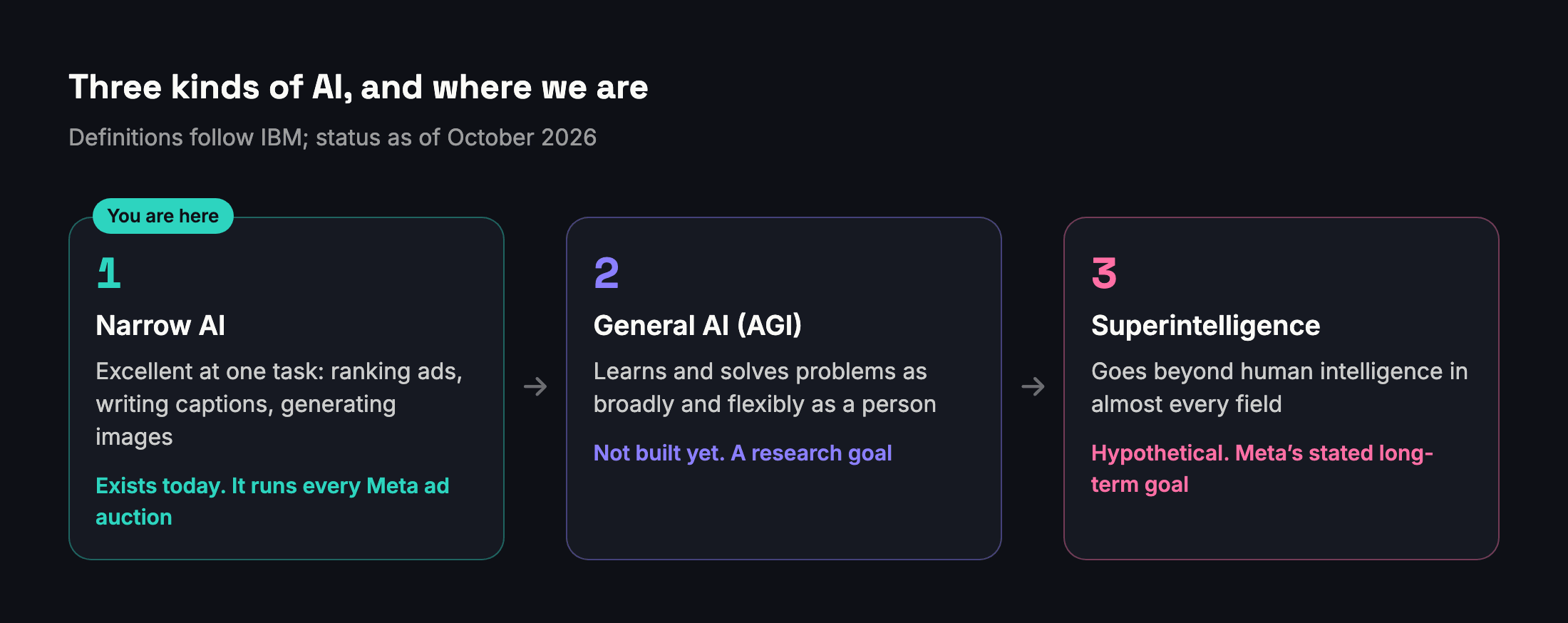
AI, AGI and superintelligence are three different things
The three terms are used as if they meant the same thing. They don’t, and the difference decides what you can plan around.
| Term | What it means | Does it exist today? |
|---|---|---|
| Narrow AI | A system that is excellent at one kind of task, such as ranking ads, writing a caption or generating a product photo | Yes. It runs every Meta ad auction |
| AGI (general AI) | A system that can learn and solve problems as broadly and flexibly as a person | Not yet |
| Superintelligence | AI whose intellectual scope goes beyond human intelligence | Hypothetical |
IBM describes artificial superintelligence as a hypothetical AI system whose intellectual scope goes beyond human intelligence, and notes that true general AI has not been developed yet either (IBM).
Everything inside Meta’s ad system today is narrow AI, however large the models are. That matters in practice: the system optimizes exactly what you ask it to optimize, using exactly the signals you give it. It does not understand your client’s business. It predicts what people will do, very well, from the data it receives.
Meta’s ambition is bigger. In its letter on personal superintelligence, Meta describes a future in which everyone has an AI that helps them reach their goals, create and connect with other people, and it set up Meta Superintelligence Labs around that goal. On its second-quarter 2026 earnings call, Mark Zuckerberg said the lab had just shipped its Muse Spark 1.1 and Muse Image models.
Meta says its goal is to put superintelligence “directly into people’s hands” instead of keeping it in one place.
A company’s goal is not a delivery date. Nobody can tell you when superintelligence will arrive, or whether it will. What you can plan around is what Meta is already putting into its ads, and that is a lot.
The AI that already runs your Meta campaigns
Every time someone opens Facebook or Instagram, several AI systems work in sequence to choose an ad for them:
- Retrieval (Andromeda). Meta’s retrieval engine narrows tens of millions of candidate ads down to a few thousand that might be relevant to this one person. When Meta introduced it, it reported a 6% improvement in recall and an 8% improvement in ad quality on selected segments (Engineering at Meta).
- Ranking (GEM and the Generative Recommender). Meta’s Generative Ads Model, GEM, helps predict which ads each person is likely to act on. Meta says it raised ad conversions by 5% on Instagram and 3% on Facebook Feed in the second quarter of 2025 (Engineering at Meta). In 2026 Meta added the Meta Generative Recommender, which uses large language models to reason about the ad and the person together instead of scoring each ad on its own.
- Automation (Advantage+). Advantage+ campaigns hand budget, audience and placement decisions to the system. Meta said its Advantage+ end-to-end solutions passed $75 billion in annual revenue run-rate in the second quarter of 2026.
- Creative (generative AI tools). In the same quarter, Meta said more than 9 million small businesses used at least one of its AI creative tools, and that use of image generation more than doubled.
- New signals (Meta AI conversations). Since December 16, 2025, in most regions, Meta uses people’s interactions with its AI features to personalize the content and ads they see, except for sensitive topics such as religion, health and politics (Meta). Meta says more than 1 billion people use Meta AI every month.

None of these systems asks for your permission ad by ad. They work inside every campaign you run, whether you choose manual settings or not. For a deeper look at how retrieval and ranking choose an ad, and what to change in your account structure because of them, read our guide to Andromeda and GEM.
What the numbers say about results
The headline numbers are good. On its second-quarter 2026 call, Meta said its newest ranking work, combined with GEM, produced an 8.3% increase in ad clicks and a 15.7% increase in conversions on Facebook. Early tests that used language models to understand what people like added 1% to app event conversions on Instagram. And in one example Meta gave, an Indian apparel brand called Underneat moved from manually built campaigns to Advantage+ sales campaigns with automatic audience, placements and budget, and saw a 13% incremental lift in purchases and 16% more add-to-cart conversions.
Advertisers are paying for those gains too. In the same quarter, Meta’s revenue was $60.8 billion, up 28% from a year earlier. The number of ad impressions grew 14% and the average price per ad rose 12%. Meta attributed the higher price to better ad performance, a stronger economy than a year before, and currency movements.
Two cautions keep these numbers useful:
- They are averages from Meta’s own tests of Meta’s own systems. They tell you the direction of the platform, not what happened in your account last month.
- When the price per ad rises, part of the improvement goes to the platform. Your job is to make sure your client gets their share, and to show it with their own numbers.
What changes in the media buying job
Meta is open about where it is heading. According to a Wall Street Journal report summarized by Reuters, Meta aims to let brands fully create and target ads with its AI tools by the end of 2026: a brand would provide a product image and a budget, and the AI would generate the image, video and text, choose who sees the ad and suggest how much to spend.
The rest of the industry is moving the same way. Marketing leaders surveyed by Gartner expect AI-driven automation of marketing work to more than double, from 16% in 2026 to 36% by 2028. In the IAB’s 2026 outlook, two-thirds of U.S. buyers said they are focused on agentic AI for ad buying and campaign execution, and 38% called understanding generative AI a major challenge, 14 points more than in 2024.
What this means in practice: the mechanical part of media buying is moving to the machine, and the parts that need judgment are becoming the whole job.
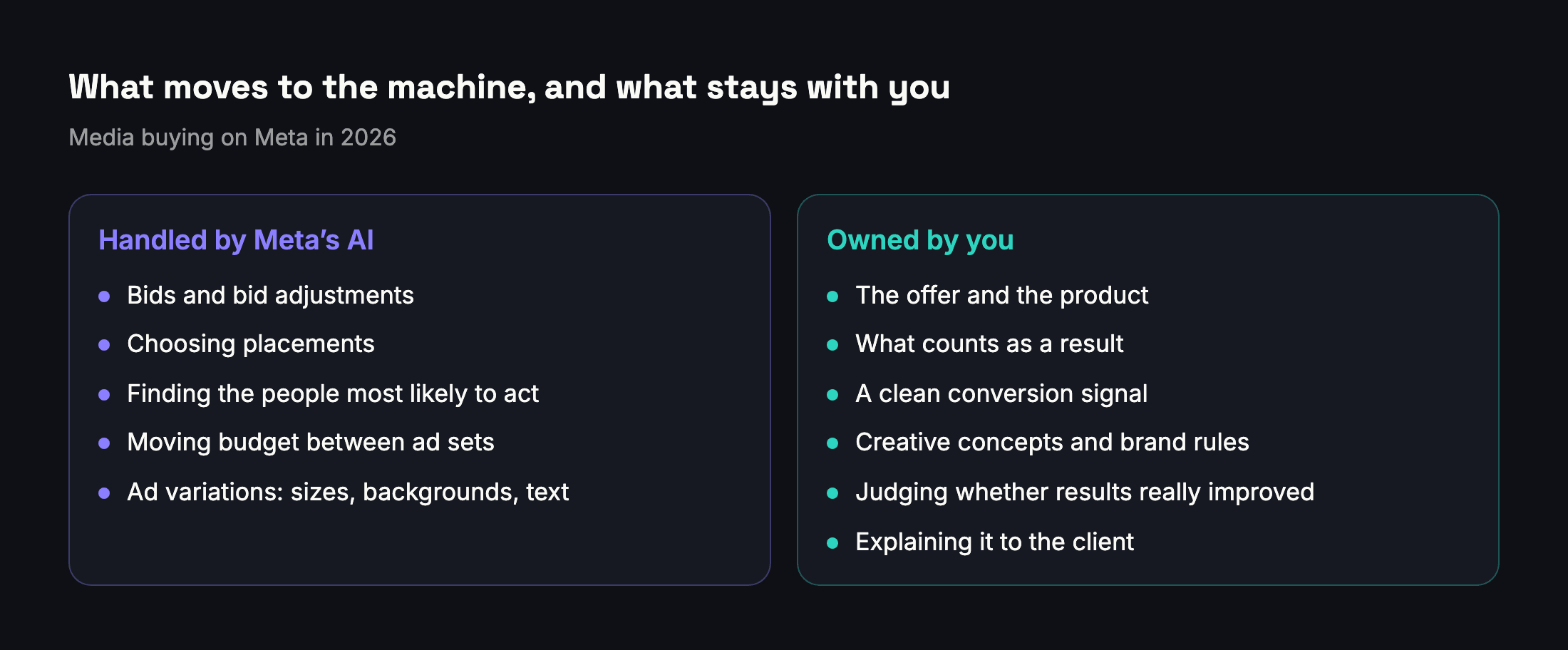
Tasks moving to the machine include bidding, choosing placements, finding the people most likely to act, pacing budget between ad sets, and producing variations of an ad in different sizes and wordings. Tasks staying with you include deciding what to sell and with which offer, defining what counts as a result, keeping the conversion signal clean, setting the creative direction and the brand’s rules, judging whether results really improved, and explaining all of it to the client.
The honest consequence: a media buyer whose value was choosing interests, duplicating ad sets and adjusting bids by hand has less to do every quarter. A media buyer who can run the whole system, from the offer to the report, is worth more than before, because the system amplifies whatever it is given, good or bad.

The new skill stack for media buyers
1. Signal quality
Meta’s AI optimizes toward the event you choose, so the event has to be the right one and it has to arrive reliably. That means a pixel and the Conversions API sending the same purchases without counting them twice, optimizing for the deepest event that still has enough volume, and passing back sales that happen outside the website. For businesses that sell inside WhatsApp chats, that last step is now possible too, as our guide to WhatsApp AI agents explains.
2. Creative strategy at volume
When AI can produce ten versions of an ad in a minute, versions stop being scarce. What stays scarce is genuinely different ideas: different angles, different people on screen, different formats, different reasons to buy. Meta’s own guidance now treats ads that look alike as variations of one creative, so the variety of concepts matters more than the number of files. Read how to build an AI creative system on Meta.
3. Measurement clients can trust
The more decisions the platform makes on its own, the more your client depends on you to tell them what actually happened. That means comparing like with like, judging each goal on its own cost per result, treating small samples as noise, and running lift tests when the budget allows it. Our guide on comparing two periods covers the method step by step.
4. Business economics
A cheaper message or purchase is only good news if it is profitable. Knowing the client’s margin, their return rate and the cost per order at which they break even turns you from someone who runs ads into someone who protects profit. It also changes the conversation with the client from cost per click to money made.

5. Directing AI agents
Agents are starting to do work with several steps: drafting campaigns, writing copy, answering customers. The skill is to give them clear goals and rules, to check what they produce before it goes live, and to know when a person has to decide. Treat AI output like the work of a fast junior colleague: useful, quick, and always in need of review.

How to use AI to improve results today
These steps work with the AI in Meta’s system rather than against it:
- Send a clean, valuable signal. Use the pixel and the Conversions API together, optimize for purchases when there are enough of them, and send order value so the system learns which customers are worth more.
- Consolidate. An ad set generally needs about 50 optimization events within seven days of its last significant edit to leave the learning phase (Meta). A few larger campaigns learn faster than many small ones.
- Let creative do the targeting. Start broad, and let different concepts attract different people.
- Refresh concepts on a schedule. Use AI tools to produce versions, but add genuinely new ideas every few weeks.
- Don’t edit during learning. Large changes to budget or creative send the ad set back to learning.
- Judge each goal on its own cost per result. Messages, purchases and leads are different results with different prices; never add them up into one number.
- Keep a person in the loop. Read every AI-generated claim, price and image before it runs. AI makes mistakes with complete confidence.
What superintelligence could change next
Everything in this section is outlook, not fact. Three directions are already visible in what Meta is building:
- Personal agents that shop. Zuckerberg said Meta will soon have agents that work around the clock on a person’s behalf. When agents compare products for people, clear prices, product details, reviews and delivery terms become part of your advertising, because an agent reads them before a person sees anything.
- Business agents that sell. Meta made its Business Agents available globally on WhatsApp and Messenger in 2026, and says more than 1 million businesses use them every week to talk to customers or complete sales. An ad that starts a conversation now often ends in a sale that AI handles at least partly.
- A business in a box. Meta said it would like to build a service that helps someone start and run a whole business on its platforms. If that happens, the cost of starting falls further and competition for attention rises.
What will not change: someone has to decide what the business sells, to whom, at what margin and what counts as success, and clients will still want a person who is accountable for the result.
How AI is changing Meta itself
AI is now the center of Meta’s business. On the same call, Meta said 3.6 billion people use at least one of its apps every day, and that its ads business, measured in dollars, is growing faster than any other company’s reported ad business. To keep it that way, Meta expects capital expenditures of $130 billion to $145 billion in 2026. In the second quarter alone it spent $31.1 billion, driven by servers, data centers and network infrastructure.

Meta is also adding ways to earn from AI beyond ads: a subscription called Meta One, and a public API for its Muse Spark model. For advertisers, the direction is clear: more automation, fewer manual controls, and AI inside every step of Ads Manager. Plan your skills, and the services you sell, around that.
Where Adams Analytics fits
When the platform makes more of the buying decisions, the work that stays with you is reading the results correctly and explaining them. That is the part Adams Analytics is built for. It connects to your Meta ad accounts and builds reports from Meta’s own numbers: results for each goal with its own cost, a comparison with the previous period that states in plain words what happened, how confident it is and what drove the change, and client reports in Arabic or English.

The machine can find the buyers. Someone still has to prove it worked, and explain it to the person paying.
The short version
- Today’s AI is narrow AI, and it already runs retrieval, ranking, budget, placements and creative in Meta ads.
- Superintelligence is a stated goal at Meta, not a product. Plan around what has shipped.
- Meta reports real gains from AI, but they are averages. Prove your client’s results with their own numbers.
- The job moves from pressing buttons to directing a system: signals, concepts, measurement, economics and agents.
- Media buyers who can explain results become more valuable as the buying becomes automatic.
Questions
Will AI replace media buyers?
AI is replacing the mechanical tasks: bidding, placements, audience selection and ad variations. The parts that need judgment, such as the offer, the conversion signal, creative direction, measurement and client communication, are becoming the core of the job. Buyers whose only skill is operating Ads Manager are the most at risk.
What is superintelligence, and does it exist yet?
Superintelligence means AI whose intellectual scope goes beyond human intelligence. It is hypothetical today. Meta says it is working toward personal superintelligence, but every AI system in Meta’s ads today is narrow AI built for specific tasks.
What are Andromeda and GEM?
They are AI models in Meta’s ad system. Andromeda narrows tens of millions of ads down to a few thousand candidates for each person, and GEM helps rank those candidates by predicting which ads each person is likely to act on.
Should I let Advantage+ run everything?
Use it where you can give it a clean conversion signal and enough conversions, and keep control of the offer, the creative concepts, the budget strategy and the measurement. Judge it by comparing each goal’s cost per result before and after, not by Meta’s average numbers.
What should a new media buyer learn first?
Conversion tracking with the pixel and the Conversions API, creative strategy, comparing results correctly, and the business economics behind a campaign. Those skills keep their value however much of the buying becomes automatic.
Sources
- Meta — Personal Superintelligence, a letter from Mark Zuckerberg (July 2025)
- Meta — Second Quarter 2026 Results Conference Call, transcript (July 2026)
- Engineering at Meta — Meta Andromeda, the personalized ads retrieval engine (December 2024)
- Engineering at Meta — GEM, Meta’s Generative Ads Model (November 2025)
- Meta Newsroom — Improving your recommendations on our apps with AI at Meta (October 2025)
- Reuters — Meta aims to fully automate advertising with AI by 2026, WSJ reports (June 2025)
- Gartner — Marketing leaders expect AI automation of marketing work to double to 36% by 2028 (May 2026)
- IAB — 2026 Outlook Study (January 2026)
- IBM — What is artificial superintelligence?
- Meta Business Help Center — About the learning phase
Send your next client report in minutes
Adams Analytics connects to your Meta ad accounts and builds branded PDF reports in English or Arabic. Free for 7 days — no credit card.
Start free trialWritten by the Adams Analytics team and checked against Meta’s documentation and our own product. Spotted something out of date? Tell us at support@buildincairo.com.