Five years ago, opening an online store meant hiring a developer for the site, a photographer for the products, a copywriter for the descriptions and an agency for the ads. Today one person with a laptop can produce a first version of all four in a weekend, with AI doing most of the production work. That is why so many young people are trying, and why the people who succeed are not always the ones you see in “I made a fortune with AI” videos.
The data shows the shift clearly. In a survey of 1,051 founders who launched businesses in 2025, Gusto found that Gen Z founders started more new businesses than Baby Boomers for the first time (9% of new businesses against 5%), that 71% of Gen Z founders used AI to launch, compared with 42% of Boomers, and that Gen Z founders were five times more likely to say they probably would not have started without AI (Gusto).
This guide looks at what is really driving the speed, how founders use AI at each step, what the first shopping agents are starting to change, and the arithmetic that decides whether a store makes money or only makes sales.

E-commerce is moving faster than ever
Three numbers from the last holiday season show how quickly shopping is changing:
| What happened | The number | Source |
|---|---|---|
| U.S. online holiday spending, November 1 to December 31, 2025 | A record $257.8 billion | Adobe |
| Traffic to U.S. retail sites from generative AI tools | Up 693.4% on a year earlier | Adobe |
| Global Cyber Week orders influenced by AI and agents | 20% of orders: $67 billion of $336.6 billion | Salesforce |
Adobe adds an honest caveat: the number of shoppers who use AI assistants is still modest, even though it is growing very fast (Adobe). Salesforce counts an order as influenced by AI and agents when AI product recommendations or conversational customer service played a part, based on data from more than 1.5 billion shoppers across more than 89 countries (Salesforce).
On the selling side, Meta says more than 9 million small businesses used at least one of its AI creative tools in the second quarter of 2026, and that more than 1 million businesses use its AI business agents every week to talk to customers or complete sales on WhatsApp and Messenger (Meta).
The pattern is the same everywhere: the time between an idea and a live store with live ads has shrunk from months to days, and AI has become part of how people find products, not only how stores are built.
How young founders use AI at every step
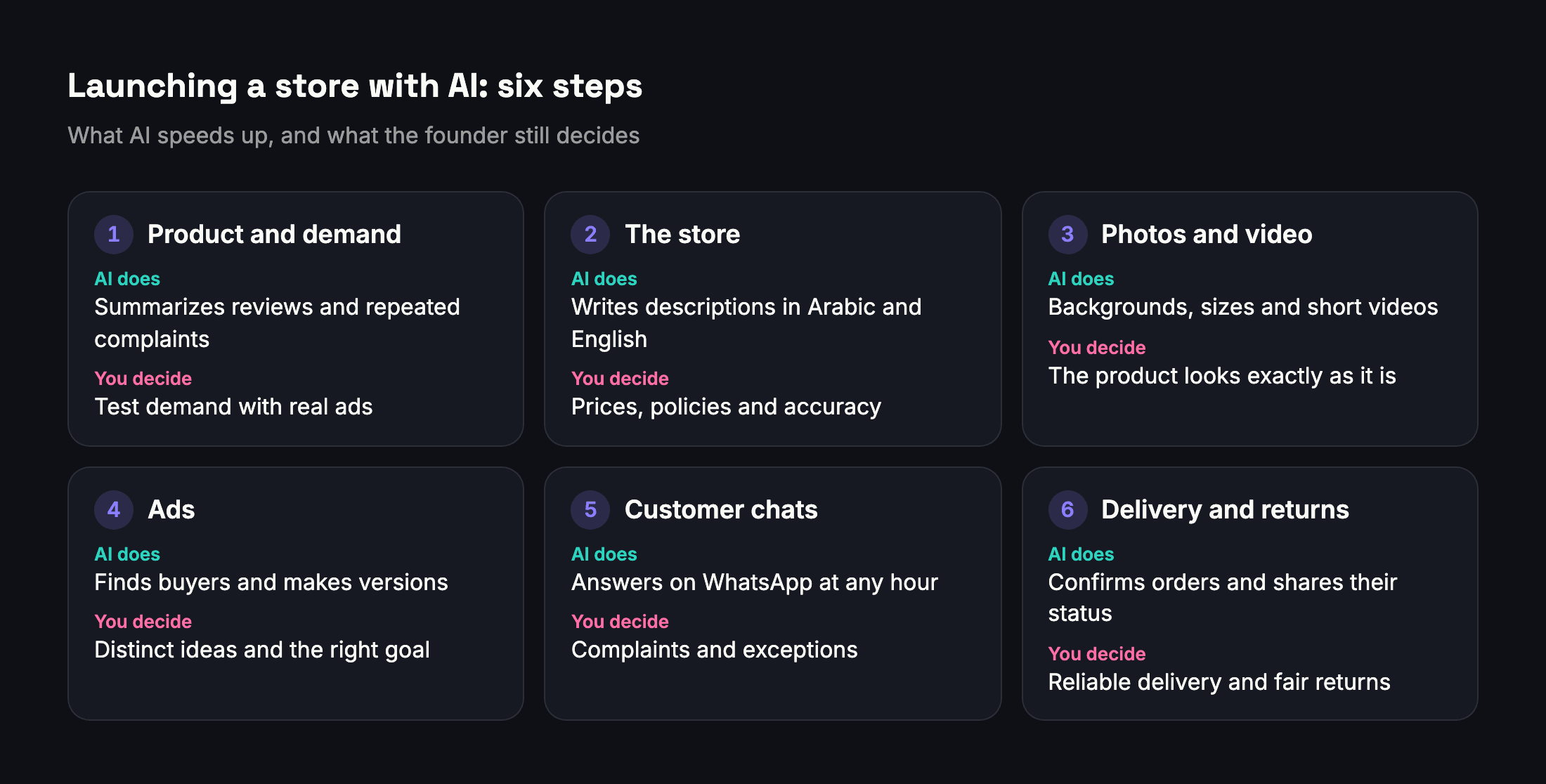
AI does not remove the steps of building a store. It shortens each one, and it moves the hard part from production to judgment.
Finding a product and checking demand
Founders use AI assistants to summarize reviews of competing products, list the complaints buyers keep repeating, and draft offers that answer them. The real test is still the market: a small ad budget on two or three different concepts tells you more about demand than any research tool can.
Building the store
Store builders now write product descriptions, suggest page layouts and translate content. In this region that matters twice: a store can launch in Arabic and English from the first day, which used to mean paying two copywriters and waiting for both.
Product photos and videos
AI can place a product in a new background, extend an image so it fits a placement, or add motion to a still photo, and Meta offers these tools inside Ads Manager. The rule that protects the store: the product in the ad must look exactly like what arrives at the customer’s door, or the money you saved comes back as refunds and angry comments.
Ads
Instead of building ten ad sets with narrow interests, founders start with one broad campaign and many different creative ideas, and let Meta’s AI find the buyers. Our guide to how Meta’s ad AI chooses who sees your ads explains why that works better now than it did a few years ago.
Conversations with customers
In Egypt and much of the region, a large share of orders start in WhatsApp. AI agents can now answer questions about sizes, prices and delivery at any hour, and hand the difficult cases to a person. We cover the setup in our WhatsApp AI agents guide.

Agentic commerce: when AI agents start to shop
The biggest change is not inside the store. It is in how people will reach it. “Agentic commerce” means AI agents that search, compare and pay on a person’s behalf, an early, practical step toward the personal superintelligence that Meta and others talk about. In a few months, the main pieces arrived:
- Buying inside a chat. In September 2025, OpenAI and Stripe launched Instant Checkout in ChatGPT, letting users in the United States buy from U.S. Etsy sellers inside the chat, with over a million Shopify merchants announced as coming soon. Stripe released the Agentic Commerce Protocol behind it as an open standard (Stripe).
- Payments made by agents. The same month, Google announced the Agent Payments Protocol, AP2, an open protocol for payments led by agents, developed with more than 60 organizations including Mastercard, PayPal and American Express (Google Cloud).
- Stores that agents can read. In December 2025, Shopify launched Agentic Storefronts, which help stores get discovered on AI platforms such as ChatGPT, Perplexity and Microsoft Copilot (Shopify).
- Agents on Meta. Meta says it will soon offer personal agents that work around the clock for people, and its business agents already handle customer conversations and sales on WhatsApp and Messenger.

What this means for a store: when an agent compares products for a shopper, it reads your product details, prices, reviews, delivery times and return policy before any person sees your ad. Clear and honest product information becomes a form of advertising.
Are young founders really making a lot of money?
Some are. Most are not, and the data does not say otherwise. The surveys above show that more young people are starting businesses and that AI helped them start; none of them shows that a typical store built with AI is very profitable.
The reason is simple: AI lowers the cost of starting, not the cost of customers. When anyone can launch a store with good photos in a weekend, more stores sell the same products to the same people, and they bid against each other for the same attention. Meta reported that the average price per ad rose 12% year over year in the second quarter of 2026.
The founders who do well tend to share a few habits:
- A real reason to buy from them: a better product, a sharper niche, a brand people remember, or service that beats the big marketplaces.
- Customers who come back, so the cost of winning a buyer is spread across several orders.
- Fast creative testing, with AI for volume and their own judgment for which ideas to keep.
- Tight numbers: they know their cost per order and their break-even point before they raise the budget.
Do the math before you scale
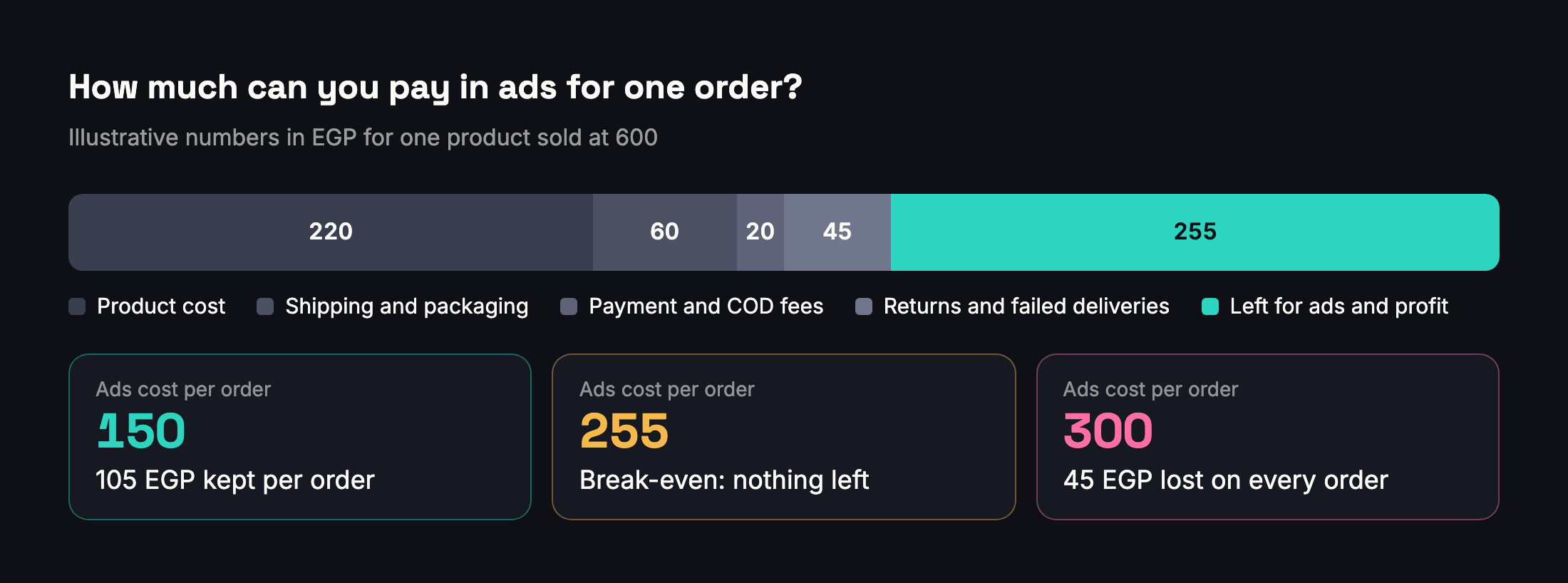
A store that sells a lot and loses money on every order is not a business. The number that decides whether you can scale is the cost per order you can afford to pay for ads.
| Per order (illustrative, EGP) | Amount |
|---|---|
| Selling price | 600 |
| Product cost | −220 |
| Shipping and packaging | −60 |
| Payment and cash-on-delivery fees | −20 |
| Returns and failed deliveries, averaged per order | −45 |
| Left to pay for ads and profit | 255 |
In this example, the store breaks even when ads cost 255 EGP per order. At 150 EGP per order it keeps 105 EGP; at 300 EGP it loses 45 EGP on every sale, however good the ads look in Ads Manager.
If you sell through WhatsApp, work it out the same way: if a conversation costs 20 EGP and one conversation in six becomes an order, ads cost 120 EGP per order. To compare what Meta reports with what your store records, read why Ads Manager and your store orders don’t match.

A 30-day launch plan with AI
- Days 1–5: the offer and the store. Pick one product and one clear promise. Build the store with AI-written copy in Arabic and English, and set up the Meta pixel and the Conversions API before any ad runs.
- Days 6–10: the first creative round. Produce six to ten genuinely different ad ideas: a demonstration, a problem and its solution, a customer’s story, a price offer, a comparison. Let AI help with versions, sizes and captions.
- Days 11–20: one broad campaign. Choose one goal, purchases or messages, give the campaign a budget that can bring enough results, and leave it alone for several days.
- Days 21–25: read the results by goal. Compare the cost per order with your break-even number, keep the two or three best ideas, and replace the rest with new ones.
- Days 26–30: decide. Compare the last week with the week before. If the cost per order is comfortably below your break-even point, raise the budget gradually; if it isn’t, change the offer or the product before you spend more.
Five mistakes AI-built stores make
AI makes some mistakes easier, because it removes the friction that used to slow people down:
- Launching ten products at once. When a product page takes minutes, it is tempting to test everything. The budget then spreads so thin that no product gets enough results to judge.
- Photos that flatter too much. An AI image that improves the product’s color or size wins clicks and loses customers. Every complaint costs you twice: the refund, and the comment under your next ad.
- Copying the video everyone else copied. When a trend video works, a hundred stores remake it with AI within a week. Meta treats near-identical ads as one creative, and shoppers scroll past the hundred-and-first version.
- Chasing the cheapest result. Cheap messages from people who never buy are worse than fewer, more expensive messages from people who do. Judge the cost per order, not only the cost per conversation.
- Nobody answering at night. Ads keep running after you go to sleep. If questions wait until morning, people buy from whoever answered first, which is exactly the gap an AI agent can close.
What stays human
AI can write, design and reply. It cannot make customers trust a store that delivers late, describes its products dishonestly or ignores complaints. Local knowledge stays human too: knowing when Ramadan moves the calendar, how shoppers in each city prefer to pay, and which promise sounds believable in Arabic.

How Adams Analytics helps
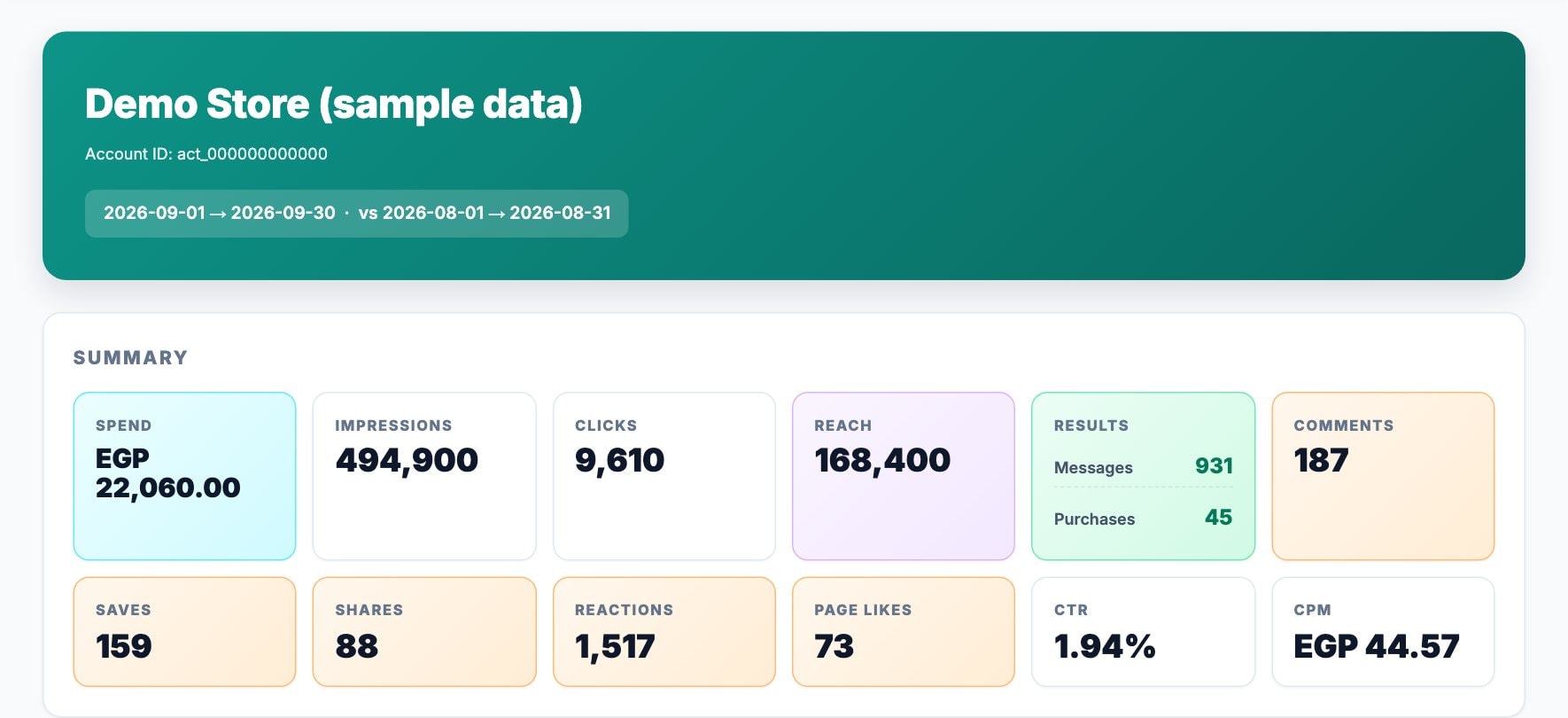
When you sell through ads, you need to know what the ads really produced. The Website Purchase report in Adams Analytics counts the website purchases Meta attributes to your ads, keeps purchases from other campaigns (such as messaging campaigns that also sold) in a separate “assisted” list, and labels the money as attributed purchase value and value after ad spend, never as revenue or profit. For stores that sell through messages, Adams Analytics uses Meta’s own Results figure with a cost per message for each goal, and compares each period with the one before in plain words.
The short version
- AI shrank the time from idea to first sale, and young founders adopted it fastest.
- Shopping traffic from AI tools is growing very fast from a small base, and agents that search and pay are arriving.
- AI lowers the cost of starting, not the cost of customers, and ad prices rise as competition grows.
- Know your break-even cost per order before you scale, and judge every ad against it.
- Accurate product information, honest images and good service are what both people and AI agents reward.
Questions
Can I really build an online store with AI alone?
You can build the first version, from the store and descriptions to the photos, ads and replies, much faster with AI. You still need a product people want, reliable delivery, and someone who checks every claim and image before customers see it.
How much budget do I need to test a product with Meta ads?
Enough to get a meaningful number of results for one goal. If your break-even cost per order is 255 EGP, a test that can only bring three or four orders will not tell you much; plan a budget that can reach dozens of conversations or several orders for each idea.
Is it fine to use AI-generated product photos in ads?
Meta’s own ad tools generate backgrounds and images, so AI imagery is part of the platform. What matters is that the product looks exactly like what the customer receives; otherwise returns and complaints cost more than the photo shoot you saved.
What is agentic commerce?
Shopping in which an AI agent searches, compares and sometimes pays on a person’s behalf. Instant Checkout in ChatGPT, Google’s Agent Payments Protocol and Shopify’s Agentic Storefronts are early examples, and they started in the United States.
How do I know whether my ads are profitable?
Work out how much is left from each order after product cost, shipping, fees and returns. That is the most you can pay in ads per order. Then compare your real cost per order from Meta, goal by goal, with that number.
Sources
- Gusto — For the first time ever, Gen Z entrepreneurs outnumber Baby Boomers in new business starts (May 2026)
- Adobe — Holiday shopping season drove a record $257.8 billion online (January 2026)
- Salesforce — AI and agents propel Cyber Week to a record $336.6B in global spend (December 2025)
- Meta — Second Quarter 2026 Results Conference Call, transcript (July 2026)
- Stripe — Instant Checkout in ChatGPT and the Agentic Commerce Protocol (September 2025)
- Google Cloud — Powering AI commerce with the new Agent Payments Protocol, AP2 (September 2025)
- Shopify — Introducing Shopify Agentic Storefronts (December 2025)
Send your next client report in minutes
Adams Analytics connects to your Meta ad accounts and builds branded PDF reports in English or Arabic. Free for 7 days — no credit card.
Start free trialWritten by the Adams Analytics team and checked against Meta’s documentation and our own product. Spotted something out of date? Tell us at support@buildincairo.com.