Since late 2025, “Andromeda” has become the word media buyers use for everything that changed in Meta ads: campaigns that stopped scaling, interest targeting that seemed to stop mattering, and the constant push for “more creatives.” Most of what you hear is half right. Andromeda is real, but it is one part of a stack of AI models that Meta has described in detail on its own engineering blog. Knowing what each part does tells you what you can still control, and what you should stop fighting.
This guide explains that stack in plain language, with Meta’s own numbers, and turns it into concrete changes to your account structure, your creative and your conversion signal.

How Meta chooses the ad someone sees
When a person scrolls Facebook or Instagram, Meta has a fraction of a second to choose an ad from every ad that could be shown to them. It does it in stages, from cheap and broad to expensive and precise:
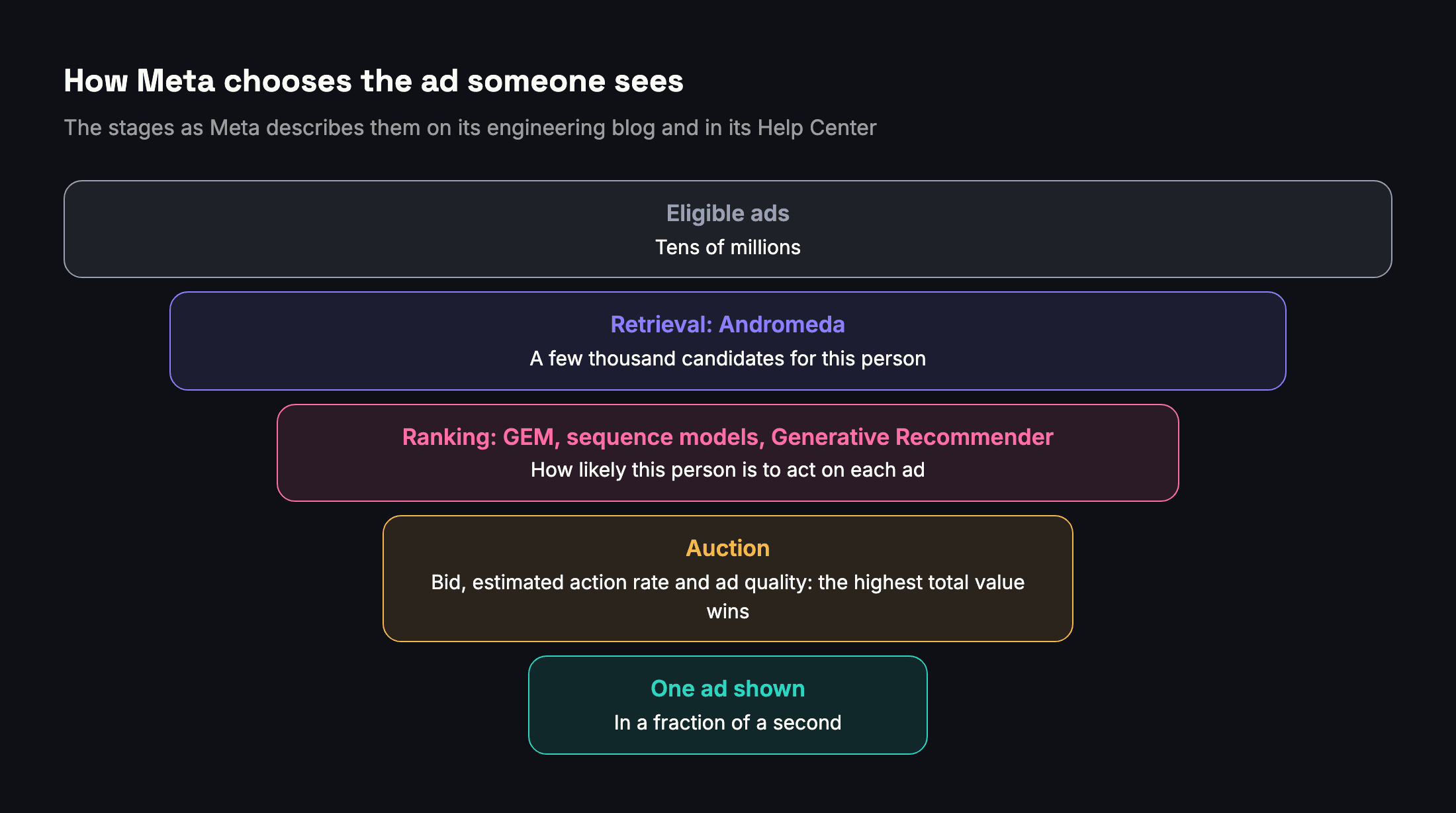
- Retrieval. From tens of millions of eligible ads, Andromeda selects a few thousand that might be relevant to this person.
- Ranking. Larger models, including GEM and newer models that read a person’s sequence of actions, estimate how likely the person is to take the action each advertiser is paying for.
- Auction. The ad with the highest total value wins the impression, and Meta builds that value from the advertiser’s bid, the estimated action rate and the ad’s quality (Meta).
The practical lesson: your ad has to win three times. It has to be retrieved, it has to be predicted to work for this particular person, and it has to be good enough to win the auction at the price you are willing to pay.
Andromeda: the retrieval stage
Meta introduced Andromeda in December 2024 as its personalized ads retrieval engine, running on NVIDIA’s Grace Hopper Superchip and on Meta’s own accelerators. Its job is the first cut: selecting a few thousand relevant ads from tens of millions of candidates. Meta reported that Andromeda improved recall by 6%, which delivered an 8% improvement in ad quality on selected segments (Engineering at Meta).
Meta was explicit about why it built it: Andromeda is designed to make use of the fast growth in the number of ad creatives, much of it produced with generative AI. In the same post, Meta said more than a million advertisers used its generative AI tools to create more than 15 million ads in a single month.
That is why creative became the main lever. In April 2025, Meta’s own marketing team wrote that, with AI-driven ad tools, the focus has shifted from niche targeting to creative diversification as the best way to find the most relevant audiences (Meta for Business). In other words, the ad itself now does much of the targeting: what it shows, who appears in it and what it promises all tell the system who it is for.
GEM, the Generative Recommender and the newest ranking models
Retrieval decides which ads are considered. Ranking decides which of them has the best chance with this person.
- GEM. Meta’s Generative Ads Model is a large foundation model for recommending ads. Meta says it increased ad conversions by 5% on Instagram and 3% on Facebook Feed in the second quarter of 2025 (Engineering at Meta).
- Models that read sequences of behavior. In August 2026, Meta described a ranking design that learns from the order and timing of a person’s actions, such as clicks, views and purchases. A large model processes each person’s long history in advance, and a fast model combines it with the candidate ad in real time. Meta reported a cumulative lift of 6% in conversions on Instagram, 3% in conversions on Facebook and 3.5% in ad clicks on Facebook, and said performance keeps improving as it adds computing power (Engineering at Meta).
- The Generative Recommender. On its second-quarter 2026 call, Meta said it now uses large language models to reason about the content of an ad and a person’s preferences together, instead of scoring each ad on its own (Meta). Combined with GEM and its user understanding models, Meta reported an 8.3% increase in ad clicks and a 15.7% increase in conversions on Facebook.

Two consequences matter for your work. First, these models learn from what people actually do after seeing ads, so a clean, consistent conversion signal is worth more than ever. Second, the newest models read the content of the ad itself, so an ad that is clear about what it sells, and to whom, is easier for the system to match with the right person.
What to change in your account
Structure: fewer, larger ad sets
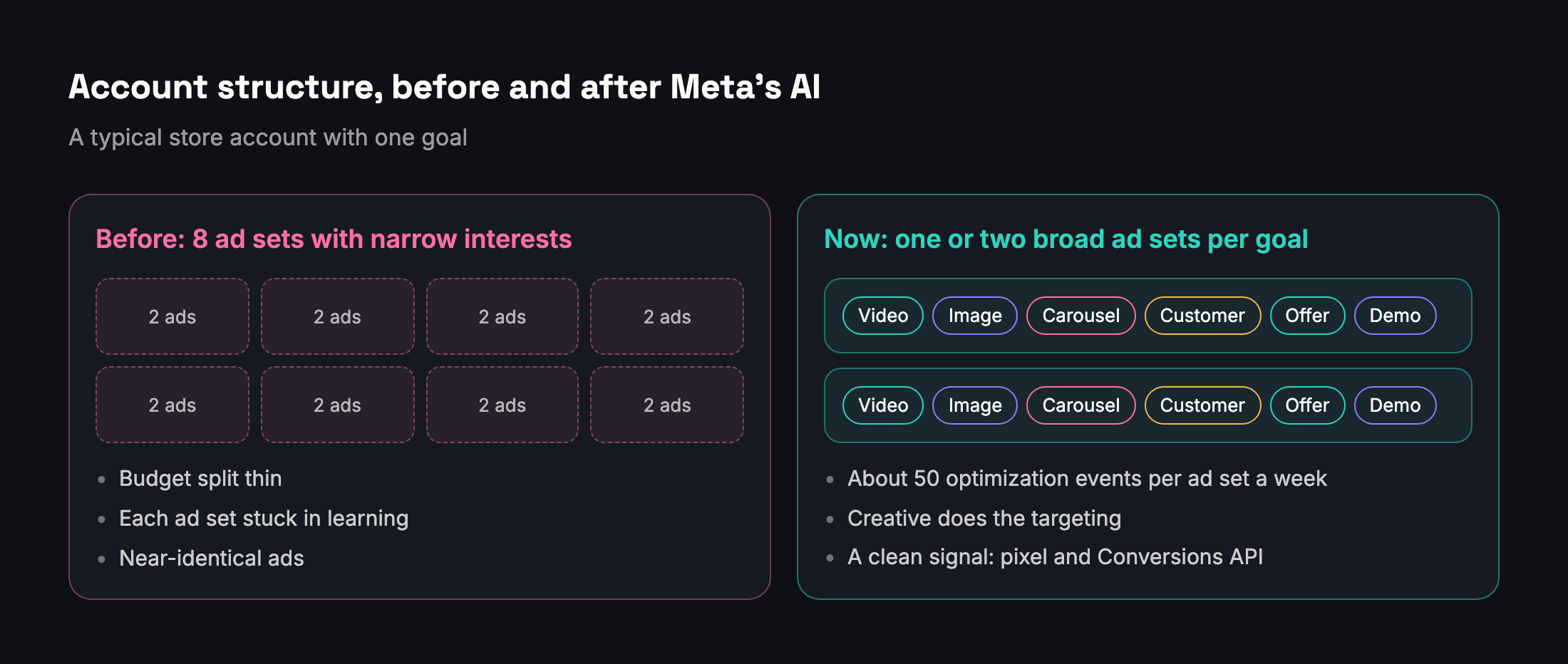
Each ad set learns on its own. Meta’s Help Center says an ad set generally needs about 50 optimization events within seven days of its last significant edit to leave the learning phase (Meta). Splitting a budget across many small ad sets keeps each one short of data. Combine ad sets where the audience and the goal are the same, and keep them apart only where something real differs, such as the country, the goal or a product line with its own price.
Targeting: start broad
Interest and lookalike targeting still exist, but when retrieval and ranking read behavior and creative, a narrow audience mostly limits where the system can look. Start broad, use exclusions only where they are necessary (for example, existing customers in a campaign meant to win new ones), and let different creatives find different people.
Creative: different concepts, not more files
In December 2025, Meta explained that when several ads look or feel alike, they are treated as variations of the same creative, and learning and delivery are shared at the level of that creative (Meta for Business). Ten versions of the same photo with different headlines count as one idea. Meta’s Help Center also describes a Creative diversity metric in Ads Manager that rates how visually similar the images and videos in an ad set are, from low to high (Meta). What helps is ads that differ in the person on screen, the setting, the format, the story and the reason to buy.

Signal: what you optimize for
Choose the deepest event that still happens often enough to learn from, send it from both the pixel and the Conversions API without counting it twice, and include order value where you can. If most of your sales close in WhatsApp, a messaging goal with purchases sent back from the chats beats optimizing for cheap clicks.
Edits: let learning finish
Every significant edit sends the ad set back into learning. Plan budget changes in steps, launch new creative concepts in batches, and give any change several days before you judge it.
Advantage+: what to hand over and what to keep
Advantage+ is where Meta’s AI makes the most decisions. Meta said its Advantage+ end-to-end solutions passed a $75 billion annual revenue run-rate in the second quarter of 2026. Its example: an Indian apparel brand moved from manually built campaigns to Advantage+ sales campaigns with Advantage+ audience, placements and budget, and saw a 13% incremental lift in purchases and a 16% increase in add-to-cart conversions.
| Decision | Hand it to the AI? | Why |
|---|---|---|
| Audience | Usually | Broad audiences let retrieval and ranking find buyers you would not have targeted |
| Placements | Usually | The system finds cheaper results across placements; check the ones sensitive for your brand |
| Budget between ad sets | Usually | It moves money to what is working faster than a person can |
| Automatic creative enhancements | Test first | Check that automatic changes keep your brand rules and your claims accurate |
| Offer, price and product | Never | AI cannot fix an offer people don’t want |
| Conversion event and value | Never | It optimizes exactly what you send it |
| Measurement | Never | You need an independent view of what the spend produced |

A simple setup that works with the AI
If you are starting an account or rebuilding one, this structure gives Meta’s AI room to work while keeping the decisions that matter with you:
- One campaign per goal. Purchases in one campaign, messages in another. Mixing goals in one campaign mixes their prices, and the system optimizes for neither well.
- One or two broad ad sets inside it, split only where something real differs, such as the country or a product line with a very different price.
- Four to six distinct concepts per ad set, each in two or three formats, for example a vertical video, a square image and a carousel.
- A budget that can reach the learning threshold. Multiply 50 by the cost per result you expect. If a purchase costs about 200 EGP, an ad set needs about 10,000 EGP a week, roughly 1,430 EGP a day, to leave learning on time.
- Two new concepts every two to three weeks, and pause the ones whose cost per result is clearly worse once each has enough results to judge.
- A weekly check and a monthly comparison: the cost per result for each goal every week, and a full comparison with the previous month for the client.
How to tell whether it is working
Meta’s numbers are averages across the platform. For your own account, the test is simpler and stricter:
- Compare like with like. The same goal, two periods of similar length, ideally not spanning a sale or a holiday.
- Judge each goal on its own cost per result. Messages, purchases and leads have different prices and never belong in one total.
- Wait for enough results. As a rule of thumb, at least 20 results in each period before you call a change real.
- Look at what drove it. A lower cost can come from cheaper reach, a better ad or a shift of budget between goals, and each one calls for a different response.
- Watch for fatigue. Rising frequency with a falling click-through rate usually means people have seen the ad too often, not that the algorithm turned against you.
Four myths about Andromeda
- “Andromeda killed targeting.” The targeting options still exist. What changed is that creative and behavior signals now do most of the work, so narrow audiences rarely help.
- “You need 50 creatives in every ad set.” You need different ideas. Fifty near-identical ads are treated as one creative.
- “It was an update that broke accounts.” Andromeda is a retrieval engine Meta introduced in 2024 and keeps improving. Sudden drops usually trace back to fatigue, a lost signal, seasonality or edits during learning.
- “With AI, you can’t influence delivery any more.” You influence it through the offer, the creative, the conversion signal, the structure and the budget, which is most of what mattered anyway.
Where Adams Analytics fits
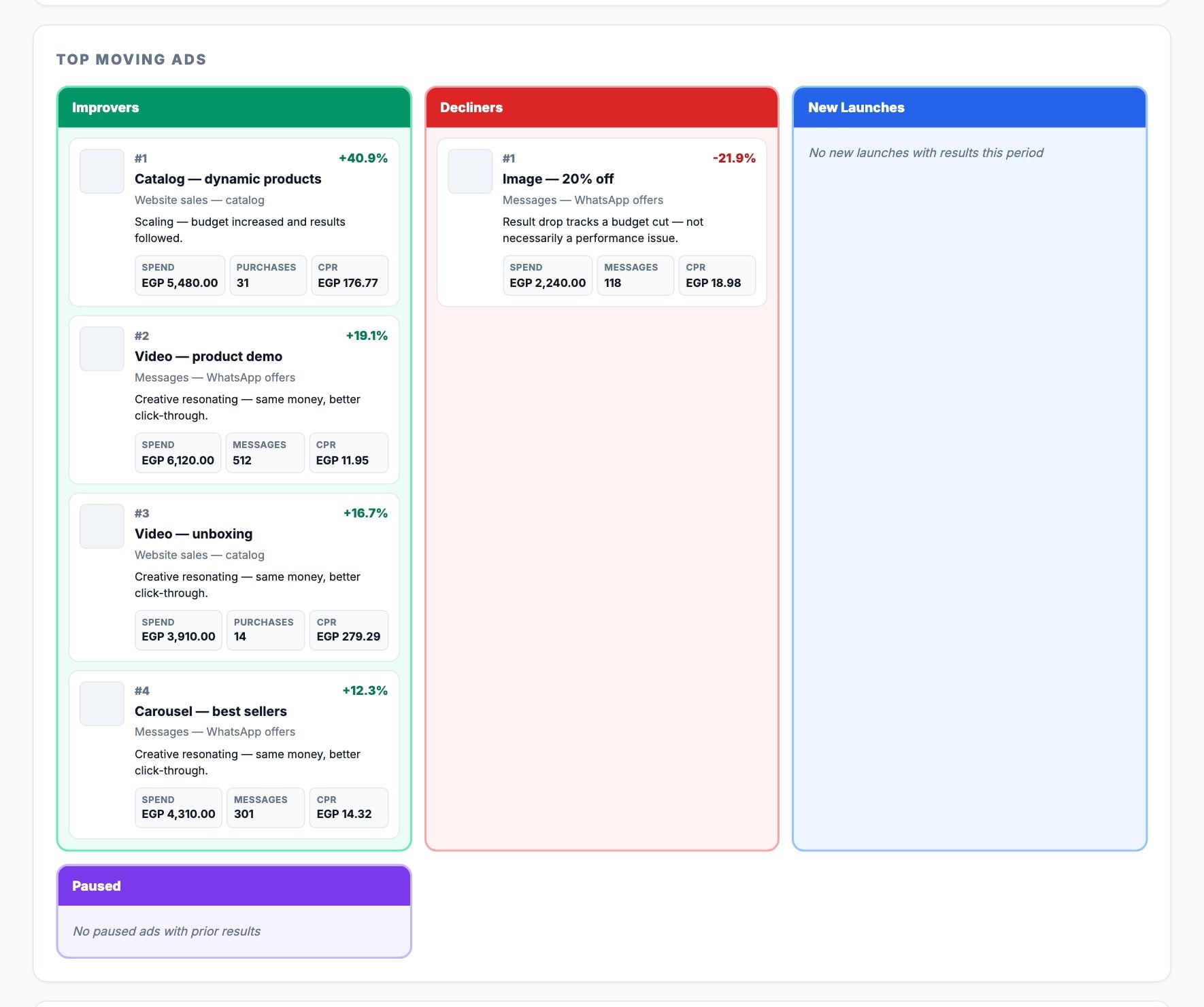
When Meta’s AI makes more of the decisions, you need a clear record of what changed and why. On every plan, an Adams Analytics comparison states what happened in plain words, says how confident it is, and lists what drove the change with a suggested next step for each, in English or Arabic. Its reports show the results for each goal with their own cost, from Meta’s own numbers, and the ads that moved the most between the two periods.
The short version
- Meta chooses an ad in three stages: retrieval (Andromeda), ranking (GEM and newer models) and the auction.
- Creative now does much of the targeting, and ads that look alike are treated as one creative.
- Consolidate so each ad set gets about 50 optimization events a week, and don’t edit during learning.
- Hand audience, placements and budget to the AI; keep the offer, the signal and the measurement.
- Judge changes goal by goal, with enough results, before you credit or blame the algorithm.
Questions
What is Meta Andromeda?
Andromeda is the retrieval engine in Meta’s ad system. For each person, it narrows tens of millions of eligible ads down to a few thousand that might be relevant, before the ranking models and the auction choose the ad that is shown.
Should I stop using interest targeting?
You don’t have to, but test broad audiences against it. Meta now recommends creative diversification over niche targeting, and narrow audiences often limit where the system can find buyers.
How many creatives should an ad set have?
Enough distinct concepts to give the system real choices, which usually means a handful of genuinely different ideas rather than dozens of variations. Ads that look alike are treated as one creative.
What is GEM?
GEM is Meta’s Generative Ads Model, a large AI model that helps rank ads by predicting which ones each person is likely to act on. Meta reported that it raised ad conversions by 5% on Instagram and 3% on Facebook Feed in 2025.
How long should I wait before judging a new campaign?
Until it has left the learning phase and each period you compare has enough results. In practice that usually means at least a week, and about 50 optimization events per ad set.
Sources
- Engineering at Meta — Meta Andromeda, the personalized ads retrieval engine (December 2024)
- Engineering at Meta — GEM, Meta’s Generative Ads Model (November 2025)
- Engineering at Meta — From user sequences to scaling laws: a multi-stage architecture for Meta’s ads ranking (August 2026)
- Meta — Second Quarter 2026 Results Conference Call, transcript (July 2026)
- Meta for Business — The Creative Advantage: unlocking the power of diversification with Meta Andromeda (April 2025)
- Meta for Business — Demystifying creative diversification (December 2025)
- Meta Business Help Center — About ad auctions
- Meta Business Help Center — About the learning phase
- Meta Business Help Center — Creative diversity
Send your next client report in minutes
Adams Analytics connects to your Meta ad accounts and builds branded PDF reports in English or Arabic. Free for 7 days — no credit card.
Start free trialWritten by the Adams Analytics team and checked against Meta’s documentation and our own product. Spotted something out of date? Tell us at support@buildincairo.com.