In Egypt and much of the Gulf, a large share of Meta ad budgets doesn’t send people to a website at all. It sends them to WhatsApp, where the sale happens in a conversation: a question about the size, then the price, the delivery date, the address and a confirmation. The ads were rarely the weak point. The chat was: replies that arrive hours late, the same ten questions answered a hundred times a day, and conversations that end with “I’ll think about it” and no follow-up.
That part is changing fast. In 2026 Meta made its Business Agents available globally on WhatsApp and Messenger, and it says more than 1 million businesses use them every week to talk to customers or complete sales (Meta). Put an AI agent behind a click-to-WhatsApp ad and the economics of a messaging campaign change. This playbook explains how the pieces fit, what to automate and what to keep human, the pricing rule that rewards fast replies, and how to measure everything from the ad to the delivered order.

What changed in 2025 and 2026
- July 2025. At its Conversations event, Meta said it was expanding Business AIs to more businesses in Mexico and exploring a Business AI that could recommend products and help sell on a business’s own website. It also announced voice and video calling for businesses on WhatsApp, ads in WhatsApp Status that can be created from Ads Manager, and one place in Ads Manager to manage marketing across WhatsApp, Facebook and Instagram (WhatsApp Business).
- 2026. Meta made Business Agents available globally on WhatsApp and Messenger and began rolling them out on Instagram. For large companies, it introduced the Meta Business Agent Platform, which gives enterprises the infrastructure to build, customize and deploy their agent at scale on WhatsApp, with controls, guardrails and measurement built in.
- What comes next, according to Meta. Mark Zuckerberg said an agent that talks to your customers every day learns over time and can bring those insights back to you: summarizing conversations, digesting what happened overnight and surfacing what customers ask for. He added that Meta wants to build this into a “business-in-a-box” service that helps people start and run a whole business on its platforms.
One example Meta shared shows the size of the change. Movida, one of Brazil’s largest car rental companies, put a Business Agent on WhatsApp to handle the whole booking, from choosing a car and getting a price to paying, in a single conversation. Returning customers could book in as few as three messages. Over one month, Movida reported 44% more daily bookings through WhatsApp than in the same period a year earlier, and said 85% of conversations in the channel were resolved entirely by the AI agent, without a person.
It matters even more in this region. Many businesses in Egypt and the Gulf run most of their sales through WhatsApp, a lot of the questions arrive late at night, especially in Ramadan, and cash-on-delivery orders need a clear confirmation of the name, address and price before anything is shipped. Those are exactly the tasks an agent does well: answering instantly, at any hour, and writing the order back to the customer in a standard format.
How click-to-WhatsApp ads and AI agents fit together
A click-to-WhatsApp ad opens a chat with the business, often with a message already written for the customer to send, so the business knows what the person came for (Meta for Developers). With an agent behind it, the path from ad to order looks like this:
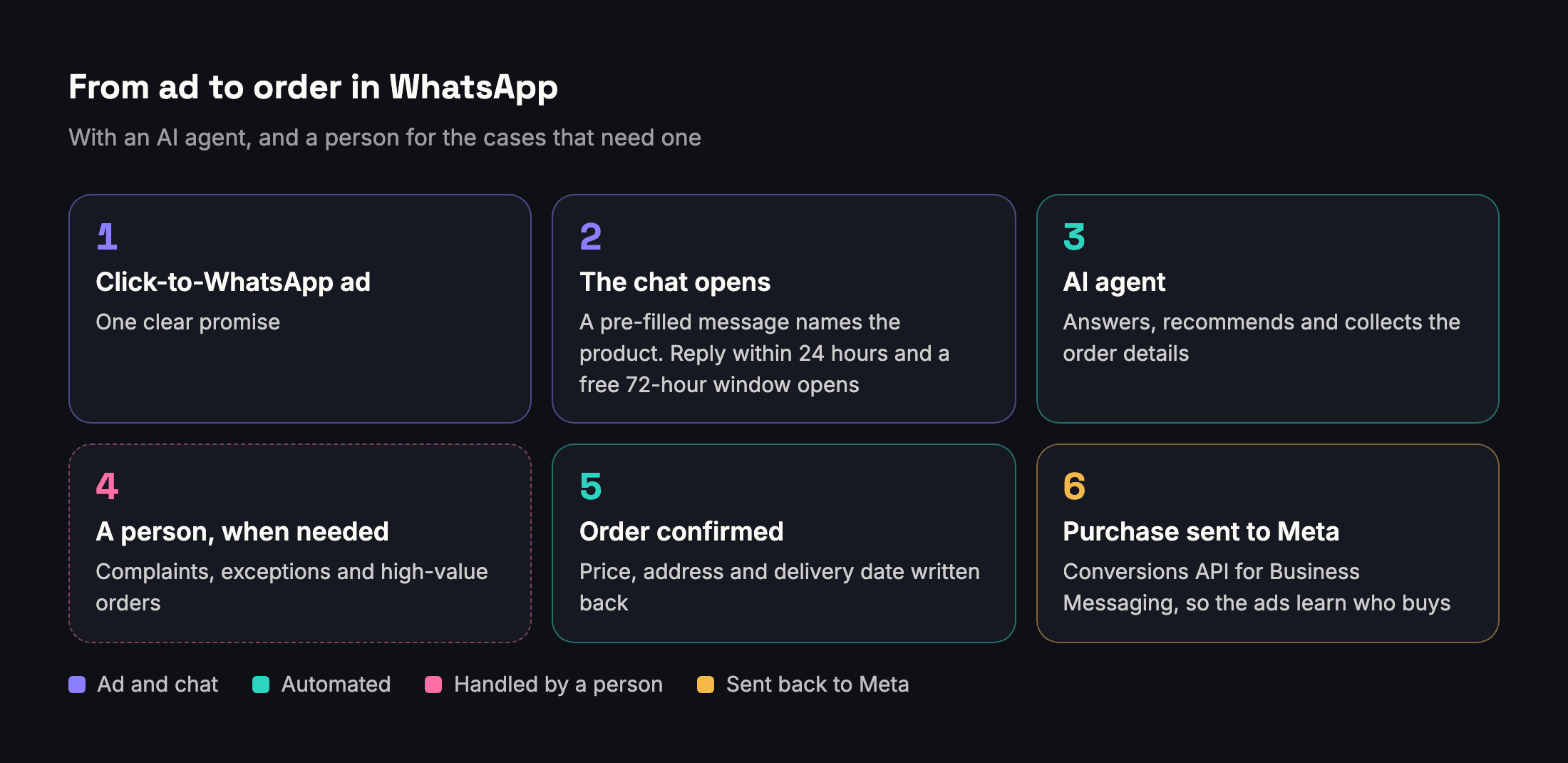
- The ad promises one clear thing: a product, an offer or a booking.
- The chat opens with a pre-filled message that names the product or the offer, so the agent starts with context.
- The agent answers the usual questions, recommends options from your catalog and collects the order details.
- A person takes over for complaints, unusual requests, high-value orders and anything the agent is not sure about.
- The order is confirmed in the chat, with the price, the address and the delivery date written back to the customer.
- The purchase goes back to Meta through the Conversions API for Business Messaging, so the ads can learn which conversations turn into sales, not only which ones start (Meta for Developers).
The last step is the one most businesses skip, and it is the one that makes the ads smarter. Without it, Meta optimizes for people who start chats; with it, Meta can learn from the people who buy.
The pricing rule that rewards fast replies
WhatsApp charges businesses for each delivered template message, at rates that depend on the message category and the customer’s country, while messages that aren’t templates are free. One rule matters most for advertisers: when someone messages you from a click-to-WhatsApp ad or a Facebook Page call-to-action button, using WhatsApp’s Android or iOS app, and you reply within 24 hours, a free entry point window opens and stays open for 72 hours, and all your messages during it are free (WhatsApp Business Platform).
This is also why slow replies are expensive twice: you lose the customer’s attention, and you lose the free window you already paid for with the ad.
What to hand to the agent, and what to keep human
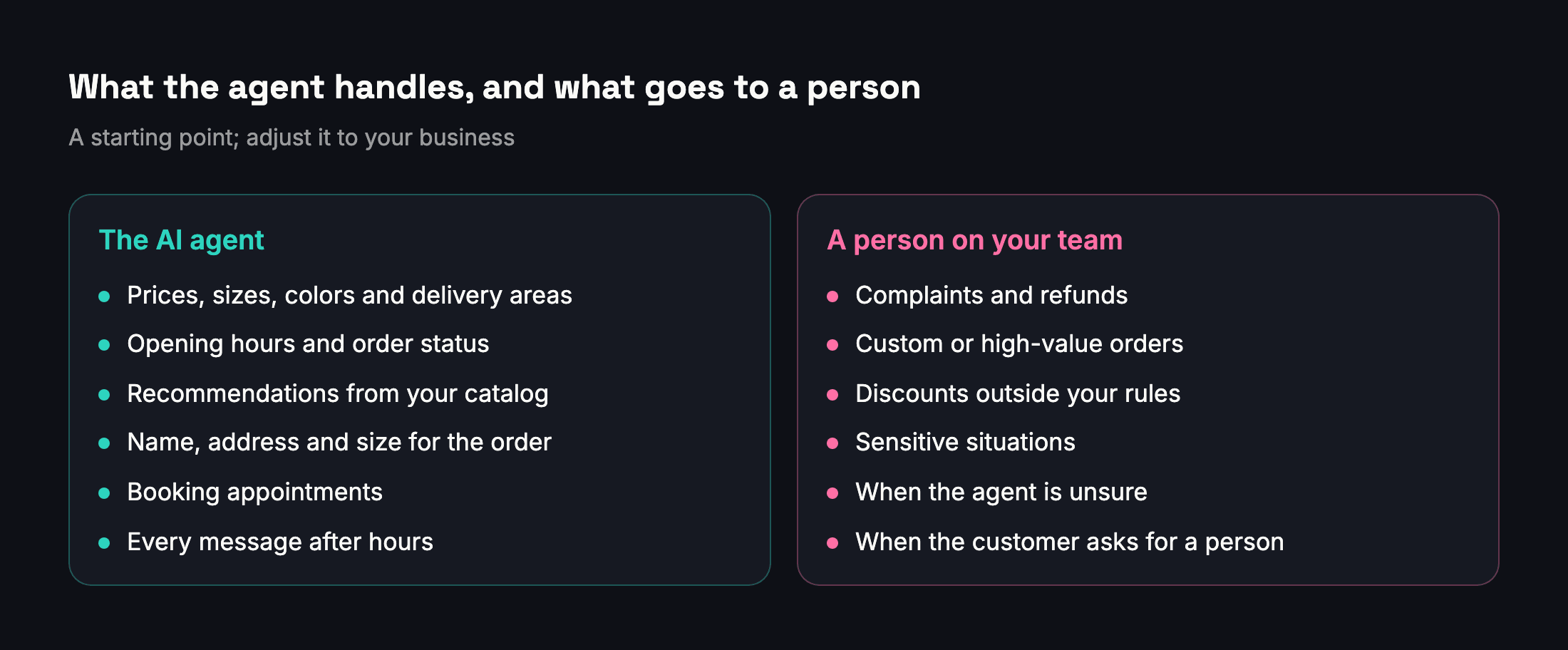
Let the agent handle the work that repeats: questions about prices, sizes, colors, delivery areas and opening hours; recommendations from your catalog; collecting the name, address and size for an order; booking appointments; order status; and every message that arrives after hours.
Keep people for the work that needs judgment or care: complaints and refunds; custom or high-value orders; discounts beyond your written rules; sensitive situations; and any conversation where the agent is unsure, the customer is upset, or the customer asks for a person.

Setting up an agent that sells
- Write one knowledge base. Products, prices, sizes, delivery areas and times, the return policy, payment methods including cash on delivery, and opening hours. Update it the day a price changes, because the agent repeats whatever it was told.
- Set the tone and the language. Short messages, in the dialect your customers use, and English when the customer writes in English.
- Write the guardrails. List what the agent must never promise: discounts outside your rules, delivery dates outside your policy, or claims about health or results.
- Design the handoff. Decide which words and situations send a chat to a person, tell the customer clearly when that happens, and set a response time your team can keep.
- Connect the ad to the chat. Use a pre-filled message that names the product or offer, so the agent knows what the customer came for.
- Test before you launch. Ask the agent twenty real questions from your old chats, fix what it gets wrong, and read the transcripts every day in the first week.

Example: the first three messages
The first replies decide whether a chat becomes an order. This is what a good start looks like for a fashion store (an illustrative example):
- The pre-filled message from the ad: “Hi, I’m interested in the black abaya from your ad.”
- The agent’s first reply: “Welcome! The black abaya is 1,350 EGP and comes in sizes S to XL. Which size would you like, and which area should we deliver to?”
- After the customer answers: “Size M is available. Delivery to Nasr City takes two days and costs 50 EGP, and you pay cash on delivery. Shall I confirm the order with your name and full address?”
- If the customer asks for a discount or complains: “I’m passing you to a colleague who can help with that right now.” Then a person takes over.
Notice what the agent does. It answers the question, gives the price and the next step in the same message, and asks one question at a time. Long menus and vague replies lose people; short, specific answers keep the conversation moving toward an order.
Measuring from the ad to the order
Meta’s main result for messaging ads is messaging conversations started: conversations started after at least seven days without messaging activity, attributed to your ads (Meta). That number tells you what your ads bought. It does not tell you what the chats sold, unless you send the sales back to Meta.
| Number to track every week | Where it comes from | Why it matters |
|---|---|---|
| Cost per conversation started | Meta | The price of each new conversation |
| Conversation-to-order rate | Your chat records | Where a good agent and a good team earn their keep |
| Cost per order | Ad spend ÷ orders | Compare it with the most you can afford per order |
| Delivered and paid orders | Your delivery records | Refused cash-on-delivery orders change the real cost |
| Share of chats handed to a person | Agent and team logs | Too high means gaps in the knowledge base; too low can mean risky answers |
| Time to first reply | Your messaging tool | The 24-hour rule and the customer’s patience |
A simple chain ties it together (with illustrative numbers): if a conversation costs 20 EGP and one conversation in five becomes an order, the ads cost 100 EGP per order. If an agent raises that to one in four, the same ads cost 80 EGP per order without any change to the campaign. For the full method, read how to measure WhatsApp and Messenger ads.
A four-week rollout plan
- Week 1: prepare. Write the knowledge base and the guardrails, set up the handoff, and test the agent on real questions from past chats.
- Week 2: launch on part of the traffic. Put the agent on one click-to-WhatsApp campaign and leave the others as they are, so you can compare.
- Week 3: compare. Look at the conversation-to-order rate, the cost per order, the share of chats handed to a person and the complaints, for chats with and without the agent.
- Week 4: decide and expand. If the agent converts at least as well, with fewer complaints, move more campaigns to it, connect purchases through the Conversions API for Business Messaging, and keep reading transcripts every week.
Risks to manage
- Wrong answers. An agent that quotes an old price starts an argument you will lose. Keep one knowledge base, and update it first.
- Promises you can’t keep. Delivery dates, discounts and results must come from your written rules, not from the agent’s guess.
- Personal data. Ask only for what the order needs, such as the name, address and phone number, and follow WhatsApp’s business policies on what you may collect and send.
- Too many templates. Marketing messages sent outside the free windows cost money per message and annoy people, so send fewer and better ones.
- No human backup. Keep a person reachable during working hours, and tell customers how to reach them.
Where Adams Analytics fits
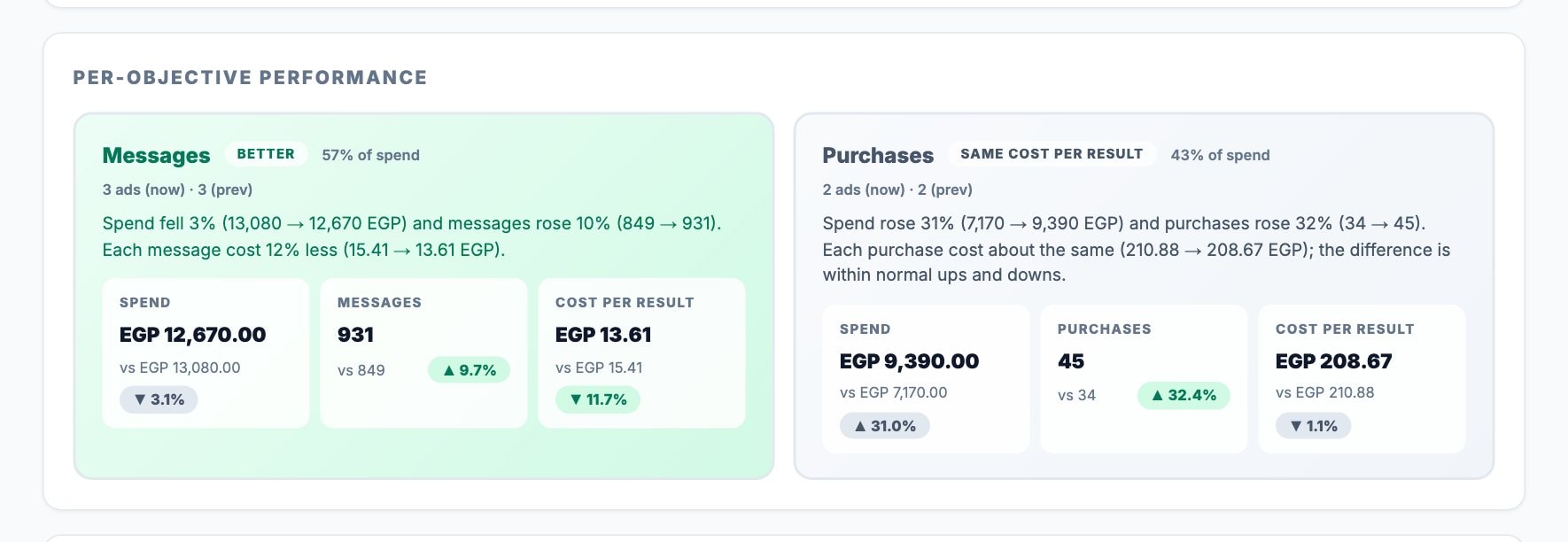
For messaging campaigns, Adams Analytics uses Meta’s own Results figure whenever Meta provides it, so messages are counted the way Ads Manager counts them, with a cost per message for each goal. Its comparison shows whether that cost improved after you introduced an agent, states in plain words how confident it is, and lists what drove the change. Reports are available in Arabic or English, for the clients who pay for the campaigns.
The short version
- Meta made Business Agents available globally on WhatsApp and Messenger in 2026, and more than a million businesses use them every week.
- A click-to-WhatsApp ad with an AI agent behind it turns conversations into orders faster, especially after hours.
- Reply within 24 hours to open WhatsApp’s 72-hour free entry point window; an agent makes that automatic.
- Let the agent handle repeated questions and order details, and keep people for complaints, exceptions and high-value sales.
- Track the cost per conversation, the conversation-to-order rate and the cost per delivered order, and send purchases back to Meta.
Questions
What is a WhatsApp AI agent for business?
An AI assistant that answers customers in your WhatsApp Business account: it replies to common questions, recommends products, collects order details and hands complex cases to a person. Meta calls its version Business Agents, and made them available globally on WhatsApp and Messenger in 2026.
Are WhatsApp conversations that come from ads free?
Messages that aren’t templates are free. When someone messages you from a click-to-WhatsApp ad and you reply within 24 hours, a free entry point window opens for 72 hours, and all messages in it are free. Template messages outside these windows are charged for each delivered message.
Will an AI agent replace my sales team?
It replaces the repetitive part: the same questions, the after-hours replies and the order details. Your team becomes more important for complaints, exceptions and high-value sales, and for checking that the agent’s answers stay correct.
How do I know which ad brought an order in WhatsApp?
Use a pre-filled message that names the product or offer, record the order in the chat, and send the purchase back to Meta with the Conversions API for Business Messaging. Then compare the cost per order by campaign.
Can businesses in Egypt and the Gulf use Meta’s Business Agents?
Meta says it made Business Agents available globally on WhatsApp and Messenger in 2026. Features often roll out gradually, so check what your WhatsApp Business account shows before you plan around them.
Sources
- Meta — Second Quarter 2026 Results Conference Call, transcript (July 2026)
- WhatsApp Business — Conversations 2025 updates (July 2025)
- Meta for Developers — Ads that click to WhatsApp
- Meta for Developers — Conversions API for Business Messaging
- Meta for Developers — Pricing on the WhatsApp Business Platform
- Meta Business Help Center — Messaging conversations started
Send your next client report in minutes
Adams Analytics connects to your Meta ad accounts and builds branded PDF reports in English or Arabic. Free for 7 days — no credit card.
Start free trialWritten by the Adams Analytics team and checked against Meta’s documentation and our own product. Spotted something out of date? Tell us at support@buildincairo.com.