Many business owners in Egypt and the Gulf read Arabic first, and their marketing reports usually arrive in English. Translating a spreadsheet doesn't fix that. An Arabic report that a client actually reads has five things right: the layout, the terms, the numbers, the dates and the writing.

Right to left, all the way through
Arabic reads from right to left, so the whole page should: headings, tables, the order of columns and the position of labels. Numbers are the exception: digits are written left to right in Arabic too.
The hard part is the lines that mix the two. A sentence with Arabic words, a number, a percentage and a Latin name such as "Meta" can be reordered when it is displayed, so a figure ends up on the wrong side of its label, or a minus sign moves. Always check the final PDF, not just the document you wrote it in.
Use Meta's Arabic terms
Clients who use Ads Manager in Arabic see Meta's own Arabic names for each metric, so use the same ones: المبلغ الذي تم إنفاقه for amount spent, النتائج for results, التكلفة لكل نتيجة for cost per result, الوصول for reach, مرات الظهور for impressions and معدل التكرار for frequency. The glossary lists the rest.
Numbers, currency and dates
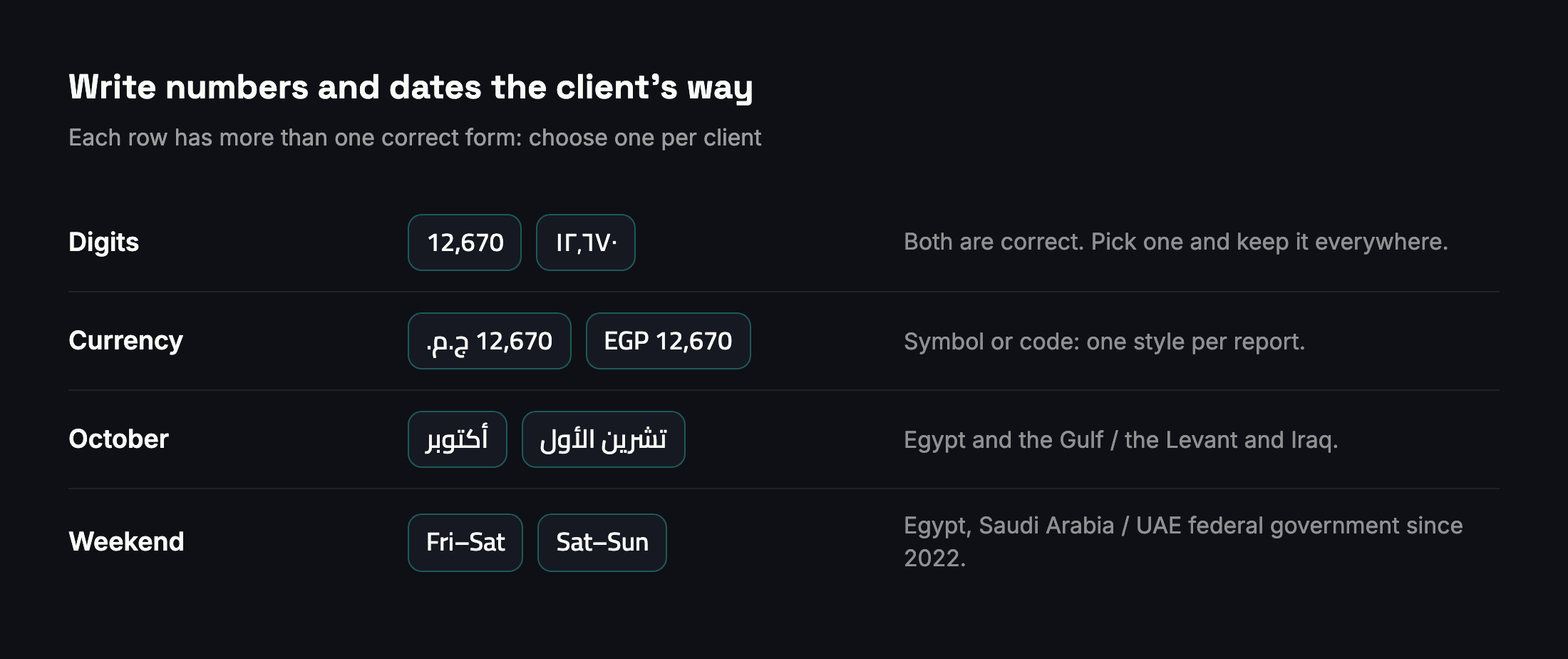
- Digits. Western digits (12,670) and Arabic-Indic digits (١٢٬٦٧٠) are both correct. Use the one the client uses, everywhere, including charts.
- Currency. The Arabic symbol (ج.م. for Egyptian pounds, ر.س. for Saudi riyals, د.إ. for UAE dirhams) or the code (EGP, SAR, AED). One style per report.
- Month names. Egypt and the Gulf say أكتوبر; the Levant and Iraq say تشرين الأول. Write months the way the client's market does.
- Weekends. The weekend is Friday and Saturday in Egypt and Saudi Arabia, but Saturday and Sunday for the UAE federal government since January 2022, and Friday to Sunday in Sharjah (UAE Government). It changes what "the weekend" and "last week" mean in a comparison.
Write in Arabic, don't translate
Write the summary and the findings directly in Arabic, in short sentences of Modern Standard Arabic, which is what most business documents use. Translate the meaning rather than the words: "Bigger, but pricier" becomes حجم أكبر بتكلفة أعلى, not a word-for-word copy. And read the result aloud once; machine-translated insight is the first thing a client notices.
Fonts and PDFs
Arabic letters change shape depending on their neighbours, so the report needs a font made for Arabic, such as Cairo or Noto Naskh Arabic. With the wrong font, letters appear disconnected or as empty boxes. Open the PDF on a phone before sending it: many clients read reports in WhatsApp.
How Adams Analytics does it
The Account Detail report in Adams Analytics can be produced in Arabic: it is laid out right to left with an Arabic font, and the comparison of two periods, with its verdict and explanations, is written in Arabic rather than translated after the fact. Quick reports cover yesterday, last week, last month and the last Thursday to Saturday. See how it works.
Questions
Should an Arabic report use Western or Arabic-Indic digits?
Both are correct. Use the style the client uses and keep it consistent across the whole report, including tables and charts.
What are Meta’s Arabic names for the main metrics?
Amount spent is المبلغ الذي تم إنفاقه, results are النتائج, cost per result is التكلفة لكل نتيجة, reach is الوصول, impressions are مرات الظهور and frequency is معدل التكرار.
How should months be written in an Arabic report?
The way the client’s market writes them: يناير to ديسمبر in Egypt and the Gulf, كانون الثاني to كانون الأول in the Levant and Iraq.
Why do numbers move around in my Arabic PDF?
Lines that mix Arabic, numbers, percentages and Latin words can be reordered when displayed. Check the final PDF, and keep such lines short.
Should an Arabic client report be written in dialect?
Most business documents use Modern Standard Arabic. Keep sentences short and plain so the report reads naturally.
Sources
Send your next client report in minutes
Adams Analytics connects to your Meta ad accounts and builds branded PDF reports in English or Arabic. Free for 7 days — no credit card.
Start free trialWritten by the Adams Analytics team and checked against Meta’s documentation and our own product. Spotted something out of date? Tell us at support@buildincairo.com.