If your Facebook Page or Instagram numbers suddenly look different, or a reporting tool answers "invalid metric", the cause is on Meta's side: it changed what it counts. Between April 2025 and June 2026, Meta replaced impressions with views on Instagram and on Facebook Pages, and then retired the unique reach metrics on Pages. Here is what changed, when, and how to report across the switch without misleading anyone.
What changed, and when
- Instagram, 21 April 2025. Views replaced impressions in media and account insights, and plays were retired with them (Meta).
- Facebook Pages, 15 November 2025. Views replaced the impressions metric on every API version (Meta).
- Facebook Pages, by 15 June 2026. A further set of Page metrics was retired on every API version, including Page and post reach (the "unique impressions" metrics), post impressions and unique video views (Meta).
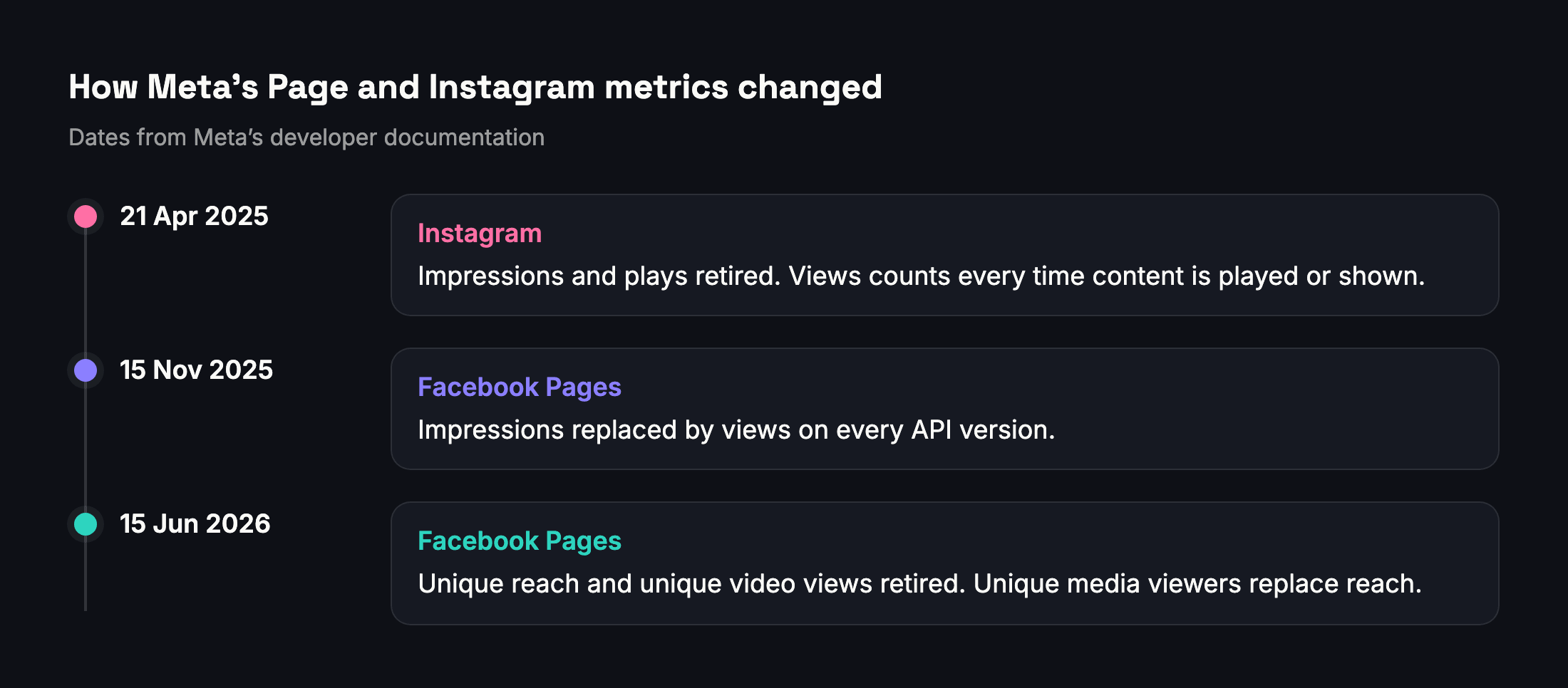
After each date, a tool that still asks Meta for a retired metric gets an "invalid metric" error instead of a number (Meta). That is why some dashboards went blank or started showing zeros.
Views are a different count from impressions
Meta defines views as the number of times your content was played or displayed, where content includes videos, posts, stories and ads (Meta). Impressions counted how many times a post entered someone's screen. The two sound close, but they are separate measurements, so treat the switch as a break in the series: a month measured in views is not "up" or "down" against a month measured in impressions.
What replaced reach on Facebook Pages
Reach used to be the number of people who had content from or about your Page on their screen. Its replacement is the number of unique media viewers, for the whole Page and for each post (Meta). Like reach, it counts people rather than views, so adding up the viewers of individual posts overstates it: someone who saw three posts is one viewer of the Page, but counts once for each of the three posts.
On Instagram, reach is still reported for posts, and Meta describes it as the number of unique accounts that saw the content at least once (Meta).
Old metric, new metric
| Old metric | What happened | Use now |
|---|---|---|
| Instagram impressions | Retired 21 April 2025 | Views |
| Instagram plays (Reels) | Retired 21 April 2025 | Views |
| Facebook Page impressions | Replaced by views, 15 November 2025 | Views |
| Facebook post impressions | Retired by 15 June 2026 | Post views |
| Facebook Page and post reach | Retired by 15 June 2026 | Unique media viewers |
| Facebook unique video views | Retired by 15 June 2026 | Views of the video post |
How to report across the switch
- Mark the break. When a report covers both sides of a change, add one line saying so, for example: "From November 2025, Facebook counts views instead of impressions."
- Compare like with like. Compare views with views. For a year-on-year comparison that starts before the switch, show the two series separately and label them, or start from the switch.
- Rename your templates. Impressions becomes views, and reach becomes viewers (Meta's term is "unique media viewers"), so your report uses Meta's words for Meta's numbers.
- Check your tools. Any tool still requesting a retired metric shows errors or empty columns. It needs an update, not a workaround.
What about ads?
These changes cover the insights of Facebook Pages and Instagram accounts. Ad reporting is a separate system: as of October 2026, Meta's ads insights still report impressions and reach for ads. Keep the two apart in your reports, and don't relabel ad impressions as views.
How Adams Analytics handles it
On plans that include Page and Instagram analytics, Adams Analytics reads Meta's current metrics (views, and unique viewers for Pages), and for each Facebook post it shows how many views came from ads and how many didn't, from Meta's own split rather than an estimate. See how it works or compare plans.
Questions
Why do my Facebook Page numbers look different since November 2025?
On 15 November 2025 Meta replaced the impressions metric with views on every API version. Views and impressions are different measurements, so the numbers are not directly comparable.
What replaced reach on Facebook Pages?
The number of unique media viewers, for the Page and for each post. Like reach, it counts people, so the viewers of individual posts should not be added up.
Can I compare this month’s views with last year’s impressions?
Not as a like-for-like change. Show the two series separately with clear labels, or start the comparison from the date the metric changed.
Why does my reporting tool say “invalid metric”?
Meta returns an invalid metric error when a tool asks for a metric it has retired. The tool needs to switch to views and unique viewers.
Do these changes affect Meta ad reports?
They cover Page and Instagram insights. As of October 2026, Meta’s ads insights still report impressions and reach for ads.
Sources
Send your next client report in minutes
Adams Analytics connects to your Meta ad accounts and builds branded PDF reports in English or Arabic. Free for 7 days — no credit card.
Start free trialWritten by the Adams Analytics team and checked against Meta’s documentation and our own product. Spotted something out of date? Tell us at support@buildincairo.com.